How Brain Oscillations Coordinate Neural Activity
The brain is never silent. Neurons fire in rhythmic patterns that rise and fall at regular intervals, known as neural oscillations or brain waves. These rhythms help coordinate communication within and between brain regions and are linked to attention, memory, perception and consciousness.
How oscillations arise
Oscillations emerge when populations of neurons interact in feedback loops, typically involving a balance of excitation and inhibition. Fast-spiking inhibitory interneurons that release GABA play a key role by periodically silencing pyramidal cells. The thalamus and cortex also generate rhythms through reverberating loops. The summed electrical activity can be recorded with EEG or MEG, or measured directly with electrodes in the brain.
Frequency bands
- Delta (0.5 to 4 Hz): slow waves of deep sleep, and also seen during certain cognitive tasks
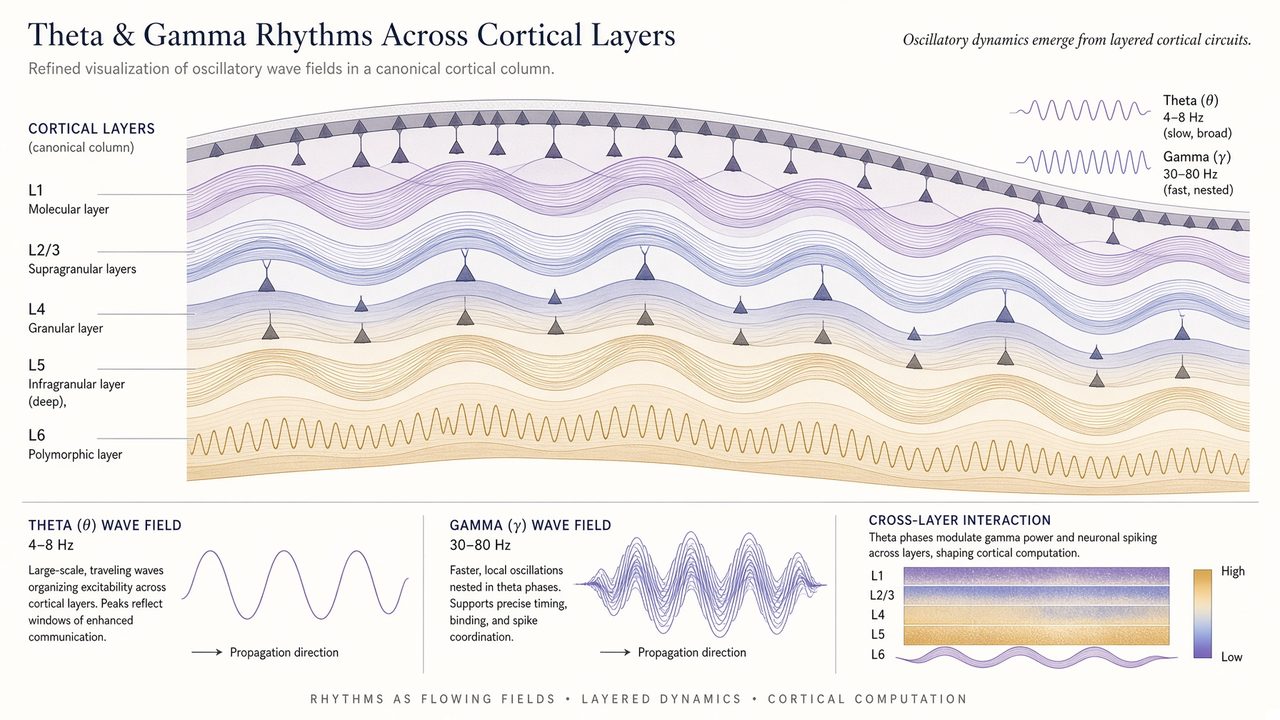
- Theta (4 to 8 Hz): prominent in the hippocampus during navigation and memory, and in frontal midline areas during cognitive effort
- Alpha (8 to 12 Hz): associated with relaxed wakefulness and with inhibiting irrelevant information, strongest over the back of the head with eyes closed
- Beta (13 to 30 Hz): related to motor control, maintaining the current state and top-down processing
- Gamma (30 to 100+ Hz): linked to local processing, attention and binding features of perception
Different frequencies often interact. In cross-frequency coupling, the phase of slow rhythms such as theta modulates the amplitude of faster gamma, thought to organize memory items in working memory.
Functions of oscillations
Communication through coherence
Pierre Fries proposed that neural groups communicate most effectively when their rhythms are synchronized, such that the sender's output arrives when the receiver is most excitable. This is the communication through coherence hypothesis.
Attention
Attention enhances gamma synchronization in sensory areas representing the attended object, while alpha power increases in regions processing ignored information.
Memory
Hippocampal theta and gamma rhythms organize encoding and retrieval, and sharp-wave ripples during sleep are involved in memory consolidation. Sleep spindles and slow oscillations coordinate transfer from hippocampus to cortex.
Movement
Beta rhythms decrease before and during movement and rebound afterward.
Perception and consciousness
Gamma synchrony has been proposed as a mechanism binding features into unified percepts, and large-scale synchrony is associated with conscious awareness in several theories, though the specific role is debated.
Oscillations in disease
- Epilepsy: excessive, hypersynchronous activity during seizures
- Parkinson's disease: excessive beta synchrony in the basal ganglia, reduced by dopamine medication and deep brain stimulation
- Schizophrenia: disrupted gamma oscillations and synchrony
- Alzheimer's disease: slowing of rhythms and reduced alpha and gamma synchrony
- ADHD and autism: altered patterns reported, though findings vary
- Depression and anxiety: altered frontal alpha asymmetry and theta activity in some studies
Using oscillations therapeutically
- Deep brain stimulation can be adaptive, responding to beta bursts
- Transcranial alternating current stimulation and TMS can entrain rhythms, with research on memory and mood
- Neurofeedback trains people to modulate rhythms
- Sensory stimulation at 40 Hz is being tested in Alzheimer's disease
- Sleep stimulation to boost slow oscillations and memory
Evidence for many of these is preliminary.
Caveats
Oscillations may be an effect of neural processing as well as a cause. Interpretations of band functions are simplified, and EEG reflects mixed sources and artifacts. Correlation does not prove causation.
Takeaway
Brain rhythms provide a language of timing that helps neurons work together. Understanding them is opening new ways to diagnose and treat brain disorders.
Further reading from authoritative sources
This article is educational and does not replace advice from a licensed clinician. See the medical disclaimer. Looking for specialist care? Browse the neurology clinic directory.