Neuroscience Foundations & Brain Structure

The brain is the most complex structure we know of, and understanding its parts makes everything else in neuroscience easier to follow. These articles walk through regions, cells, circuits and rhythms in plain language, from the hippocampus and prefrontal cortex to synapses, myelin and brain waves.

Brain science articles

The Corpus Callosum: Bridging the Brain's Hemispheres
Neuroscience Foundations

The Corpus Callosum: Bridging the Brain's Hemispheres

The corpus callosum is the largest bundle of nerve fibers, connecting left and right hemispheres. Learn what it does, what split-brain studies revealed and what happens when it is missing.

The Basal Ganglia and the Art of Habit Formation
Neuroscience Foundations

The Basal Ganglia and the Art of Habit Formation

The basal ganglia help select actions and turn repeated behaviors into habits. Learn how these structures work, the role of dopamine, and how Parkinson's and Huntington's affect them.

Inside the Insula: Where the Body Meets the Mind
Neuroscience Foundations

Inside the Insula: Where the Body Meets the Mind

The insula senses the body's internal state and links it to emotion, awareness and decision-making. Learn its functions, role in disorders and how interoception shapes feelings.

How Brain Oscillations Coordinate Neural Activity
Neuroscience Foundations

How Brain Oscillations Coordinate Neural Activity

Brain waves are rhythmic patterns of neural activity that coordinate communication between regions. Learn how oscillations arise, what each frequency band does and how they relate to cognition and disease.
The Pineal Gland and the Rhythm of Sleep
Neuroscience Foundations

The Pineal Gland and the Rhythm of Sleep

The pineal gland produces melatonin to signal night and help regulate sleep and circadian rhythms. Learn how light controls it, what melatonin does and what the evidence says about supplements.
How the Brain Processes Sound: From Ear to Cortex
Neuroscience Foundations

How the Brain Processes Sound: From Ear to Cortex

Sound travels from the ear through the brainstem to the auditory cortex, where pitch, location and meaning are decoded. Learn each stage and what happens in hearing loss and tinnitus.

The Visual Cortex: Decoding the World We See
Neuroscience Foundations

The Visual Cortex: Decoding the World We See

The visual cortex processes information from the eyes through hierarchies that detect edges, motion, color and objects. Learn the pathways, key areas and what damage causes.

Occipital Insights: Beyond Basic Vision
Neuroscience Foundations

Occipital Insights: Beyond Basic Vision

The occipital lobe is the brain's main visual processing center, but also contributes to imagery, reading and plasticity. Learn how it works and what damage causes.

Temporal Lobe Tales: Memory, Language, and Emotion
Neuroscience Foundations

Temporal Lobe Tales: Memory, Language, and Emotion

The temporal lobe supports hearing, memory, language and emotion. Learn its structures, such as the hippocampus and amygdala, and what temporal lobe epilepsy and damage reveal.

Frontal Lobe Functions: From Planning to Personality
Neuroscience Foundations

Frontal Lobe Functions: From Planning to Personality

The frontal lobe, the brain's largest, governs movement, planning, judgment and personality. Learn its regions, executive functions and what Phineas Gage and frontotemporal dementia reveal.

How the Brain's Hemispheres Specialize
Neuroscience Foundations

How the Brain's Hemispheres Specialize

The left and right hemispheres specialize in different tasks, but work together. Learn what lateralization means, which myths about left-brain and right-brain people are false and what research shows.

The Ventral Tegmental Area and the Reward Circuit
Neuroscience Foundations

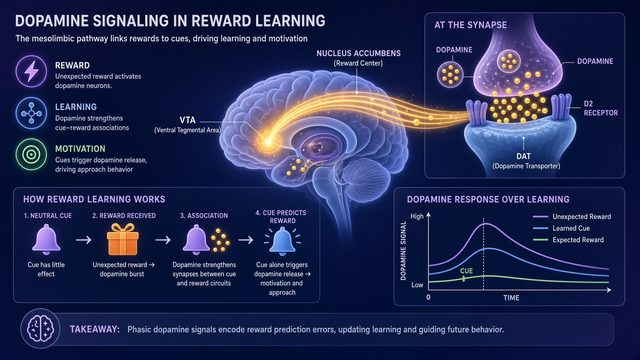
The Ventral Tegmental Area and the Reward Circuit

The ventral tegmental area makes dopamine that drives motivation and learning. Learn how the reward circuit works, how it relates to addiction and depression, and what dopamine really does.

How the Brainstem Regulates Breathing and Heart Rate
Neuroscience Foundations

How the Brainstem Regulates Breathing and Heart Rate

The brainstem automatically controls breathing and heart rate using centers in the medulla and pons. Learn how carbon dioxide sensing, reflexes and the vagus nerve keep you alive without thinking.

The Fornix: A Highway Through the Limbic System
Neuroscience Foundations

The Fornix: A Highway Through the Limbic System

The fornix is a C-shaped fiber bundle linking the hippocampus to other limbic structures. Learn its role in memory, what damage causes and its link to Alzheimer's and deep brain stimulation research.

How the Brain's Reward System Motivates Behavior
Neuroscience Foundations

How the Brain's Reward System Motivates Behavior

The brain's reward system uses dopamine and opioid pathways to drive wanting, liking and learning. Learn how motivation works, why habits form, and how to use reward science for healthier behavior.

The Claustrum: The Brain's Mysterious Conductor
Neuroscience Foundations

The Claustrum: The Brain's Mysterious Conductor

The claustrum is a thin sheet of neurons connected to nearly the whole cortex. Learn why scientists are intrigued, what evidence links it to attention and consciousness, and why much remains unknown.

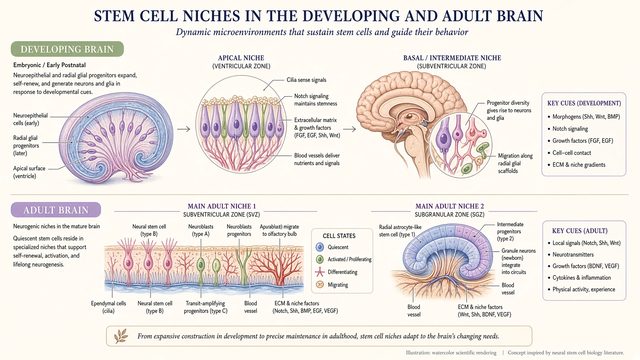
Neurogenesis: New Neurons in the Adult Brain
Neuroscience Foundations

Neurogenesis: New Neurons in the Adult Brain

Adult neurogenesis is the birth of new neurons, mainly in the hippocampus. Learn what animal and human studies show, why it is debated, and what factors may support it.

How the Brain Senses Pain: Pathways and Processing
Neuroscience Foundations

How the Brain Senses Pain: Pathways and Processing

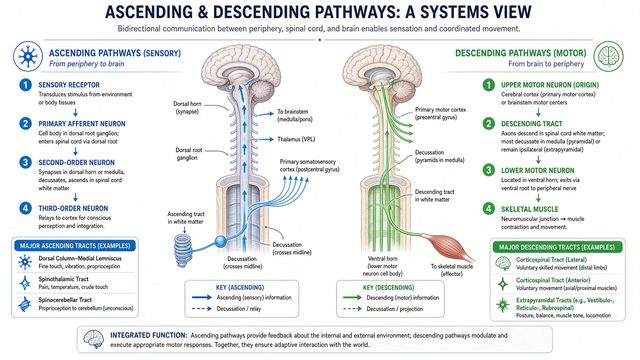
Pain involves nociceptors, spinal cord pathways, the thalamus and multiple brain regions, and is shaped by emotion and expectation. Learn how pain signals travel and how the brain can amplify or dampen them.

The Autonomic Nervous System and Brain-Body Communication
Neuroscience Foundations

The Autonomic Nervous System and Brain-Body Communication

The autonomic nervous system controls heart rate, digestion and other automatic functions through sympathetic and parasympathetic branches. Learn how the brain regulates the body and what dysautonomia is.

Mirror Neurons: Empathy, Imitation, and Debate
Neuroscience Foundations

Mirror Neurons: Empathy, Imitation, and Debate

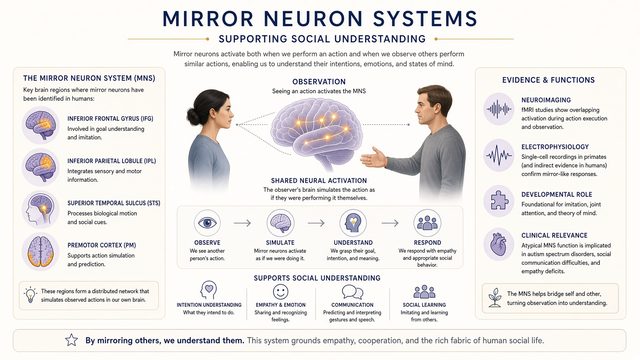
Mirror neurons fire both when you act and when you watch someone else act. Learn the discovery, proposed links to empathy and imitation, and why scientists argue about what they really do.

How the Brain Stores Procedural Memories
Neuroscience Foundations

How the Brain Stores Procedural Memories

Procedural memory stores skills like riding a bike or typing. Learn which brain regions, including the basal ganglia and cerebellum, support it, why it survives amnesia and how to practice effectively.

The Neurobiology of Habit Loops
Neuroscience Foundations

The Neurobiology of Habit Loops

Habits follow a loop of cue, routine and reward governed by the basal ganglia and dopamine. Learn how habits form in the brain, why they are hard to break and how to change them.

Biofeedback & neurofeedback in this topic

What an EEG Can Tell You About Your Brain
Biofeedback

What an EEG Can Tell You About Your Brain

An EEG records the brain's electrical activity through scalp sensors. Learn what it can reveal about seizures, sleep and attention, what it cannot, and how neurofeedback uses it.

Mapping Brain Activity: qEEG and Brain Health
Biofeedback

Mapping Brain Activity: qEEG and Brain Health

Quantitative EEG converts brainwave recordings into statistical maps. Learn how qEEG works, what it can and cannot show, its uses in research and clinics, and cautions about commercial claims.

More articles in this topic are being added. Meanwhile, see the neurology clinic directory.