How the Brain Coordinates the Senses: Multisensory Integration
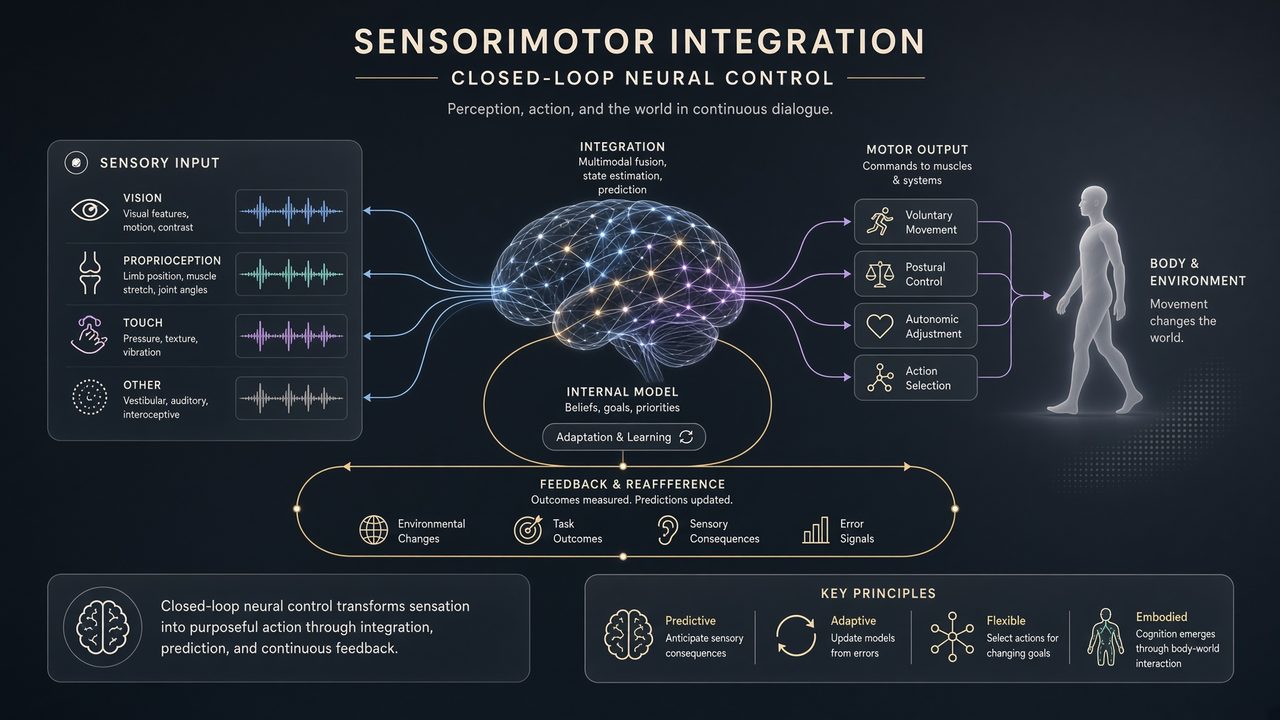
You see a person's lips move while hearing their voice, and your brain delivers a single, coherent event. This blending of the senses, multisensory integration, happens constantly, and most of the time we are unaware of it.
Where it happens
Early theories assumed that each sense was processed separately and then combined in higher association areas. Research shows integration occurs at many levels:
- Superior colliculus: neurons respond to visual, auditory and touch cues from the same location in space, orienting the head and eyes.
- Posterior parietal cortex, especially the intraparietal sulcus: integrates senses to guide reaching and map space around the body.
- Superior temporal sulcus: combines faces and voices, important for speech.
- Premotor cortex: responds to stimuli near the body, linking touch and vision.
- Insula and frontal regions: combine body signals with external cues.
- Early sensory cortices: even primary visual and auditory cortex can be influenced by other senses.
Principles of integration
Barry Stein and Alex Meredith described rules from studies of superior colliculus neurons:
- Spatial rule: stimuli from the same place are combined, while those from different places do not enhance each other.
- Temporal rule: stimuli that occur at about the same time are integrated.
- Inverse effectiveness: weaker individual signals benefit more from combination, which explains why seeing a speaker's face helps most in noisy places.
Computational models suggest that the brain weighs each sense by its reliability, in a manner similar to Bayesian inference. In a dark room, hearing counts for more, and in a quiet one, vision dominates spatial judgments.

Illusions that reveal integration
- McGurk effect: watching a mouth articulate "ga" while hearing "ba" produces the perception of "da."
- Ventriloquist effect: a voice seems to come from the moving dummy because vision dominates location.
- Rubber hand illusion: synchronized touch on a hidden hand and a visible fake hand can make the fake hand feel like part of the body.
- Sound-induced flash illusion: two beeps with one flash make you see two flashes.
- Bouba-kiki effect: most people link the word "bouba" with round shapes and "kiki" with spiky ones, a form of cross-modal correspondence.
Development and plasticity
Infants begin with fairly blended senses and gradually learn to refine their combination, with integration abilities maturing through childhood. People who lose one sense often show enhancements in others, with brain regions normally devoted to one sense taking on other roles. Training can also tune integration, for example through audiovisual practice.
Synesthesia
In synesthesia, stimulation of one sense involuntarily triggers another, such as seeing colors for letters or tasting words. It affects perhaps 2 to 4 percent of people, runs in families, and is associated with unusual connectivity or reduced inhibition between sensory areas.
When integration goes awry
- Autism: differences in multisensory integration, such as wider temporal binding windows, have been reported and may relate to sensory sensitivities.
- Schizophrenia: altered audiovisual integration
- Dyslexia: audiovisual integration of letters and sounds may be affected
- Aging: older adults may rely more on multisensory cues, but integration can become less precise
- Vestibular disorders: conflicting signals from balance, vision and body position cause dizziness
- Motion sickness: results from sensory conflict
- Hearing loss: impacts speech understanding, which is helped by lip reading
Using it in daily life
- Face the speaker and reduce background noise to improve understanding.
- Learn with multiple senses, such as reading aloud or drawing diagrams.
- Support balance by maintaining vision, vestibular and foot sensation.
- Design interfaces and teaching materials that use consistent cues across senses.
Takeaway
Our unified experience of the world is built by integrating senses, not simply receiving them. This makes perception resilient, and illusions give us a window into the process.
Further reading from authoritative sources
This article is educational and does not replace advice from a licensed clinician. See the medical disclaimer. Looking for specialist care? Browse the neurology clinic directory.