Inside the Prefrontal Cortex: The Seat of Executive Function
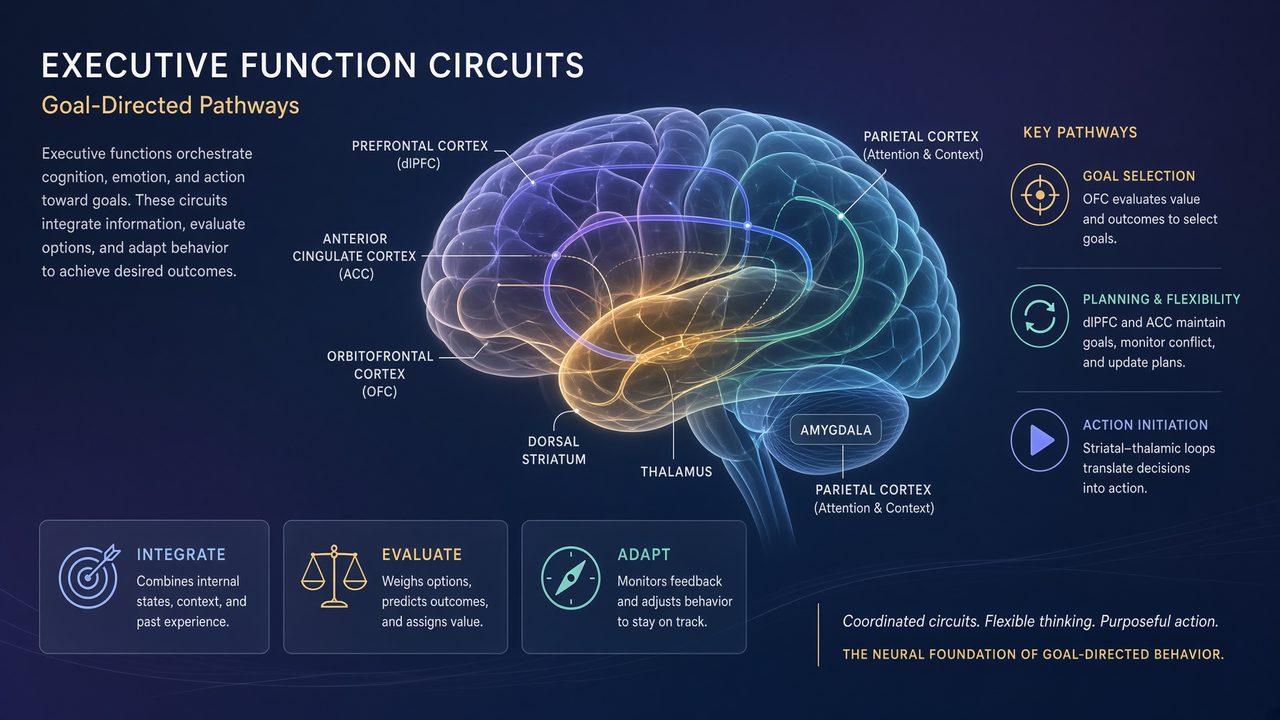
Directly behind your forehead sits the prefrontal cortex, the part of the brain most associated with planning, self-control and flexible thinking. It makes up a larger share of the human brain than of most other animals' brains, and it is among the last regions to mature.
What "executive function" means
Executive functions are the mental skills that help you manage yourself and your tasks. Researchers usually group them into three core abilities:
- Working memory: holding and manipulating information over a short time, such as keeping a phone number in mind while you dial.
- Inhibitory control: resisting impulses and distractions, such as not checking your phone mid-conversation.
- Cognitive flexibility: switching between tasks or viewpoints when circumstances change.
From these building blocks come higher-level skills such as planning, problem-solving, organizing and decision-making.
A tour of the main regions
The prefrontal cortex is not a single structure. Different parts have different specialties.
Dorsolateral prefrontal cortex
Located on the upper and outer surface, this region supports working memory, reasoning and attention control. It is heavily involved when you have to keep a plan in mind and update it.
Ventromedial and orbitofrontal cortex
Found on the underside and inner surface, these areas link emotion with decision-making. They help assign value to options and are important for social judgment and weighing risk and reward.
Ventrolateral prefrontal cortex
This region helps with selecting information, stopping an action once it has started, and parts of language production.
Anterior cingulate and medial areas
Closely connected to the prefrontal cortex, these areas monitor conflict and errors and help decide how much effort a task deserves.

The famous case of Phineas Gage
In 1848 a railroad worker named Phineas Gage survived an accident in which an iron rod passed through the front of his skull. Accounts say he recovered physically but his personality and behavior changed. The story has been embellished over the years and the details are debated, but it helped establish the idea that the frontal lobes are crucial for personality and self-regulation.
Development across the lifespan
The prefrontal cortex continues maturing into the mid-twenties. During adolescence, connections are pruned and insulated with myelin, improving efficiency. This helps explain why teenagers can reason well in calm settings yet take more risks when emotions or peers are involved. In later life, the prefrontal cortex tends to show some of the earliest age-related changes, which is why multitasking and speed of processing often decline gradually.
What weakens prefrontal function
The prefrontal cortex is sensitive to physiological state. Several factors can temporarily or persistently impair it:
- Acute stress, which shifts control toward more automatic, emotional circuits
- Sleep deprivation, which reduces attention and impulse control
- Alcohol and some other substances
- Chronic stress, depression and anxiety
- Traumatic brain injury, stroke and dementia, especially frontotemporal dementia
- Attention-deficit/hyperactivity disorder, in which executive networks function differently
Strengthening executive function
Evidence supports a few practical approaches. Regular aerobic exercise, good sleep, and structured activities that demand planning and self-control, such as learning an instrument or playing strategy-heavy games, are associated with better executive performance. Mindfulness practice may improve attention regulation. For people with ADHD, a combination of behavioral strategies, coaching and, when appropriate, medication prescribed by a clinician can make a major difference.
Simple external supports also help: write down plans, break large tasks into steps, reduce distractions, and build routines so that fewer decisions depend on willpower alone.
When to talk to a doctor
Sudden changes in personality, judgment or organization in an adult, especially after a head injury or alongside other neurologic symptoms, deserve prompt medical evaluation.
Further reading from authoritative sources
This article is educational and does not replace advice from a licensed clinician. See the medical disclaimer. Looking for specialist care? Browse the neurology clinic directory.