Mirror Neurons: Empathy, Imitation, and Debate
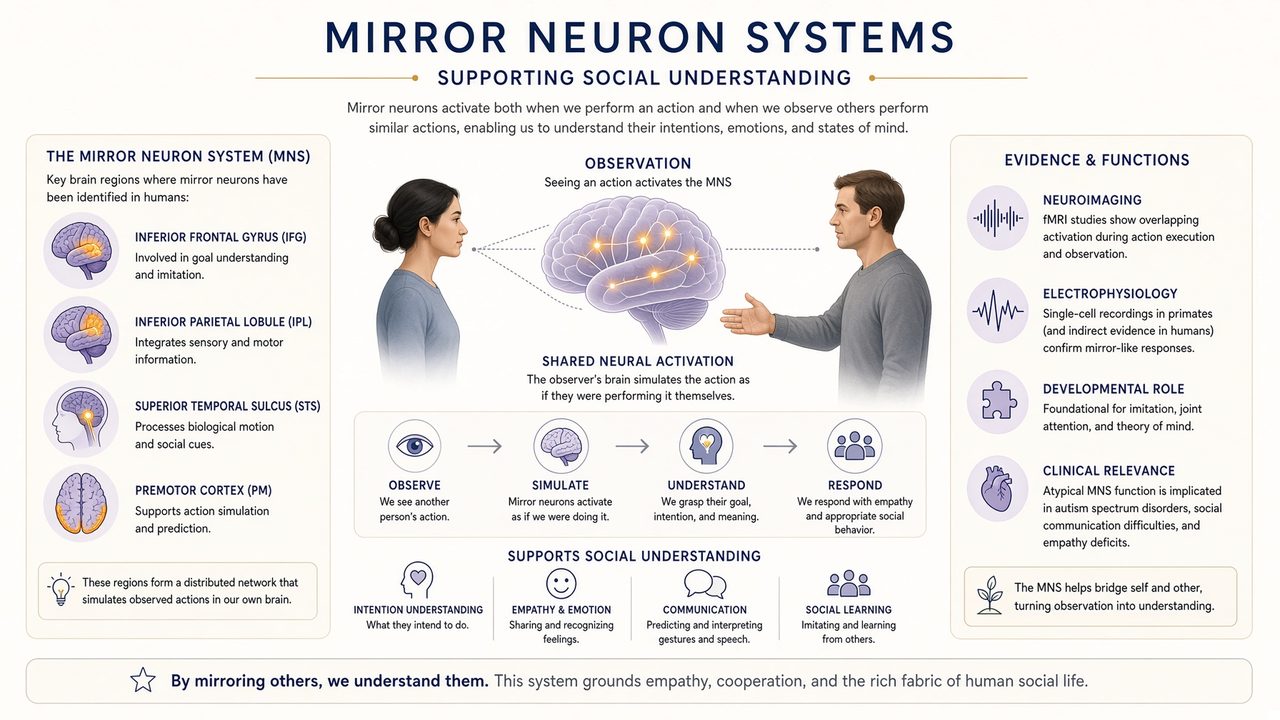
In the early 1990s, a team led by Giacomo Rizzolatti in Parma, Italy, recording from the premotor cortex of macaque monkeys, noticed something odd. Certain neurons fired when a monkey grasped a peanut, and also when the monkey watched a researcher grasp one. They were named mirror neurons, and they quickly became among the most talked-about discoveries in neuroscience, as well as one of the most debated.
The discovery
The cells were found in area F5 of the premotor cortex and later in the inferior parietal lobule. Many fire for particular goals, such as grasping or tearing, regardless of exactly how the hand moves. Some respond even when the final part of an action is hidden, suggesting they encode intention or goal. Other related neurons respond to the sound of an action, such as paper tearing.
Evidence in humans
Direct recordings are rare, but a 2010 study in epilepsy patients with implanted electrodes found single neurons in the frontal and temporal lobes that responded to both executing and observing actions. Most human evidence is indirect: functional MRI shows overlapping activation in premotor and parietal areas during action observation and execution, and TMS studies show that motor cortex excitability rises when watching actions. The term "mirror system" is typically used for these regions, because single-neuron proof is limited.
Proposed roles
- Action understanding: by simulating an action internally, we may grasp what another person is doing.
- Imitation and learning: observing others and copying skills, a process important in childhood.
- Empathy: shared activation, as when people watch someone experience pain or disgust, involves the insula and anterior cingulate, which some researchers call a mirroring mechanism.
- Language evolution: Rizzolatti and Arbib proposed that gestural communication in primates evolved into speech through the mirror system, an influential but speculative idea.
- Social understanding in autism: some researchers proposed that a "broken mirror" underlies autism, a hypothesis that has not held up well in later studies.
The critique
Neuroscientist Gregory Hickok and others argue that the claims have outrun the data:
- Monkeys have mirror neurons but do not imitate much, and people with damage to mirror areas can still understand actions.
- Mirror neurons respond to many kinds of stimuli, and their selectivity is more flexible than early reports implied.
- Cecilia Heyes suggested that mirror neurons are not innate but built through ordinary associative learning, as we see our own actions while performing them.
- Action understanding relies on many other regions, including the superior temporal sulcus and prefrontal cortex.
- Popular claims that mirror neurons explain empathy, culture or autism are not supported at that scale.
Reviewers now generally accept that mirror neurons exist, and that they are part of a broader action-observation network, but doubt that they alone explain social cognition.
Practical implications
Even if the strongest claims fail, observation and practice remain powerful:
- Action observation therapy after stroke, where patients watch movements before practicing them, is being studied for rehabilitation, with modest evidence.
- Mental practice and visualization help athletes and musicians.
- Learning by watching is effective, especially for motor skills.
- Modeling behavior for children matters, regardless of its neural basis.
Reading the science critically
When you see headlines saying that mirror neurons "make us human" or explain compassion, treat them as metaphors rather than established facts. The solid finding is about premotor and parietal cells that link seeing and doing. The rest is hypothesis.
Takeaway
Mirror neurons illustrate both the excitement and the caution of brain science. They reveal a genuine connection between perception and action, while their deeper meaning remains open.
Further reading from authoritative sources
This article is educational and does not replace advice from a licensed clinician. See the medical disclaimer. Looking for specialist care? Browse the neurology clinic directory.