Myelin Matters: How Insulation Speeds Up Brain Signals
Wrapped around many of the brain's nerve fibers is a fatty coating called myelin. Like insulation on an electrical wire, it keeps signals strong and fast. Myelin is the reason white matter is white, and healthy myelin is critical for thinking, movement and sensation.
What myelin is
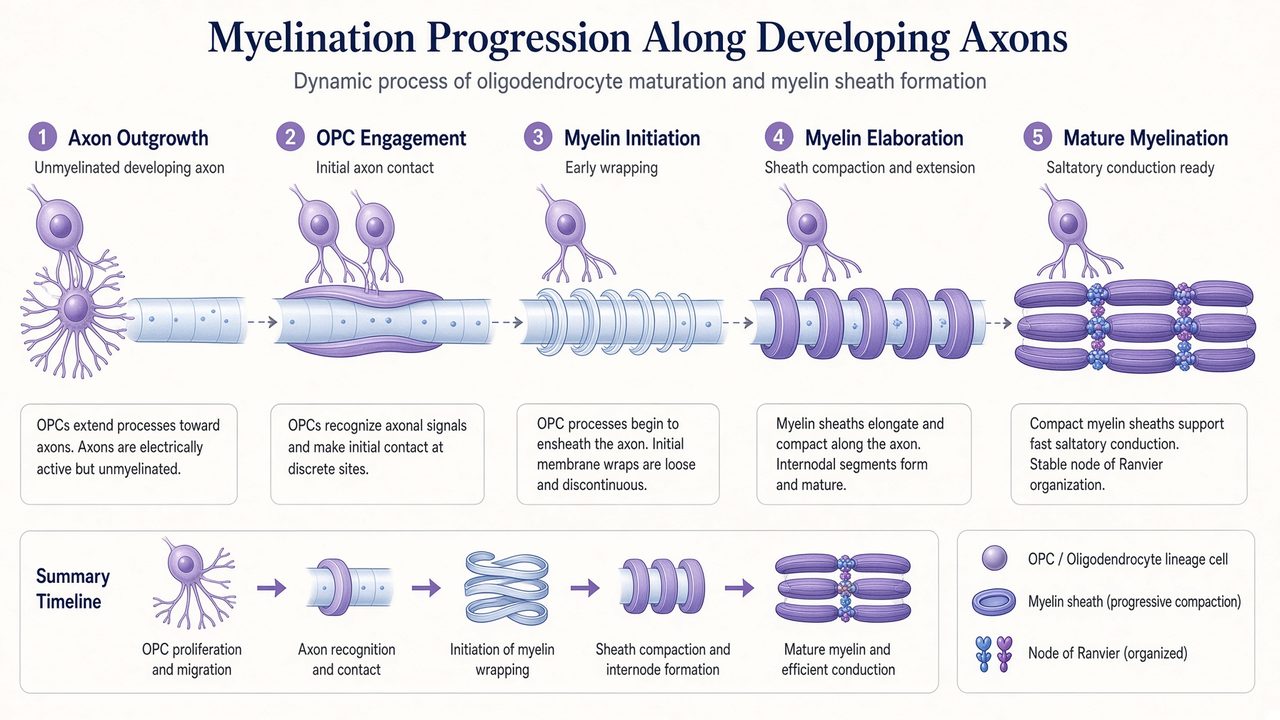
Myelin is a membrane made mostly of lipids (about 70 to 80 percent) with proteins such as myelin basic protein and proteolipid protein. In the central nervous system, oligodendrocytes form it, and in the peripheral nervous system, Schwann cells do. Each segment of myelin wraps the axon in many layers, interrupted by nodes of Ranvier, gaps where ion channels cluster.
How it speeds signals
In an unmyelinated axon, the electrical impulse travels continuously along the membrane. In a myelinated axon, the insulation prevents current leakage so that the impulse jumps from node to node, a process called saltatory conduction. It saves energy as well as time. A myelinated fiber can conduct at up to 100 meters per second or more, while an unmyelinated one may conduct at about one meter per second.

Development
Myelination begins before birth and continues for decades. Sensory and motor areas myelinate early, and the frontal lobes later, into the mid-twenties and beyond. This timeline matches the development of abilities such as planning and impulse control. Adequate nutrition, including iron, fats and iodine, and a responsive environment support healthy myelination in infancy.
Myelin and learning
Evidence shows that myelin is not fixed. Experience can change it, a phenomenon called adaptive myelination. Studies in humans using diffusion MRI found that learning to juggle, play piano or read is associated with changes in white matter structure, and animal experiments showed that preventing new myelin formation impairs motor learning and memory. Myelin may tune the timing of signals so that networks fire in synchrony.
When myelin is damaged
Multiple sclerosis
The immune system attacks central myelin, causing slowed or blocked conduction and a range of symptoms. Remyelination can occur but is often incomplete.
Leukodystrophies
Inherited diseases that impair myelin formation or maintenance, such as metachromatic leukodystrophy and adrenoleukodystrophy.
Guillain-Barré syndrome and CIDP
Autoimmune conditions attacking peripheral myelin, causing weakness and numbness.
Charcot-Marie-Tooth disease
Inherited peripheral neuropathies, some affecting myelin.
Other causes
Vitamin B12 deficiency, toxins, infections such as progressive multifocal leukoencephalopathy, and small vessel disease can damage myelin. Age-related myelin decline contributes to slower processing.
Repair strategies
Researchers are developing treatments to promote remyelination, such as drugs that stimulate oligodendrocyte precursor cells, and stem cell therapies. Some clinical trials of remyelinating agents, such as clemastine in optic neuritis, have shown modest benefits. Disease-modifying therapies for MS prevent new damage, though they do not rebuild myelin directly.
Supporting myelin health
- Eat a balanced diet with enough protein, healthy fats, iron, B vitamins and iodine.
- Exercise, which promotes white matter integrity in studies.
- Sleep well, as oligodendrocyte precursor cells proliferate during sleep.
- Do not smoke, since smoking is linked to white matter damage.
- Manage blood pressure and diabetes.
- Limit alcohol.
- Keep learning, to engage adaptive myelination.
Takeaway
Myelin is a dynamic tissue crucial to the speed and precision of brain communication. Protecting it supports lifelong brain function.
Further reading from authoritative sources
This article is educational and does not replace advice from a licensed clinician. See the medical disclaimer. Looking for specialist care? Browse the neurology clinic directory.