Neurons at Work: The Electrifying World of Synaptic Transmission
The brain's roughly 86 billion neurons communicate through a combination of electrical and chemical signals. Understanding this process, from a single spike to a synaptic message, underlies everything in neuroscience from thought to medication.
Anatomy of a neuron
- Dendrites receive incoming signals
- Cell body (soma) integrates inputs
- Axon carries the output signal, sometimes meters long
- Axon terminals release neurotransmitters
The resting state
A neuron at rest maintains a voltage difference across its membrane of about minus 70 millivolts, with more negative charge inside. This resting potential is created by ion pumps, especially the sodium-potassium pump, and selective ion channels.

The action potential
When the combined inputs at the axon's initial segment reach a threshold, voltage-gated sodium channels open, and sodium rushes in, quickly reversing the membrane voltage. Then sodium channels inactivate and potassium channels open, and potassium flows out, restoring the negative state. This all-or-none wave of voltage travels down the axon. In myelinated axons, the impulse jumps between gaps called nodes of Ranvier, a process called saltatory conduction, which greatly increases speed. Signals can travel at over 100 meters per second.
The synapse
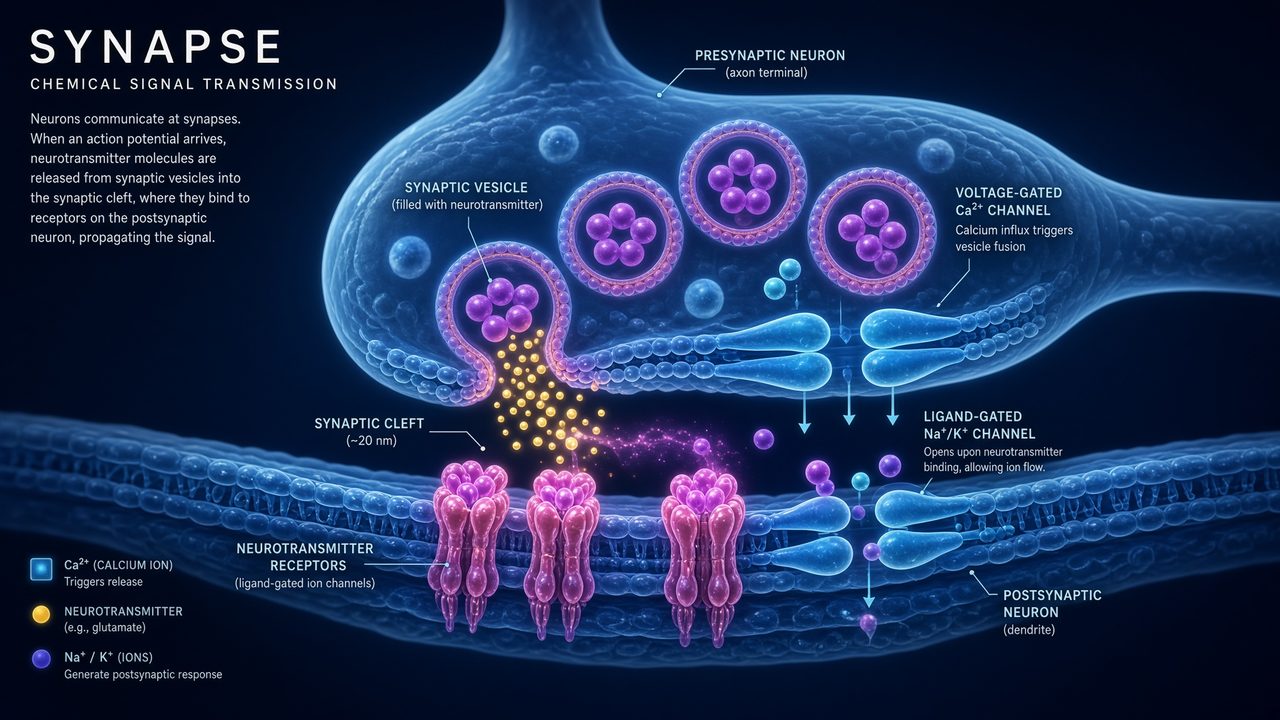
Most neurons are separated by a tiny gap, the synaptic cleft. When an action potential arrives at the axon terminal:
1. Calcium channels open, and calcium enters. 2. Vesicles fuse with the membrane and release neurotransmitters into the cleft. 3. Neurotransmitters bind to receptors on the next neuron. 4. Receptors respond. Ionotropic receptors open ion channels directly and act quickly, while metabotropic receptors trigger intracellular signaling cascades that act more slowly. 5. The signal ends as neurotransmitters are removed by reuptake transporters, broken down by enzymes or diffuse away.
Some synapses are electrical, linked by gap junctions that pass current directly, allowing very fast synchronization.
Excitation and inhibition
- Glutamate is the main excitatory neurotransmitter and makes the next neuron more likely to fire.
- GABA is the main inhibitory transmitter and makes firing less likely.
A neuron adds up thousands of excitatory and inhibitory inputs. Balance between them is crucial, and disruptions contribute to epilepsy, anxiety and other conditions.
Neuromodulators
Dopamine, serotonin, norepinephrine and acetylcholine often act as modulators, adjusting the gain and state of whole circuits rather than conveying specific messages.
Plasticity
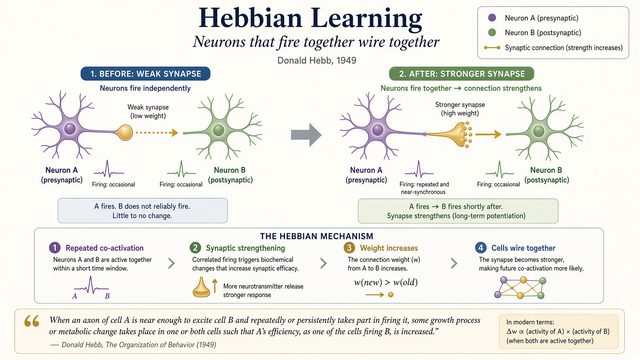
Synapses change with experience. Repeated activation can strengthen connections (long-term potentiation) while others weaken, forming the basis for learning and memory.
When transmission goes wrong
- Local anesthetics block sodium channels, stopping pain signals.
- Antidepressants such as SSRIs block reuptake of serotonin.
- Antiepileptic drugs often reduce excitability or enhance GABA.
- Parkinson's disease involves loss of dopamine neurons.
- Myasthenia gravis impairs transmission at nerve-muscle synapses.
- Botulinum toxin blocks acetylcholine release, causing paralysis.
- Alcohol and benzodiazepines enhance GABA signaling.
Energy demands
Maintaining ion gradients uses a large fraction of the brain's energy, which is why it needs a constant supply of oxygen and glucose.
Takeaway
Each thought and movement is a cascade of spikes and synaptic messages. Appreciating this foundation clarifies how drugs, diseases and experiences alter brain function.
Further reading from authoritative sources
This article is educational and does not replace advice from a licensed clinician. See the medical disclaimer. Looking for specialist care? Browse the neurology clinic directory.