The Amygdala's Dual Role: Fear Detection and Emotional Memory
The amygdala is a pair of almond-shaped clusters of neurons deep in the temporal lobes. It is famous as the brain's "fear center," but that label is incomplete. The amygdala helps decide what is emotionally important, and it helps the brain remember it.
Structure
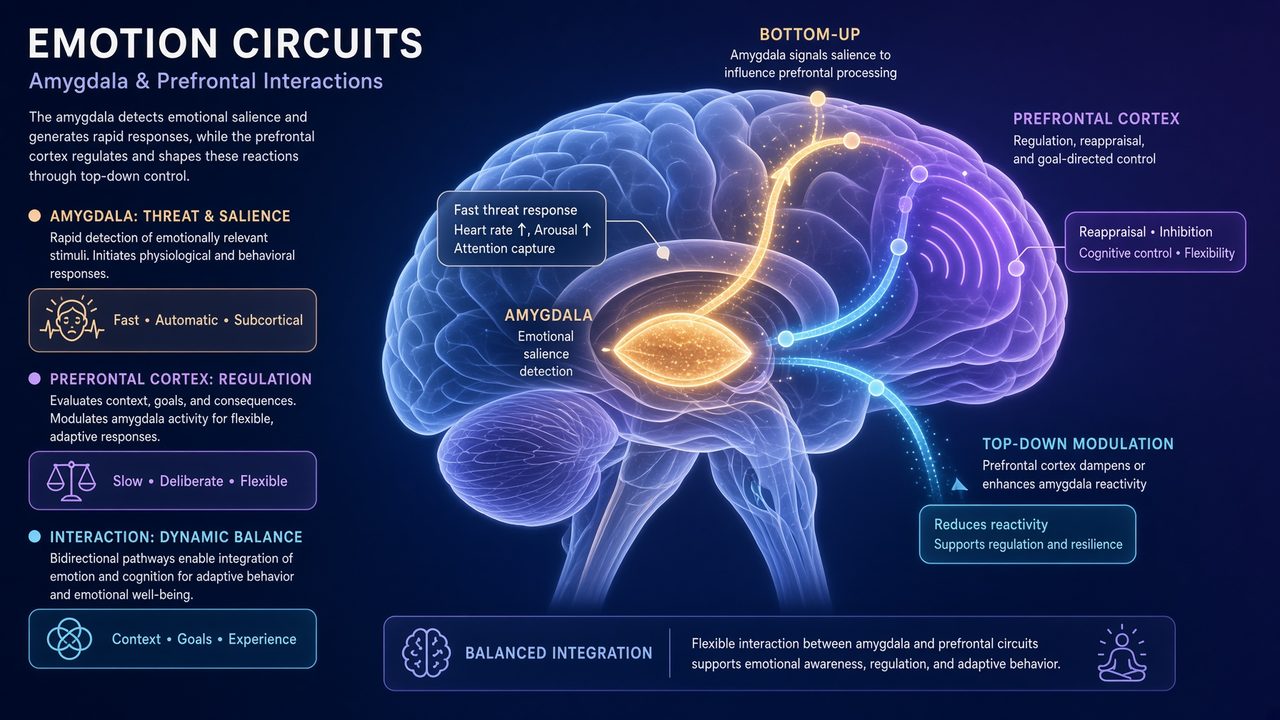
The amygdala contains several nuclei with distinct roles. The basolateral complex receives sensory information from the thalamus and cortex, and the central nucleus sends output to the hypothalamus and brainstem to drive bodily responses such as increased heart rate, freezing and stress hormone release.
Fast and slow routes
Research by Joseph LeDoux showed that sensory information can reach the amygdala by two routes. A fast "low road" via the thalamus delivers crude information, allowing a rapid reaction to a possible danger. A slower "high road" via the cortex provides detailed analysis, which may confirm or cancel the alarm. This helps explain why you jump at a curved stick that turns out not to be a snake.

Fear learning
In classic fear conditioning, a neutral tone paired with a mild shock comes to trigger fear. The amygdala is essential for forming and expressing this association. Extinction, learning that the tone is now safe, depends on interaction between the amygdala and the ventromedial prefrontal cortex, which can dampen amygdala output. Exposure-based therapies for phobias and post-traumatic stress disorder rely on this process.
Emotional memory
Emotionally arousing events are usually remembered better than neutral ones. During arousal, stress hormones such as norepinephrine and cortisol act on the amygdala, which in turn modulates memory consolidation in the hippocampus. That is why you may recall a vivid detail of a frightening event but not what you had for lunch the day before.
Beyond fear
- Positive emotion and reward. Parts of the amygdala respond to rewarding stimuli, and neurons there encode both pleasant and unpleasant values.
- Social cognition. The amygdala is active when people view faces, especially expressions of fear, and helps interpret social cues.
- Attention to ambiguity. It becomes active when situations are uncertain.
- Decision-making. It contributes emotional value to choices.
The rare case of patient S.M., who lost both amygdalae to a genetic disease, is instructive. She showed little conventional fear in many situations, yet could still feel panic when she inhaled carbon dioxide, suggesting multiple fear pathways.
Anxiety and trauma
Heightened amygdala reactivity is observed in people with anxiety disorders, PTSD and sometimes depression, particularly when prefrontal regulation is weaker. Effective treatments such as cognitive behavioral therapy, certain medications and mindfulness training are associated with changes in amygdala and prefrontal activity.
Stress and structure
Chronic stress can increase the activity and dendritic complexity of neurons in the amygdala in animal studies, while shrinking those in the hippocampus and prefrontal cortex, a pattern that may help sustain anxious states.
Myths to avoid
The amygdala does not act alone, and it is not simply a fear button. Fear involves networks including the hippocampus, insula, hypothalamus and brainstem. Describing amygdala activity as "the brain's emotion" is an oversimplification.
Calming the system
Regular exercise, sleep, slow breathing, mindfulness practice and therapy can all reduce threat reactivity over time. If anxiety interferes with daily life, speak with a healthcare professional.
Further reading from authoritative sources
This article is educational and does not replace advice from a licensed clinician. See the medical disclaimer. Looking for specialist care? Browse the neurology clinic directory.