The Default Mode Network: What Your Brain Does at Rest
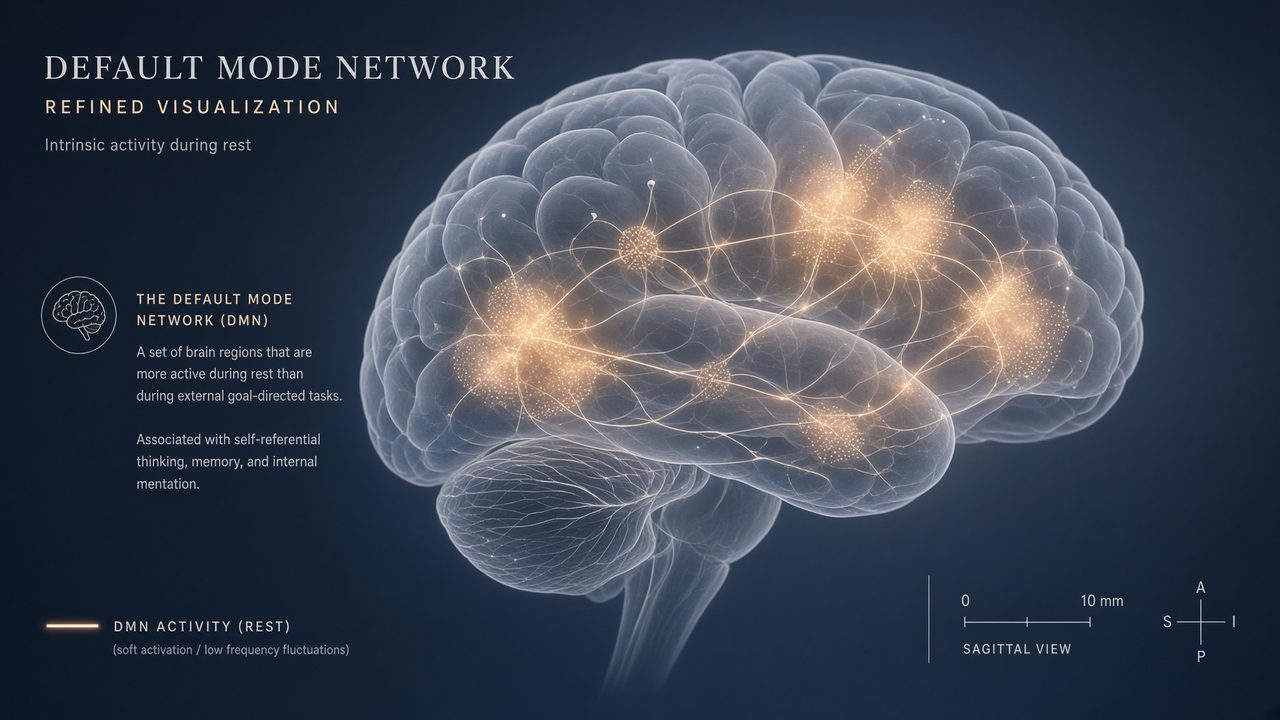
When you stop concentrating on a task, your brain does not go quiet. A set of regions called the default mode network (DMN) becomes more active, supporting daydreaming, remembering the past, imagining the future and thinking about other people. Its discovery changed how neuroscientists think about the resting brain.
Discovery
In the 1990s and early 2000s, researchers using PET and fMRI noticed that certain regions consistently decreased in activity during demanding tasks, compared with rest. Marcus Raichle named this baseline pattern the "default mode," and suggested that the brain's resting state is highly active, consuming most of its energy even without a task.
Key regions
- Medial prefrontal cortex: self-referential thought and social cognition
- Posterior cingulate cortex and precuneus: hub for integrating information and autobiographical memory
- Angular gyrus and inferior parietal cortex: semantic processing and attention to memory
- Hippocampus and medial temporal lobe: episodic memory
- Lateral temporal cortex

What it does
The DMN is engaged when we:
- Recall personal memories
- Imagine the future
- Think about ourselves and our traits
- Consider others' thoughts and intentions, called theory of mind
- Engage in moral reasoning
- Mind wander
- Construct narratives
Researchers see it as supporting a "mental model" or internal simulation of the self and the world.
Relation to other networks
The DMN is often anti-correlated with task-positive networks, such as the frontoparietal control network and the dorsal attention network, which handle goal-directed attention. The salience network, anchored in the insula and anterior cingulate, helps switch between them. Flexible switching between networks is part of healthy cognition. In creative thinking, DMN and control networks can work together.
Mind wandering
People spend a large share of waking time, about 47 percent in one well-known smartphone study, with minds wandering. Mind wandering can lead to creativity and planning, but excessive, unpleasant rumination is linked to lower mood. DMN activity tends to rise with wandering and decline with focused attention.
DMN and mental health
- Depression: increased DMN connectivity and activity are linked to rumination
- Anxiety and PTSD: altered DMN connectivity is reported
- Schizophrenia: abnormal DMN regulation
- ADHD: difficulty suppressing the DMN during tasks
- Autism: differences in DMN connectivity linked to self and social processing
Findings are often group-level and not diagnostic.
DMN and Alzheimer's disease
Amyloid deposits appear early in DMN regions, and DMN connectivity declines in Alzheimer's disease, making the network a focus of early detection research. The metabolic demands of the DMN may make it vulnerable.
Meditation, psychedelics and the DMN
Experienced meditators show reduced DMN activity and altered connectivity during mindfulness practices, associated with reduced mind wandering. Psychedelic drugs such as psilocybin acutely decrease DMN integrity, and researchers are exploring whether this contributes to their therapeutic effects in depression, though the interpretation remains under study.
Practical lessons
- Let your mind wander sometimes, through walks, showers and breaks, since it supports creativity and planning.
- Notice rumination and shift it with activity, mindfulness or problem-solving.
- Sleep well to keep networks balanced.
- Stay active, socially and physically, which supports network health.
Takeaway
A resting brain is a busy brain. The default mode network reveals that much of our mental life, including memory, imagination and sense of self, unfolds internally.
Further reading from authoritative sources
This article is educational and does not replace advice from a licensed clinician. See the medical disclaimer. Looking for specialist care? Browse the neurology clinic directory.