Deep Brain Stimulation: How It Works
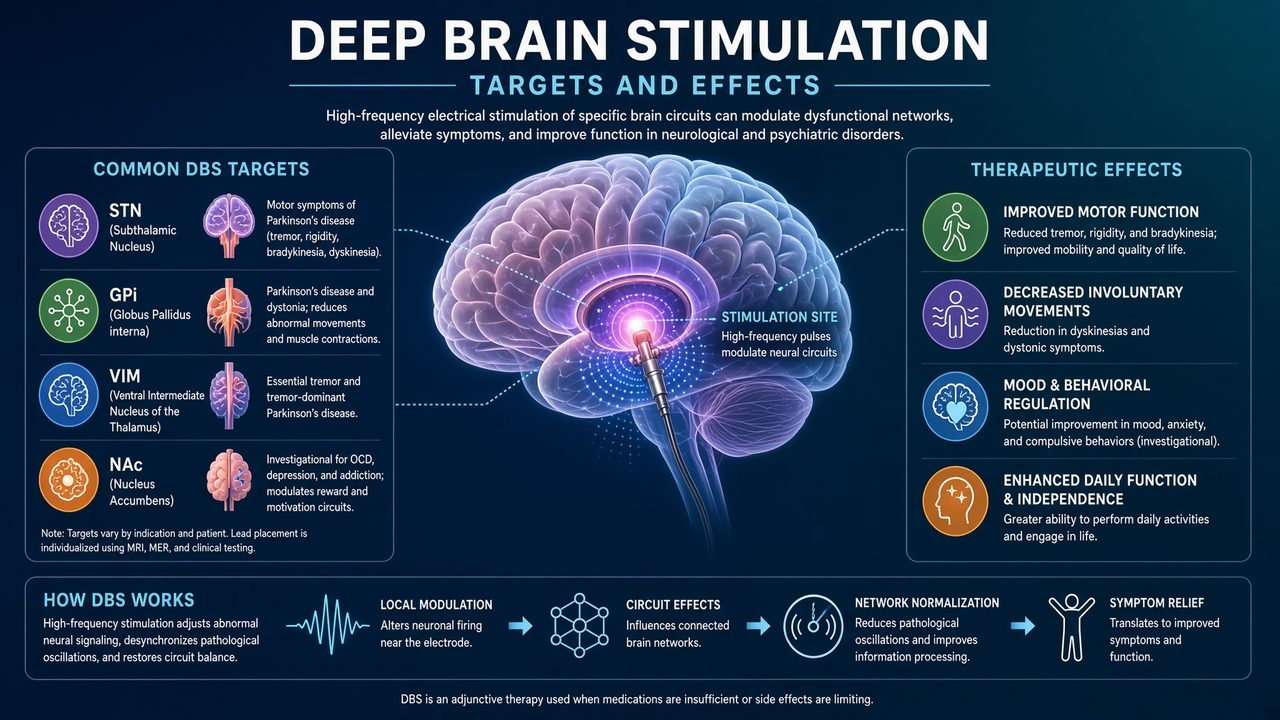
Deep brain stimulation, or DBS, delivers mild electrical pulses to specific brain areas through implanted electrodes. Often described as a pacemaker for the brain, it has helped hundreds of thousands of people with movement disorders and is being explored for other conditions.
The system
A DBS system has three parts: thin electrodes placed in a target region, an extension wire under the skin, and a pulse generator, usually implanted under the collarbone, that sends adjustable electrical pulses. Surgeons use MRI and recordings from neurons to place the electrodes precisely. Afterward, a clinician programs the device and adjusts settings over weeks. Patients can often use a handheld controller or app within limits. Rechargeable or replaceable batteries last years.
How it is thought to work
The exact mechanism is still debated. High-frequency stimulation may block or disrupt abnormal rhythms, such as excessive beta oscillations in Parkinson's disease, and may change how neurons fire and release neurotransmitters, effects that reach connected networks. Rather than simply turning a region off, DBS appears to regularize abnormal communication in circuits.

Conditions treated
- Parkinson's disease: targets include the subthalamic nucleus and globus pallidus internus. DBS can reduce tremor, stiffness, slowness and medication-related dyskinesia, and allow lower medication doses. It is most helpful for people who respond well to levodopa but have fluctuations.
- Essential tremor and dystonia: targets include the thalamus (ventral intermediate nucleus) and globus pallidus.
- Epilepsy: stimulation of the anterior nucleus of the thalamus can reduce seizures in some people.
- Obsessive-compulsive disorder: approved under a humanitarian device exemption in the United States.
- Experimental uses: treatment-resistant depression, Tourette syndrome, Alzheimer's disease, addiction, chronic pain and cluster headache. A study by Helen Mayberg targeted the subcallosal cingulate for depression, showing benefit in some patients, though a major trial of another target did not meet its endpoint.
Who is a candidate
Candidates are usually evaluated by a team including a neurologist, neurosurgeon, neuropsychologist and others. Good candidates for Parkinson's disease generally have symptoms that respond to levodopa, have disabling fluctuations, and do not have significant dementia or psychiatric instability. Age alone is not a barrier, but overall health matters.
Risks and side effects
- Surgical risks: bleeding (about 1 to 3 percent for symptomatic hemorrhage), infection, and hardware problems
- Stimulation effects: speech difficulty, tingling, muscle contractions, balance problems, mood changes or, rarely, impulsivity
- Cognitive effects: subtle changes in verbal fluency or processing in some patients
- Device issues: battery replacement and lead breakage
- MRI restrictions: certain scans require special protocols.
The future
Adaptive or closed-loop DBS senses brain signals and adjusts stimulation automatically. In 2024 and 2025, devices that adapt to brain activity were approved or studied in Parkinson's disease. Improved electrodes with directional steering, better imaging and personalized targeting are also advancing.
Life with DBS
After surgery, expect a recovery period and several programming visits. Carry a device identification card, tell every health professional you have a DBS system before any scan or procedure, and keep follow-up appointments for battery checks. Many patients continue to need medication, though often at lower doses.
Takeaway
DBS is a mature, effective therapy for selected patients with movement disorders and an expanding research tool. Careful evaluation and programming are key to results.
Further reading from authoritative sources
- National Institute of Neurological Disorders and Stroke (NINDS)
- National Center for Complementary and Integrative Health (NCCIH)
This article is educational and does not replace advice from a licensed clinician. See the medical disclaimer. Looking for specialist care? Browse the neurology clinic directory.