Intermittent Fasting and Brain Health
Intermittent fasting, such as skipping meals for set windows or eating only within eight hours, has become popular for weight loss, and researchers have asked whether it also benefits the brain. Animal data are intriguing, but human evidence is still limited.
Common patterns
- Time-restricted eating: eating within a window of 6 to 10 hours daily, such as 16:8
- Alternate-day fasting: alternating normal eating days with very low calorie days
- 5:2 pattern: two low-calorie days per week
- Prolonged fasts: 24 hours or more, which carry greater risk and should be medically supervised
Possible mechanisms
- Ketones: after about 12 to 16 hours without food, the liver produces ketone bodies such as beta-hydroxybutyrate, which neurons use as fuel. Ketones may act as signaling molecules that promote BDNF and reduce inflammation.
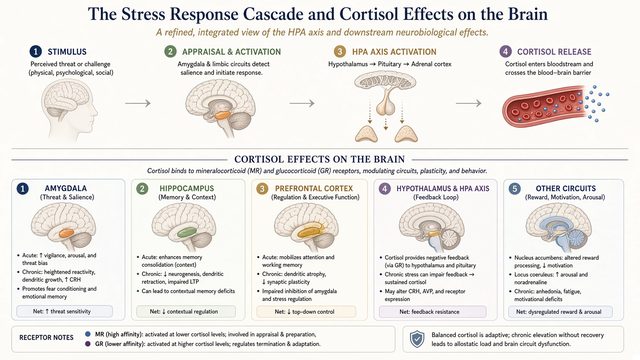
- Stress resistance and autophagy: Mark Mattson at the National Institute on Aging has proposed that metabolic switching between glucose and ketones stimulates adaptive cellular stress responses, increasing neuronal resilience, autophagy, mitochondrial health and neurogenesis in rodents.
- Reduced inflammation and improved insulin sensitivity.
- Circadian effects: time-restricted eating may reinforce circadian rhythms in metabolism.
- Animal findings: intermittent fasting and calorie restriction in rodents improved learning, delayed age-related decline and reduced damage in models of stroke, Alzheimer's and Parkinson's disease.

Evidence in humans
- Cognition in healthy adults: meta-analyses of intermittent fasting find small or no benefits for cognitive performance, and some tasks may be impaired during fasting hours, especially attention. A trial in older adults with overweight found modest improvements in some memory measures after calorie restriction, but results are inconsistent.
- Mild cognitive impairment and Alzheimer's: small pilot studies suggest possible benefits from ketogenic or fasting approaches, with no solid proof, and large trials are lacking.
- Mood: some studies report improved mood and reduced fatigue, while others find irritability and hunger-related distress. Fasting can worsen mood in some people.
- Sleep: time-restricted eating may improve or disturb sleep.
- Weight and metabolic health: a major trial in the New England Journal of Medicine in 2022 by Deying Liu and colleagues found that time-restricted eating did not produce greater weight loss than a regular schedule with calorie counting. Benefits for blood sugar and blood pressure may appear, mostly through weight loss.
- Cardiovascular concerns: a 2024 preliminary analysis presented by the American Heart Association suggested an association between eating within an eight-hour window and higher cardiovascular mortality, though it was observational and not peer-reviewed at the time.
- Evidence gaps: short follow-up, variable methods, and lack of long-term studies.
Who should be cautious or avoid
People with diabetes on insulin or sulfonylureas (risk of hypoglycemia), a history of eating disorders, pregnant or breastfeeding women, children and adolescents, older adults at risk of malnutrition, and people with medical conditions or on medications should talk to a doctor first. Intermittent fasting may trigger binge eating or disordered patterns in vulnerable people.
If you try it
- Start gently, such as a 12-hour overnight fast, and extend if comfortable.
- Eat nutrient-dense foods in the eating window, including protein, vegetables, whole grains and healthy fats.
- Hydrate, with water, tea or black coffee.
- Watch for symptoms such as dizziness, headaches, poor concentration, or irritability, and stop if they occur.
- Do not skip meals that matter for performance, if concentration is critical.
- Prioritize sleep and exercise.
- Seek medical guidance to tailor an approach.
Takeaway
Intermittent fasting is an intriguing area of brain science, though not a proven way to protect the brain. A balanced, sustainable diet is the safer foundation.
Further reading from authoritative sources
This article is educational and does not replace advice from a licensed clinician. See the medical disclaimer. Looking for specialist care? Browse the neurology clinic directory.