How Sleep Affects Memory Consolidation
Studying late into the night may feel productive, yet research shows that much of the work of turning experiences into lasting memory occurs during sleep. Sleep is not downtime for memory; it is an active stage of processing.
The basics of consolidation
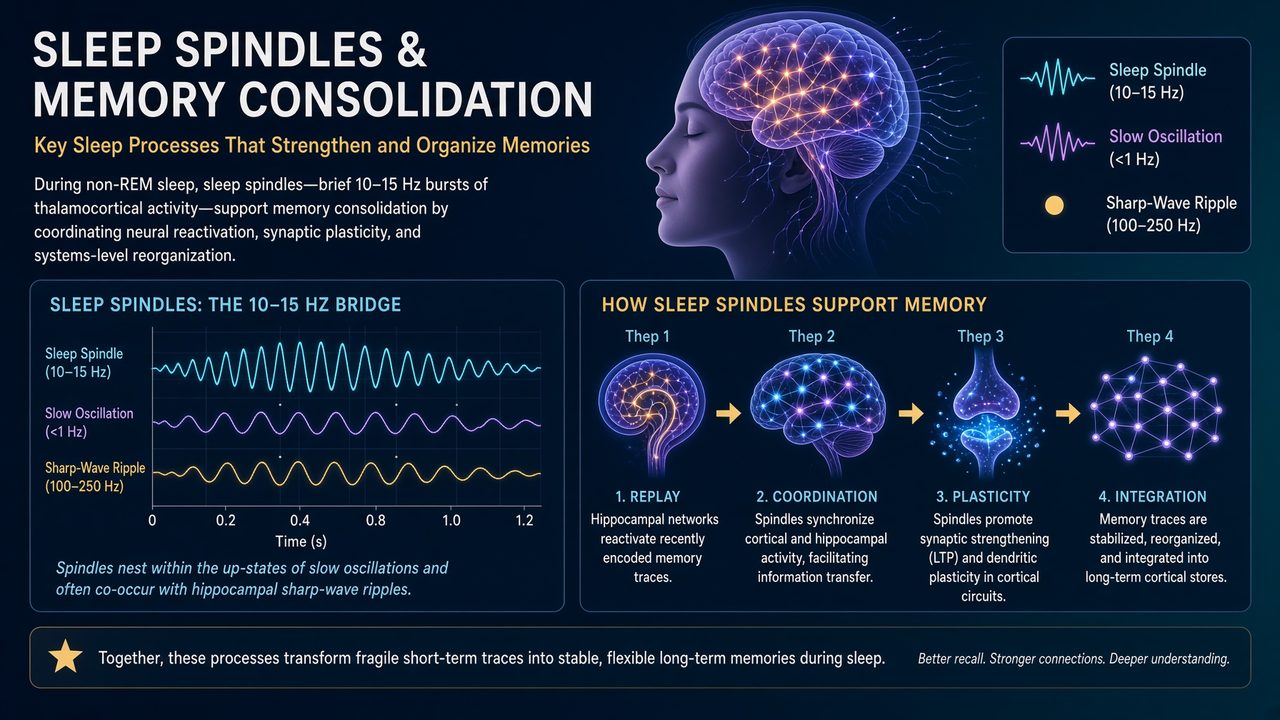
New memories are first encoded in the hippocampus and associated cortical networks, and are initially fragile. Consolidation is the process of stabilizing them and gradually transferring them into long-term cortical storage. The active systems consolidation model, proposed by Jan Born and colleagues, suggests that during non-REM sleep the hippocampus replays recent experiences, and the replay is coordinated with cortical slow oscillations and thalamocortical sleep spindles, which promote transfer of information to the neocortex.
The sleep rhythms
- Slow oscillations (about 1 Hz): deep sleep waves that coordinate activity across the cortex. Enhancing slow oscillations through gentle electrical or acoustic stimulation improved memory in some studies by Born's group and Phyllis Zee's group.
- Sleep spindles (12 to 15 Hz): brief bursts of activity that are associated with learning and IQ. Spindle density increases after learning, and correlates with memory gains.
- Sharp-wave ripples: fast hippocampal events that coincide with replay.
- REM sleep: supports consolidation of emotional and procedural memories, and creative integration. Some theories propose a sequential hypothesis, in which non-REM and REM cooperate.

What studies show
- Declarative memory: people who sleep after learning word pairs remember more than those kept awake for the same period, and even a nap helps, as shown in studies by Jan Born, Robert Stickgold and Sara Mednick.
- Procedural memory: motor skills such as finger-tapping sequences improve overnight without further practice, according to work by Matthew Walker, and stage 2 sleep, with spindles, is linked.
- Targeted memory reactivation: cues such as a scent or sound present during learning and re-presented during slow wave sleep can enhance memory, as in a study by Björn Rasch showing that a rose scent during sleep improved recall.
- Insight and generalization: sleep helps people discover hidden rules, as in a study by Ullrich Wagner, where sleep doubled the chance of discovering a hidden shortcut in a number task.
- Sleep deprivation: staying awake the night after learning impairs retention even after recovery sleep, and sleeping poorly before learning reduces the ability to encode new information.
- Age: consolidation changes with age, with reduced slow wave sleep and spindles in older adults associated with weaker memory consolidation. Children show strong sleep-dependent learning.
- Limits: not every memory benefits equally, and some findings do not replicate.
How to use sleep to learn better
- Study, then sleep: review important material before bedtime, and get a full night's sleep.
- Avoid all-nighters before exams.
- Space learning across days to allow several nights of consolidation.
- Nap after learning if you cannot get a full night.
- Keep a regular schedule and a comfortable sleep environment.
- Limit alcohol, which disrupts sleep architecture, and avoid sleep-impairing medications where possible.
- Treat sleep disorders such as apnea and insomnia.
- Be skeptical of sleep-learning gadgets, since learning completely new material, such as a language, while asleep does not work.
Takeaway
Sleep is when the brain files, strengthens and connects what you learned. Treat it as part of your study plan.
Further reading from authoritative sources
- National Institute of Neurological Disorders and Stroke (NINDS)
- National Center for Complementary and Integrative Health (NCCIH)
This article is educational and does not replace advice from a licensed clinician. See the medical disclaimer. Looking for specialist care? Browse the neurology clinic directory.