Why Dreams Matter: Theories and Evidence
Humans spend roughly two hours a night dreaming, yet the purpose of dreams remains one of science's open questions. Researchers have proposed several theories, and evidence suggests that dreaming is not just random noise.
What dreams are
Dreams are experiences during sleep, with images, sensations, emotions and a sense of narrative. They occur in all sleep stages, but REM dreams tend to be longer, more vivid, emotional and bizarre, while non-REM dreams are often shorter and more thought-like.
The brain during dreams
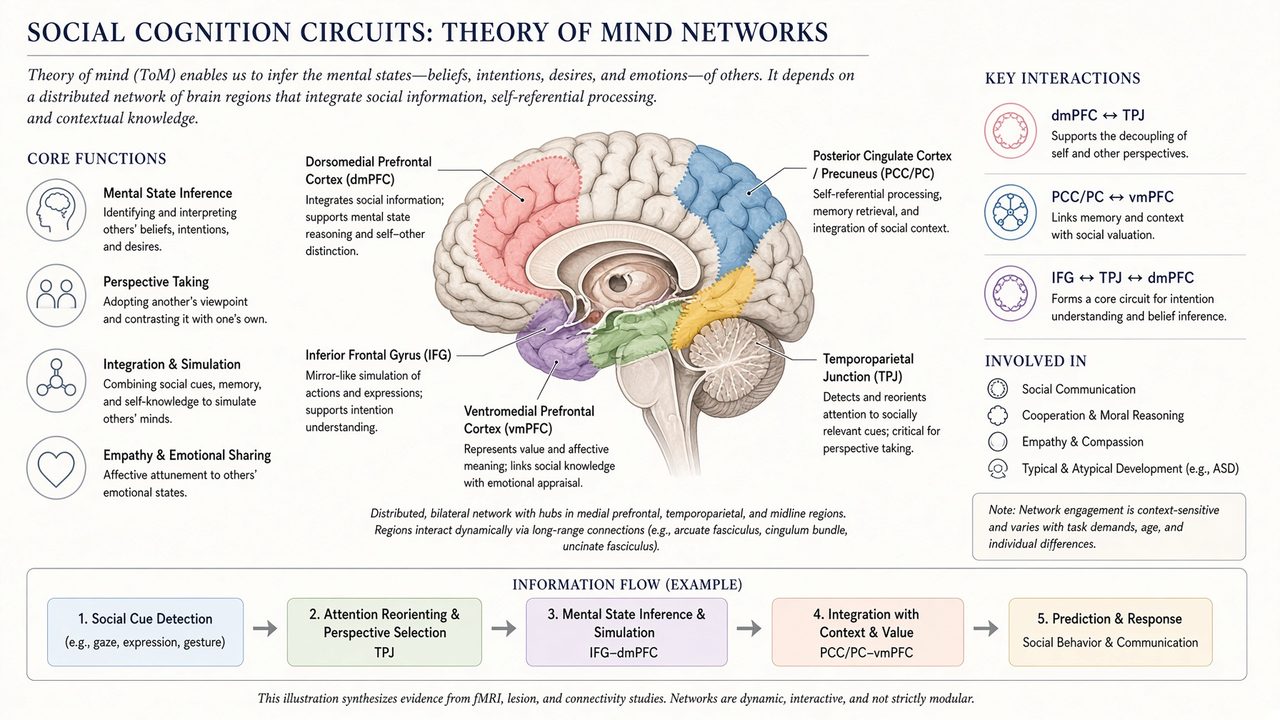
During REM sleep, the amygdala, visual association areas and limbic regions are highly active, while parts of the prefrontal cortex involved in logic and self-monitoring show reduced activity. This pattern may explain why dreams feel emotional and strange while we accept them uncritically. Neurotransmitters shift: acetylcholine is high, while norepinephrine and serotonin are low.

Major theories
Activation-synthesis and its successors
J. Allan Hobson and Robert McCarley proposed in 1977 that dreams result from the cortex trying to make sense of random brainstem signals. Later versions emphasize that dreams are not entirely random and reflect the dreamer's concerns and memories.
Memory consolidation
Sleep helps stabilize memories, and dream content often draws on recent experiences, a phenomenon called the day residue effect. Studies show that people who dreamed about a learned task, such as a maze, improved more afterward, though the evidence is limited and debated.
Emotional regulation
Matthew Walker and Rosalind Cartwright proposed that REM sleep, with its low norepinephrine, offers a safe setting to reprocess emotional experiences, softening their emotional charge. Findings are suggestive but not conclusive.
Threat simulation
Antti Revonsuo proposed that dreaming evolved to rehearse responses to threats. Many dreams do feature danger, though many also feature everyday life.
Continual-activation and predictive ideas
Newer proposals suggest dreaming reflects the brain's constant model-building and that dreams may protect the visual system or generalize learning, such as the "overfitted brain hypothesis."
What dreams reflect
Dream content correlates with waking concerns, relationships, recent events and emotions, a principle called the continuity hypothesis. People with depression, anxiety or trauma often have more negative dreams. Content analysis suggests common themes, such as being chased, falling, or being unprepared.
Nightmares and trauma
Frequent nightmares can disrupt sleep and are common in PTSD. Imagery rehearsal therapy, in which people rewrite and rehearse the ending of a nightmare while awake, is an effective treatment. A medication, prazosin, has been used in some cases.
Lucid dreaming
In lucid dreams, people realize they are dreaming and may control events. Research with signaling by eye movements has confirmed it occurs during REM. Training techniques may help some people, and lucid dreaming is being explored for nightmares, though more research is needed.
Can dreams be interpreted?
Freud emphasized hidden symbolic meanings, but modern neuroscience does not support the idea of universal symbol dictionaries. Dreams can offer insight into your mood and preoccupations, but interpretations are subjective. Cultural and personal context matters.
Dreams and creativity
Some famous insights are reported to have arrived in dreams, and REM sleep appears to foster linking of unusual associations, which may help problem solving.
Remembering dreams
Most dreams are forgotten, in part because chemical conditions in sleep are not conducive to memory formation. Waking up during or just after REM and writing dreams down promptly increases recall.
Takeaway
Whatever their function, dreams are a natural product of an active sleeping brain. Do not worry about dream content, but if nightmares or sleep problems distress you, talk to a healthcare provider.
Further reading from authoritative sources
- National Institute of Neurological Disorders and Stroke (NINDS)
- National Center for Complementary and Integrative Health (NCCIH)
This article is educational and does not replace advice from a licensed clinician. See the medical disclaimer. Looking for specialist care? Browse the neurology clinic directory.