Understanding Brain Health Research Studies

News about brain health arrives constantly: a new drug, a food that boosts memory, a scan that predicts dementia. Understanding how studies work helps you to separate solid findings from hype, and to decide whether to take part in research.
Types of studies
- Laboratory and animal studies: useful for understanding mechanisms, but results in mice often do not translate to people.
- Case reports and series: describe a few patients, and generate hypotheses.
- Observational studies: cohort and case-control studies follow or compare groups, and can reveal associations, for example between exercise and lower dementia risk, but cannot prove cause, because of confounding and reverse causation.
- Randomized controlled trials: participants are randomly assigned to treatment or control, which balances other factors, and are the gold standard for testing treatments. Blinding of participants and researchers reduces bias.
- Systematic reviews and meta-analyses: combine results from many studies, and are stronger when included studies are of good quality.
- Clinical guidelines: expert recommendations based on evidence
Key questions to ask
- Who was studied? Age, sex, health status and background affect whether results apply to you.
- How many? Small studies can give unstable results, as noted in discussions of reproducibility.
- What was compared? Look for a good control or placebo group.
- What was measured? Memory test scores and brain scans are not the same as real-world function or disease prevention. Biomarker changes do not always translate into benefit.
- How big is the effect? Statistical significance is not the same as clinical importance. Look at absolute risk, and not only relative risk, since doubling a tiny risk is still tiny.
- How long? Short studies may miss long-term outcomes.
- Who paid, and who is on the team? Conflicts of interest do not invalidate studies, but should be considered.
- Has it been replicated?
- Was it peer reviewed? Preprints are not yet reviewed.

Correlation versus causation
People who take supplements may also exercise more, eat better and have higher education. Unless trials randomize, such factors can create misleading associations. Mendelian randomization and careful modeling can strengthen causal arguments, but they rely on assumptions.
Phases of clinical trials
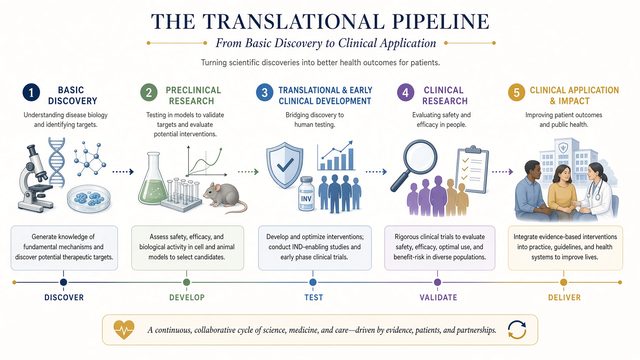
Phase 1 tests safety in small groups, phase 2 explores effectiveness and dosing, phase 3 compares treatment to standard care or placebo in large groups, and phase 4 monitors after approval.
Participating in research
Studies need volunteers, and participation can give access to cutting-edge care and contribute to knowledge. Before joining:
- Understand informed consent: purpose, procedures, risks, benefits, alternatives, costs, compensation and your right to withdraw at any time
- Ask who oversees the study: an institutional review board or ethics committee protects participants
- Ask about data privacy, and what happens to your samples and information
- Learn what happens after the study: will you receive results?
- Check registries: ClinicalTrials.gov, and national registries list legitimate studies
- Be wary of studies that charge large fees or promise cures
Finding research
Search ClinicalTrials.gov, university research centers, and disease organizations. Registries such as Alzheimer's Prevention Registry and Brain Health Registry connect volunteers to studies.
Takeaway
Good questions help you read research critically. Look for solid design, meaningful outcomes and replication, and consider helping research by participating.
Further reading from authoritative sources
This article is educational and does not replace advice from a licensed clinician. See the medical disclaimer. Looking for specialist care? Browse the neurology clinic directory.