Cognitive Flexibility: What It Is and How to Train It
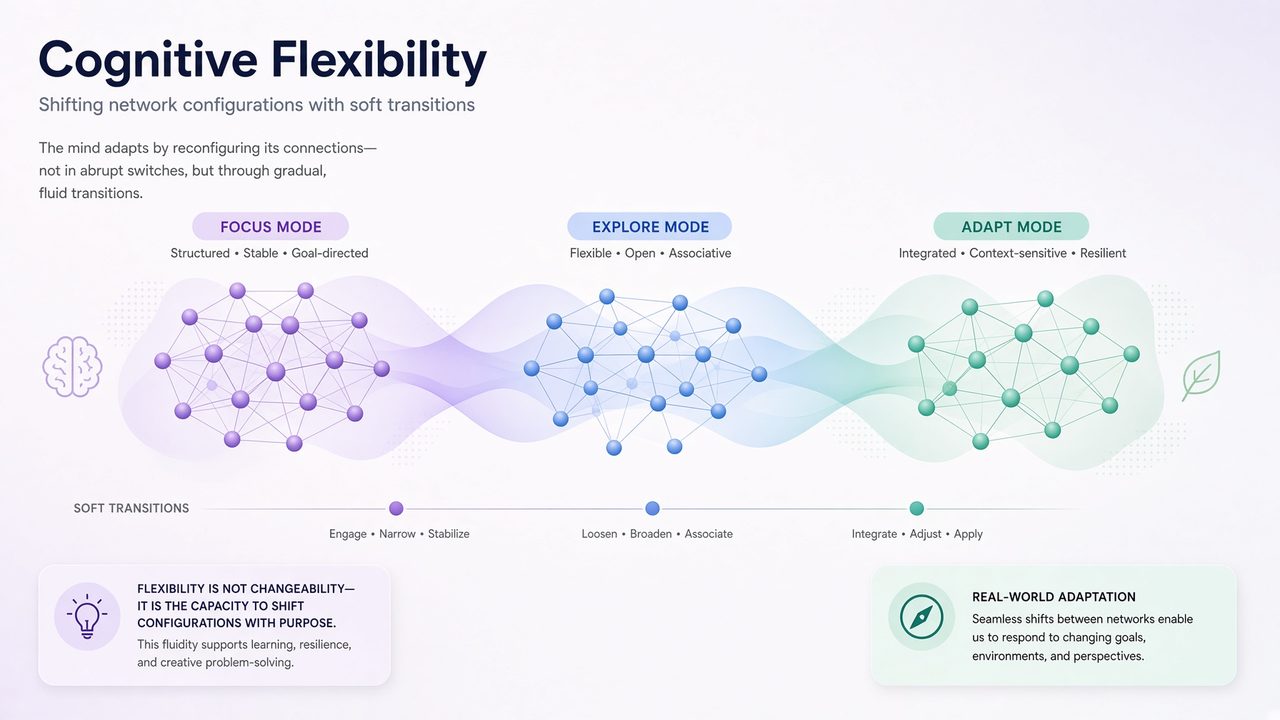
Plans change. A road is closed, a colleague proposes a new approach, a problem requires a different strategy. Cognitive flexibility, the mental ability to adapt to new conditions, switch between ideas and consider alternatives, helps us navigate such moments. It is a core executive function.
Aspects of flexibility
- Task switching: shifting attention between tasks or rules
- Set shifting: changing strategy when rules change, as in the Wisconsin Card Sorting Test
- Perspective taking: considering another person's viewpoint
- Reversal learning: adapting when reward contingencies change
- Conceptual flexibility: generating alternative ideas, and seeing problems from different angles
- Emotional flexibility: adapting emotional responses to circumstances
Together with working memory and inhibition, flexibility forms the triad of core executive functions proposed by Akira Miyake.
Brain regions
- Dorsolateral prefrontal cortex: maintains rules and goals, and updates them
- Anterior cingulate cortex: detects conflict and the need for change
- Orbitofrontal cortex: tracks changes in reward value, key for reversal learning
- Inferior frontal gyrus and presupplementary motor area: inhibits the old response
- Frontoparietal control network: coordinates adaptive control
- Striatum and dopamine: dopamine modulates the balance between stability and flexibility. Too little dopamine in prefrontal cortex can lead to rigidity, and too much to distractibility.
Neural efficiency matters: there is a "stability-flexibility tradeoff," and the brain balances maintaining goals against responding to change.

Development and aging
Cognitive flexibility develops through childhood and adolescence, with the prefrontal cortex maturing into the twenties. Young children often perseverate, as in the "dimensional change card sort" task, where they continue sorting by the old rule. In aging, flexibility and task switching often decline, with switch costs increasing, though experience can offset some of this in daily life.
When flexibility is impaired
- ADHD, autism, OCD and anxiety may involve difficulties with shifting. Autistic people may show a preference for sameness and detail, and the research suggests that these differences are complex and not simply deficits.
- Frontal lobe injury and frontotemporal dementia: perseveration and rigidity.
- Parkinson's disease: impaired set shifting.
- Depression and rumination: difficulty disengaging from negative thoughts.
- Eating disorders: cognitive rigidity has been observed in anorexia nervosa.
- Stress and fatigue: impair flexibility temporarily.
- Substance use: impairs reversal learning.
What may help
Evidence for training broad cognitive flexibility is mixed. Computerized "brain games" tend to improve the trained tasks with limited transfer. Activities with better support include:
- Physical exercise, particularly aerobic and coordination-demanding activities, with benefits for executive function across ages
- Learning new, complex skills, such as an instrument, a language or a sport
- Bilingualism, associated in some studies with improved switching, although findings are debated
- Mindfulness and meditation, which may improve attentional flexibility
- Improvisation and creative arts, which require adaptive thinking
- Sleep and stress management, as fatigue and stress hamper executive functions
- Cognitive behavioral therapy, which teaches reframing and flexibility in thinking
- Exposure to diverse perspectives and travel
Everyday strategies
- Change routines occasionally: take a different route, try a new cuisine.
- Practice perspective-taking: argue the opposing view or imagine how others see a situation.
- Generate alternatives: when solving a problem, come up with three other approaches.
- Reappraise: reinterpret stressful events in a different light.
- Break big changes into steps, and allow time to adjust.
- Reduce multitasking, which taxes switching.
- Notice rigid thoughts, such as "always" and "never," and test them.
Takeaway
Flexibility lets us adapt, learn and cooperate. Staying active, curious and rested helps keep this ability strong across life.
Further reading from authoritative sources
- National Institute of Neurological Disorders and Stroke (NINDS)
- National Center for Complementary and Integrative Health (NCCIH)
This article is educational and does not replace advice from a licensed clinician. See the medical disclaimer. Looking for specialist care? Browse the neurology clinic directory.