Working Memory: The Brain's Mental Scratchpad
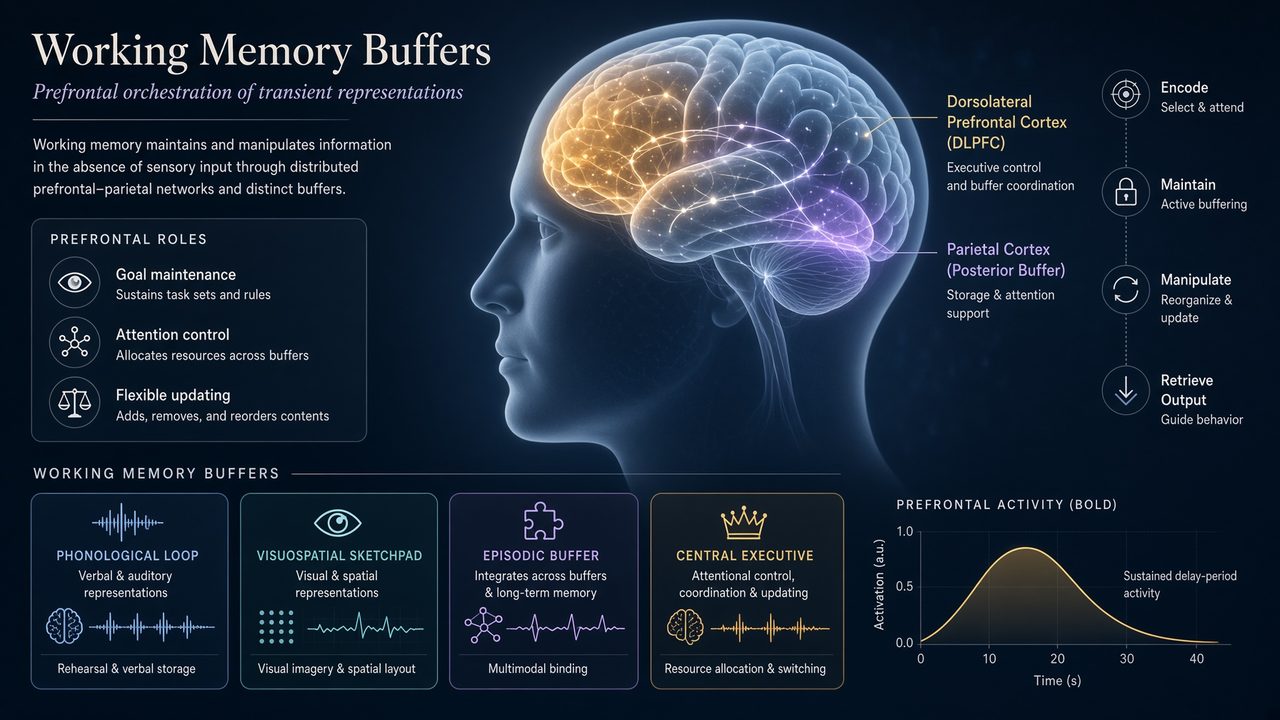
When you do a mental calculation, follow directions someone just gave you, or hold a sentence in mind until you finish reading it, you are using working memory. It is the brain's mental scratchpad: a limited-capacity system that keeps information available for short periods so you can use it.
How researchers describe it
In 1974 psychologists Alan Baddeley and Graham Hitch proposed a model that replaced the older idea of a single short-term store. In its updated form it has several parts:
- Phonological loop: holds spoken and written verbal information, as when you silently repeat a phone number.
- Visuospatial sketchpad: holds images and spatial layouts, such as the arrangement of furniture in a room.
- Central executive: directs attention, coordinates the other components and manipulates information.
- Episodic buffer: integrates information from different sources and links it to long-term memory.
Other models emphasize the role of attention and describe working memory as the part of long-term memory that is currently active. Researchers continue to debate details, but most agree that attention control is essential.
How limited is it?
In 1956 psychologist George Miller suggested that people can hold about seven items, plus or minus two. More recent research suggests the true limit for new, unrelated items is closer to three to five chunks. The key concept is the chunk: a meaningful unit. The letters F, B, I, C, I, A are six items, but if you recognize them as two agency acronyms they become two chunks. This is why experts can remember far more within their field.

What brain regions are involved
Working memory relies on networks that include the prefrontal cortex and the parietal cortex. Neurons in the prefrontal cortex can keep firing while a piece of information is held in mind. Dopamine plays a role in stabilizing these representations, which is one reason dopamine-related conditions can affect working memory.
What affects working memory
Things that reduce it
- Stress and anxiety, which consume mental resources with worry
- Sleep deprivation
- Multitasking and interruptions
- Certain medications and alcohol
- Aging, which gradually reduces capacity and speed for many people
- Conditions such as ADHD, depression and traumatic brain injury
Things that support it
- Regular aerobic exercise
- Adequate sleep
- Managing stress through relaxation, mindfulness or therapy
- Reducing distractions
Does working memory training work?
Computerized programs can improve performance on the tasks practiced, and sometimes on very similar tasks. However, reviews of the research generally find limited evidence that these gains transfer to broader skills such as school performance or everyday attention. If you enjoy these exercises, there is no harm, but they should not replace proven strategies.
Strategies that help in daily life
You can work with your working memory's limits instead of fighting them:
- Offload to the outside world. Write lists, set reminders and use calendars.
- Chunk information. Group phone numbers or tasks into meaningful units.
- Break tasks into steps and finish one before starting the next.
- Reduce competing demands. Turn off notifications while doing complex work.
- Use visualization or association to tie new items to things you already know.
When to seek help
Difficulty keeping track of instructions or conversations that is new, severe, or affecting school or work can have many causes, from sleep problems to attention disorders to neurological conditions. A clinician can help sort out the reason and suggest options.
Further reading from authoritative sources
- National Institute of Neurological Disorders and Stroke (NINDS)
- National Center for Complementary and Integrative Health (NCCIH)
This article is educational and does not replace advice from a licensed clinician. See the medical disclaimer. Looking for specialist care? Browse the neurology clinic directory.