Curiosity and Learning: The Neuroscience of Wanting to Know
Curiosity, the desire to know, is not just a pleasant feeling. It changes how the brain processes and remembers information. Neuroscience is revealing why curious people learn more, and how to stimulate that state.
What the research shows
A 2014 study by Matthias Gruber, Bernard Gelman and Charan Ranganath had participants rate their curiosity about trivia questions and then undergo fMRI while waiting for the answers. When curiosity was high:
- Activity increased in the caudate and nucleus accumbens, parts of the dopamine-driven reward circuit.
- Memory improved for the answers, and also for unrelated faces shown during the wait.
- Connectivity between the midbrain and hippocampus was strengthened, and this was associated with better memory a day later.
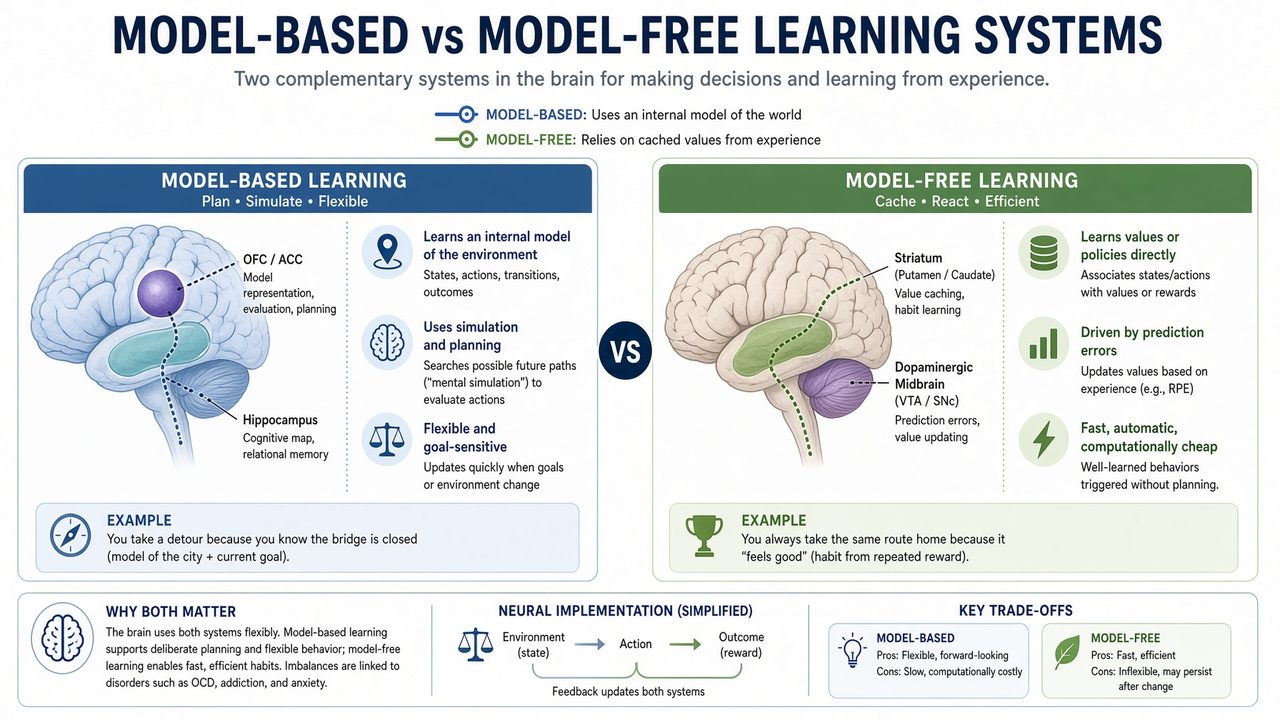
The results suggest that curiosity activates dopamine, which enhances hippocampal learning, much like the effect of reward.
Types of curiosity
- Epistemic curiosity: the desire for knowledge, as in wanting to know the answer to a puzzle
- Perceptual curiosity: attraction to novel stimuli
- Diversive versus specific curiosity: a broad search for stimulation versus targeted pursuit of a particular gap
- Interpersonal curiosity: interest in others' thoughts and feelings
The information gap
George Loewenstein proposed that curiosity arises when we perceive a gap between what we know and what we want to know. It is strongest when we know a little, and have some confidence that we can fill the gap. A teaser, a cliffhanger or a puzzle exploits this principle. Studies by Jacqueline Gottlieb and others show that people and animals value information itself, and that dopamine neurons respond to cues that predict information, much as they do for rewards.
Curiosity and novelty
Novel stimuli activate the substantia nigra and ventral tegmental area, and the hippocampus. Researchers describe a "hippocampal-VTA loop" in which novelty encourages dopamine release, promoting memory formation. This is one reason new environments and experiences are memorable.
Individual differences
Trait curiosity varies and is moderately stable, but state curiosity can be raised. Anxiety dampens exploration, and a safe environment encourages it. Curiosity tends to decline with age on some measures, but remains available and is associated with better outcomes in later life, including cognitive performance and wellbeing.
Curiosity in education
- Students who are curious perform better in school, even after accounting for intelligence and self-control, according to a meta-analysis.
- Questions before lessons can prime curiosity and improve learning.
- Autonomy in choosing what to explore enhances engagement.
- Surprise and puzzles prompt exploration.
Cultivating curiosity
- Ask questions, and write down things you wonder about.
- Embrace "I don't know" as a starting point.
- Make predictions before learning, then check them.
- Seek novelty: travel, new routes, new hobbies, and conversations with people different from yourself.
- Follow tangents when time allows.
- Learn the basics of an area, since a little knowledge creates gaps that invite exploration.
- Create a safe environment for questions, for children and adults.
- Limit distractions and compulsive scrolling, which provide shallow novelty without depth.
- Reflect and share discoveries with others.
Curiosity and wellbeing
Higher curiosity is associated with greater life satisfaction, social closeness and resilience. It also promotes openness to different viewpoints.
Takeaway
Curiosity is a brain state that makes learning easier. Nurturing it, in yourself and in those you teach, may be one of the most effective ways to learn.
Further reading from authoritative sources
- National Institute of Neurological Disorders and Stroke (NINDS)
- National Center for Complementary and Integrative Health (NCCIH)
This article is educational and does not replace advice from a licensed clinician. See the medical disclaimer. Looking for specialist care? Browse the neurology clinic directory.