Flashbulb Memories: Are They as Accurate as We Think?
Where were you when you heard about a major news event, a personal tragedy or a historic moment? Many people say they remember such moments in photographic detail. These are called flashbulb memories, and research reveals an important twist: they are vivid and confident, but not necessarily accurate.
Origin of the idea
In 1977, Roger Brown and James Kulik coined the term, proposing that surprising, consequential events trigger a special "now print" mechanism that creates detailed, lasting records. They studied memories of events such as the assassination of President Kennedy and observed that people could describe where they were and what they were doing.
What the research found
Later studies tested accuracy rather than relying on confidence:
- Challenger explosion (1986): Ulric Neisser and Nicole Harsch asked students to write accounts the day after the disaster, then again two and a half years later. Many gave very different accounts, some wrong in key details, yet were highly confident, and when shown their original reports, some insisted that their new memory was correct.
- September 11, 2001: Large studies, including one led by William Hirst, followed thousands of Americans over the following decade. Consistency of details about the event itself declined over time, mostly in the first year, then leveled off, while confidence and vividness stayed high. Personal circumstances, such as where people were, were generally recalled more consistently than details about the event.
- Other events, such as the death of Princess Diana, a verdict in a famous trial, and sports results, show similar patterns.

Why they feel so real
- Emotion and arousal activate the amygdala, which enhances the vividness and the feeling of recollection.
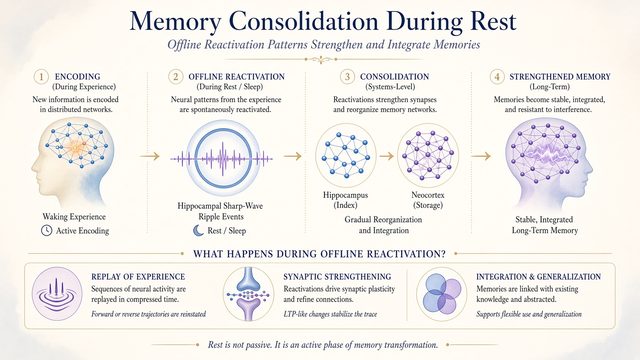
- Rehearsal: people retell the story and see media coverage repeatedly, which can strengthen the story and also reshape it.
- Narrative construction: the brain fills gaps with plausible details.
- Source confusion: details from later conversations or news may be integrated into the original memory.
- Confidence is based on vividness, not on accuracy. Subjective feelings of "reliving" are not reliable signals of correctness.
Are they special at all?
Researchers debate whether flashbulb memories are a distinct category. The current consensus is that they are produced by ordinary memory processes, enhanced by emotion, importance and rehearsal. They are better remembered than typical events in terms of the gist and the sense of vividness, but they are subject to the same distortion and forgetting as other memories. Some studies show that central details, such as the fact that the event occurred and who was involved, are retained more accurately than peripheral ones.
Implications
- Eyewitness testimony: confident, emotional witnesses can still be mistaken, which is why courts and investigators attempt to collect accounts early and avoid leading questions.
- Trauma memory: vividness does not guarantee accuracy, though the core of a traumatic event may be well remembered.
- Personal disputes: two people can recall an emotional event differently and each be sincere.
- History and journalism: contemporaneous records are more reliable than later recollection.
What you can do
- Write down important events soon after they happen, including notes, photos and messages.
- Check details against external records when accuracy matters.
- Treat confidence as a poor guide to accuracy, in yourself and others.
- Be generous in disagreements, since memories change without any deception.
- Avoid pressuring others to confirm a story, since pressure can introduce errors.
Takeaway
Flashbulb memories capture something real, usually the gist and the emotional impact, but not a photographic record. Feeling certain is not the same as being right.
Further reading from authoritative sources
- National Institute of Neurological Disorders and Stroke (NINDS)
- National Center for Complementary and Integrative Health (NCCIH)
This article is educational and does not replace advice from a licensed clinician. See the medical disclaimer. Looking for specialist care? Browse the neurology clinic directory.