How Children's Brains Learn: Developmental Cognitive Neuroscience
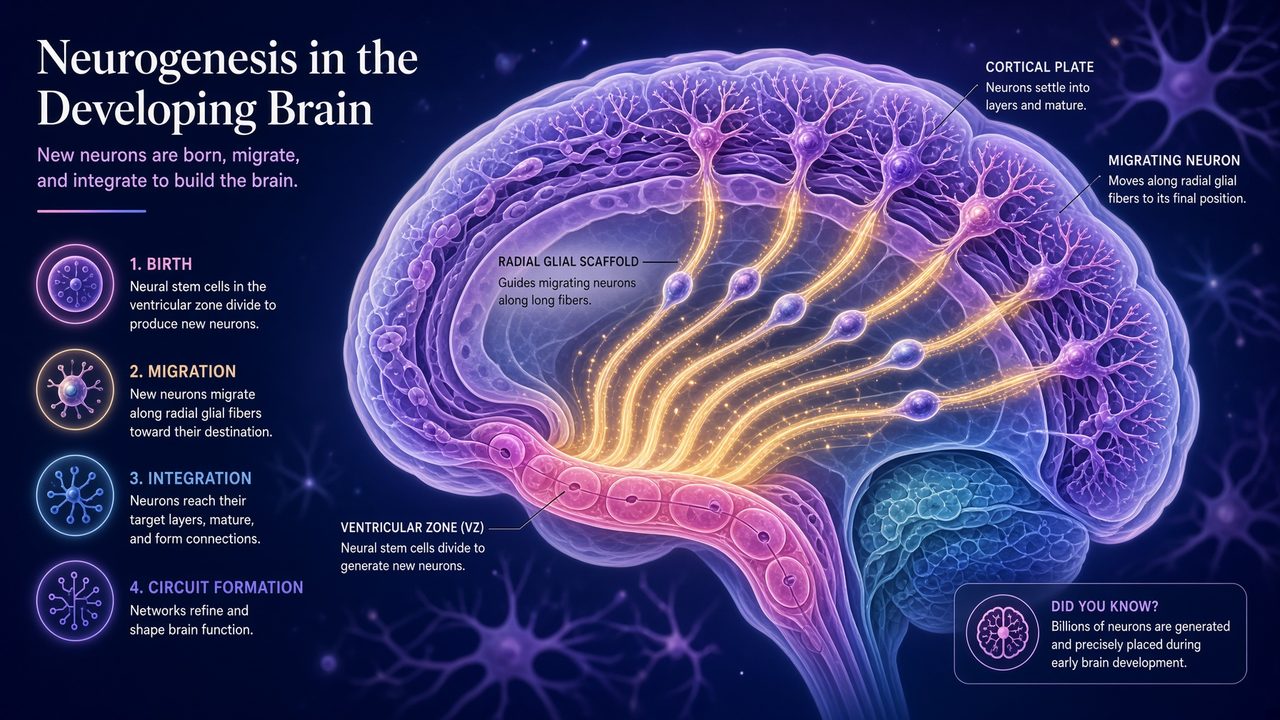
The brain of a child is not a small adult brain. It is a system under construction, with sensitive periods, rapid growth and refinement guided by experience. Developmental cognitive neuroscience reveals how children learn and how adults can support them.
Growth and refinement
- Prenatal period: neurons are generated at an astonishing rate, up to hundreds of thousands per minute, and migrate to their positions.
- Infancy: synapses are produced in abundance. By age two or three, a child has more synapses than an adult.
- Childhood and adolescence: synaptic pruning eliminates less-used connections, refining circuits, while myelination speeds communication. Gray matter volume peaks in childhood, depending on region, and declines through adolescence.
- Sequence: sensory and motor areas mature first, then language and spatial areas, and the prefrontal cortex last, into the mid-twenties.
The total brain size reaches about 90 percent of adult size by age five, but connectivity and function continue to develop.
Sensitive periods
Certain abilities are especially easy to acquire at particular ages. Examples include:
- Vision: normal visual input in the first years is needed for development, and untreated amblyopia can cause lasting impairment.
- Language: exposure to speech and language in the early years matters, and children deprived of language show lasting difficulties.
- Attachment and social learning: responsive caregiving supports emotional regulation.
Researchers favor the term "sensitive period" over "critical period," since many abilities remain plastic, though with more effort, later in life.

Experience shapes the brain
- Serve and return interactions: back-and-forth exchanges between child and caregiver build neural circuits for language and social skills, a concept emphasized by Harvard's Center on the Developing Child.
- Language exposure: the amount and quality of conversational turns predict vocabulary growth.
- Enrichment versus deprivation: studies of children raised in severely deprived institutions, such as the Bucharest Early Intervention Project, found that moving children to foster families earlier produced better cognitive and emotional outcomes.
- Stress: toxic stress from chronic adversity without supportive adults can alter stress systems and prefrontal and hippocampal development. Positive relationships buffer these effects.
How children learn best
- Play: play is a primary way children explore, practice skills and develop executive function.
- Active, curious exploration: children learn more from exploring than from passive listening.
- Repetition and routine: repeated experiences consolidate learning.
- Sleep: young children need considerable sleep for memory consolidation and brain growth.
- Movement and exercise support attention and learning.
- Social learning: children learn from watching and interacting with people, more than from screens.
- Reading together: shared book reading builds language and bonding.
Screens
Evidence suggests that high levels of passive screen time in early childhood are associated with poorer language and attention outcomes, while interactive, high-quality content used with caregivers can be beneficial. Pediatric guidelines recommend limiting screen time for young children and prioritizing sleep and face-to-face interaction.
Adolescence
The adolescent brain is undergoing major remodeling. Reward systems become highly responsive while prefrontal control is still developing, which contributes to risk-taking and novelty seeking, and also to a window of heightened learning and social sensitivity.
Supporting development
- Talk, sing and read with children from birth.
- Provide responsive, warm caregiving.
- Allow free play and outdoor time.
- Ensure good nutrition and sleep.
- Seek early evaluation for concerns about hearing, vision, language or development, since early intervention is effective.
- Reduce exposure to chronic stress and provide supportive relationships.
Takeaway
Children's brains are remarkably receptive. Everyday interactions, from conversation to play to a good night's sleep, are the building blocks of lifelong learning.
Further reading from authoritative sources
- National Institute of Neurological Disorders and Stroke (NINDS)
- National Center for Complementary and Integrative Health (NCCIH)
This article is educational and does not replace advice from a licensed clinician. See the medical disclaimer. Looking for specialist care? Browse the neurology clinic directory.