How the Brain Learns from Mistakes
Mistakes sting, but they are among the most valuable learning signals the brain receives. A dedicated error-monitoring system flags when outcomes differ from expectations and drives adaptation, if we let it.
Prediction errors
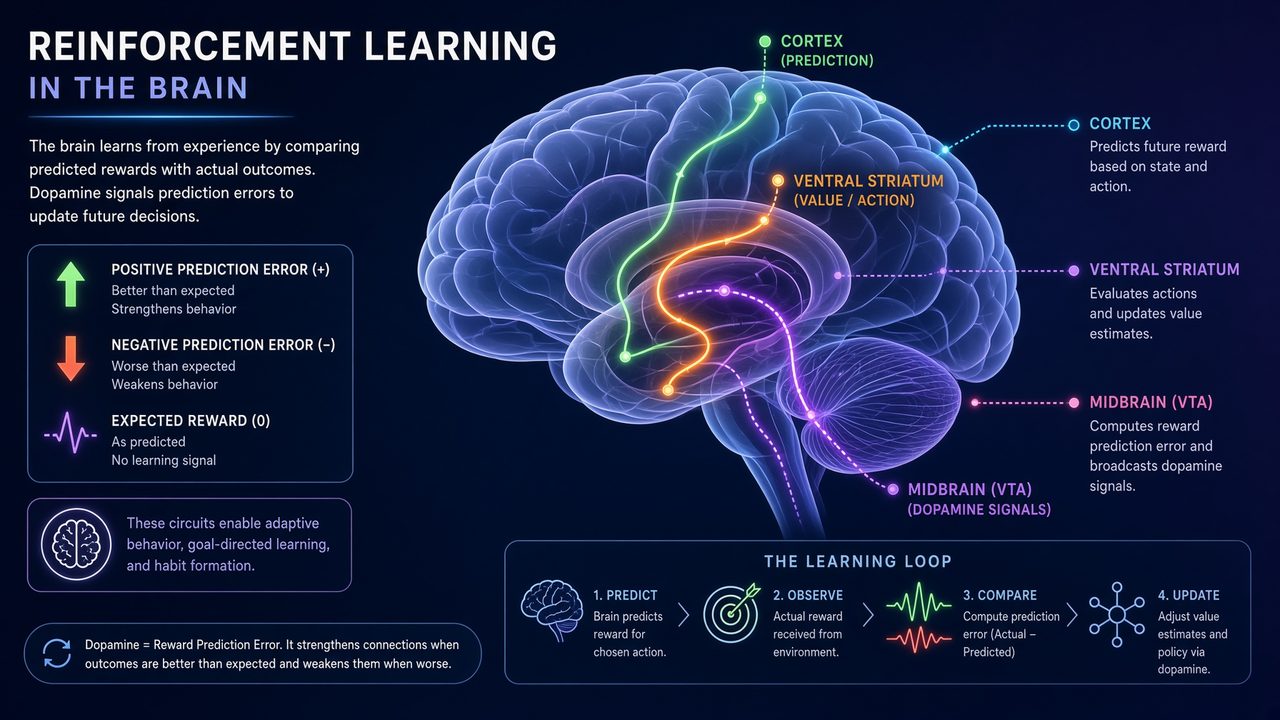
The brain constantly predicts what will happen. When reality differs, a prediction error is generated. Dopamine neurons in the midbrain fire when outcomes are better than predicted, and dip when they are worse, updating the value of actions in the striatum and prefrontal cortex. Cerebellar circuits similarly learn from motor errors, which is why people adapt to wearing prism goggles that shift their vision.
The anterior cingulate and error detection
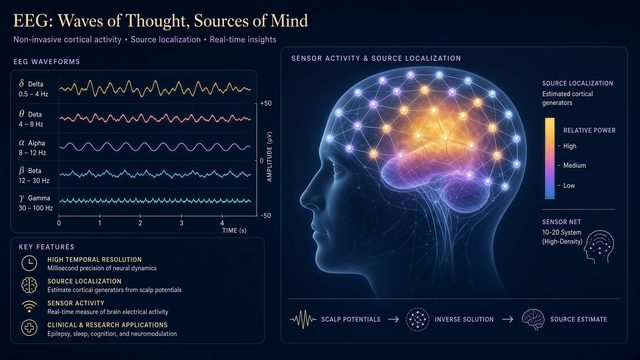
When a person makes an error, EEG records an error-related negativity (ERN), a sharp negative deflection generated mainly in the anterior cingulate cortex, within 100 milliseconds of the response, often before the person is even consciously aware of the mistake. A slightly later signal, the error positivity, is related to conscious awareness of error. After an error, people typically slow down, a phenomenon called post-error slowing, as the prefrontal cortex increases control. The ACC signals the need for adjustment, and the lateral prefrontal cortex implements it.

Learning from feedback
- Reinforcement learning: actions are adjusted based on whether outcomes are better or worse than expected.
- Hippocampal contribution: episodic memory for specific mistakes helps avoid repeats.
- Insula and amygdala: these regions give emotional weight to errors.
- Surprising errors produce stronger learning, especially when you were highly confident. Studies of the hypercorrection effect show that errors made with high confidence are more likely to be corrected when feedback is given.
Mindset matters
Jason Moser and Carol Dweck's research found that people with a growth mindset, who believe abilities can improve, showed a larger error positivity and improved accuracy after errors, suggesting more attention to mistakes. Those with a fixed mindset showed less engagement with errors. Anxiety, perfectionism and shame can interfere with learning by pushing attention toward self-criticism, leading to avoidance, a pattern linked with heightened ACC and amygdala reactivity.
When errors are costly
In high-stakes settings such as medicine or aviation, a culture of psychological safety, in which people can report errors without punishment, improves learning, as studies by Amy Edmondson have shown. Checklists and debriefs reduce repeated mistakes.
Errorful learning
Making errors can actually enhance learning in some situations:
- Pretesting: attempting to answer questions before learning, even guessing incorrectly, improves later retention of the correct answer.
- Retrieval practice with feedback is more effective than re-reading.
- Productive failure: attempting problems before receiving instruction can deepen understanding in math and science.
Errors are not helpful without feedback or if they are repeated and rehearsed.
Learning from mistakes in practice
- Notice the error without harsh self-judgment.
- Seek feedback promptly, so the brain can link action and outcome.
- Analyze the cause: was it knowledge, attention, strategy or stress?
- Make a plan to try again, ideally soon.
- Review mistakes periodically, keeping an error log for studying.
- Treat mistakes as information and talk to yourself as you would a good friend.
- For children: praise effort and strategy, and model calm responses to your own errors.
- Take breaks when overly frustrated, since stress impairs learning.
Disorders and error processing
Altered error monitoring is observed in anxiety (heightened), OCD (heightened), ADHD, schizophrenia and addiction (reduced), and is an area of active research as a marker.
Takeaway
Your brain is wired to notice mistakes and learn from them. With the right mindset and feedback, errors become some of the best teachers you have.
Further reading from authoritative sources
- National Institute of Neurological Disorders and Stroke (NINDS)
- National Center for Complementary and Integrative Health (NCCIH)
This article is educational and does not replace advice from a licensed clinician. See the medical disclaimer. Looking for specialist care? Browse the neurology clinic directory.