How the Brain Learns Motor Skills
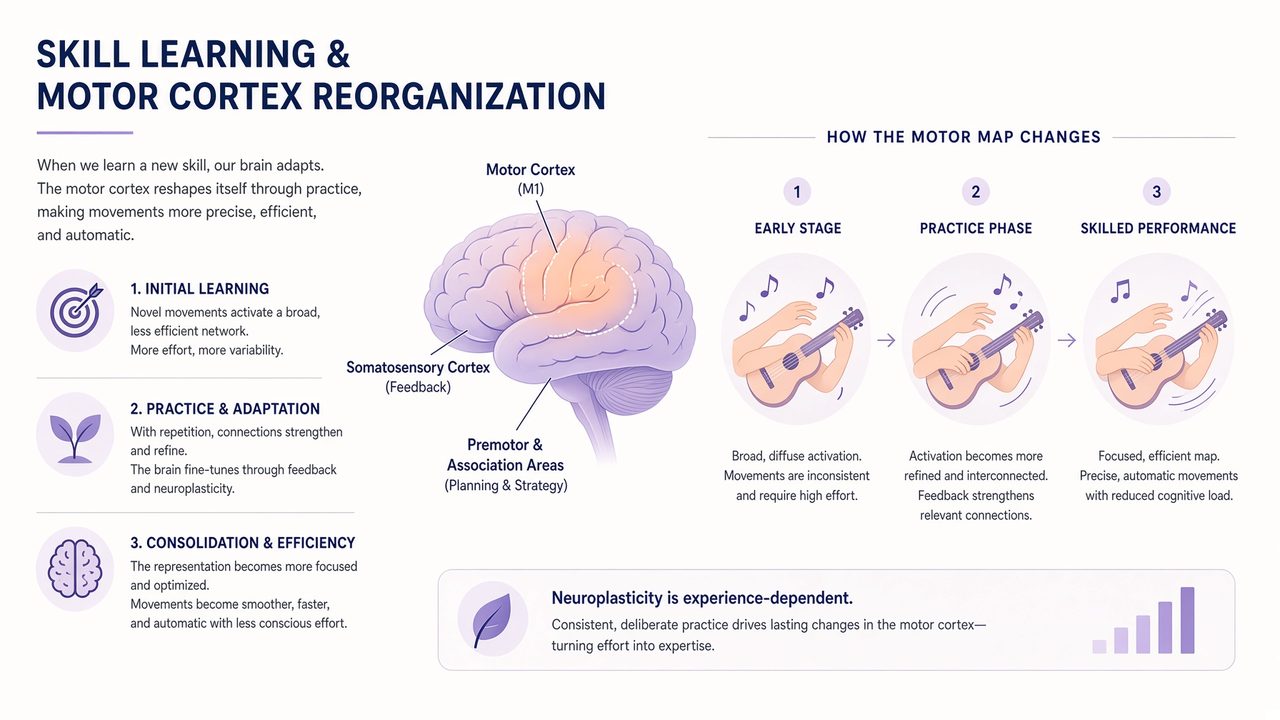
Learning to tie your shoes, type, swim or play the violin all start awkwardly and, with practice, become smooth and automatic. Motor learning engages a distributed network and unfolds in stages, with clear principles that can guide practice.
Stages of motor learning
Paul Fitts and Michael Posner described three stages:
1. Cognitive stage: the learner figures out what to do, requiring attention and instructions. Performance is variable and errors are frequent. The prefrontal cortex and hippocampus are heavily involved. 2. Associative stage: movements are refined, errors decrease, and the learner links actions with sensory feedback. 3. Autonomous stage: performance becomes smooth and automatic, requiring little conscious attention. Control shifts toward the striatum, cerebellum and motor cortex.
Brain networks
- Motor cortex (M1) and premotor areas: representations expand and refine with practice.
- Cerebellum: supports error-based learning by comparing predicted and actual sensory outcomes and adjusting future movements. It is important for adaptation, such as when learning to throw while wearing prism goggles.
- Basal ganglia: support reinforcement learning, the selection and sequencing of successful actions, and habit formation.
- Parietal cortex: integrates spatial and sensory information.
- Sensory feedback pathways: proprioception and vision inform adjustments.

Adaptation versus skill learning
Motor adaptation involves recalibrating an existing movement to changed conditions, such as walking on a slippery floor, and depends heavily on the cerebellum. Skill learning involves improving speed and accuracy beyond baseline, or acquiring a new pattern, with substantial contributions from the motor cortex and basal ganglia.
Consolidation and sleep
After practice, skills undergo consolidation. Sleep, particularly stage 2 non-REM sleep with spindles, boosts performance on motor sequence tasks, as shown by Matthew Walker and others. Even without sleep, a period of several hours stabilizes the skill against interference. Practicing a competing skill soon after learning can disrupt the first.
Principles of effective practice
- Provide feedback: knowledge of results and knowledge of performance, such as video, help error correction. Too much feedback, however, can make learners dependent on it. Reduced or delayed feedback can promote retention.
- Vary practice: random or varied practice leads to better retention and transfer than blocked practice, even though it makes initial performance worse.
- Distribute practice: spaced sessions beat massed practice.
- Whole versus part practice: complex skills benefit from practicing parts, and then integrating them.
- Mental practice: imagining movements activates motor circuits and supplements physical practice.
- External focus of attention: focusing on the effect of the movement, such as the target, leads to better performance than focusing on body movements, as Gabriele Wulf has shown.
- Errorless versus error-based learning: errors are informative when feedback is clear, though too many errors can discourage learners.
- Sleep: schedule practice before sleep when possible.
- Motivation and reward: rewards enhance retention, and a sense of autonomy supports learning.
- Overlearning helps solidify skills, particularly for high-stakes situations.
Plasticity and age
Children learn motor skills readily, but adults and older adults can learn too, albeit more slowly. Older adults benefit from longer practice, clear instructions and feedback.
Disorders and rehabilitation
- Parkinson's disease: impaired automatic movement and sequence learning, helped by external cues such as rhythmic sounds
- Cerebellar damage: impaired adaptation and coordination
- Stroke: relearning relies on the same mechanisms.
- Developmental coordination disorder: difficulty learning motor skills, with support from occupational therapy.
- Focal dystonia: maladaptive plasticity in task-specific movements.
Takeaway
Motor learning relies on a team of brain regions, shaped by practice, feedback and sleep. Understanding these principles helps you practice more efficiently.
Further reading from authoritative sources
- National Institute of Neurological Disorders and Stroke (NINDS)
- National Center for Complementary and Integrative Health (NCCIH)
This article is educational and does not replace advice from a licensed clinician. See the medical disclaimer. Looking for specialist care? Browse the neurology clinic directory.