Math in the Brain: Numerical Cognition Explained
Humans and many animals share a basic sense of quantity. Building on this ancient system, children learn symbols, arithmetic and eventually abstract mathematics. Neuroscientists have mapped how the brain represents number and how this system can go wrong.
The approximate number system
Infants only a few days old respond to changes in numerosity, and so do monkeys, birds and fish. This approximate number system (ANS) estimates quantities without counting, and its precision obeys Weber's law: it is easier to tell 10 from 20 than 50 from 60. Neurons that respond to specific quantities have been found in the parietal and prefrontal cortex of monkeys. In people, the intraparietal sulcus is consistently active during tasks involving magnitude, whether the number is shown as dots, digits or words.
Exact numbers and symbols
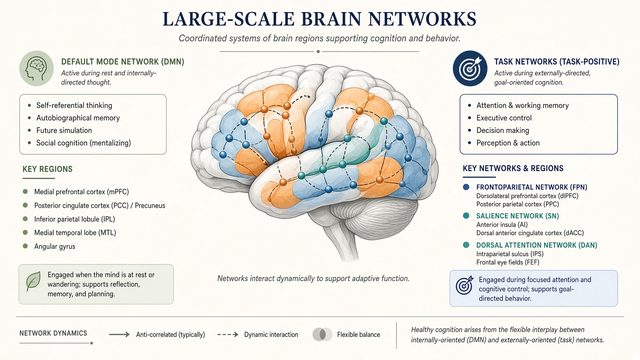
Learning number words and digits connects the approximate system to exact, symbolic representations. Counting principles develop in early childhood, and many cultures with limited number words show that exact large-number concepts depend on cultural tools such as language. Researchers like Stanislas Dehaene have proposed a "triple-code model" with regions for:
- Quantity (parietal): the meaning of numbers
- Verbal (left angular gyrus and language areas): facts like multiplication tables recalled as verbal sequences
- Visual (fusiform and occipital): recognizing digits

Mental arithmetic
Different operations use different strategies. Subtraction and complex calculation rely heavily on quantity manipulation in the intraparietal sulcus, while memorized multiplication facts depend more on language regions. As children become skilled, they shift from effortful counting that engages the prefrontal cortex and hippocampus to fast, fact-based retrieval from the temporal lobe. Working memory and attention in frontal regions are essential for multi-step problems.
The mental number line
People tend to represent numbers along a spatial line, small on the left and large on the right in cultures that read left to right, the SNARC effect. Parietal circuits shared with spatial attention support this. Finger counting also shapes how number is represented in the brain.
Dyscalculia
Developmental dyscalculia affects an estimated 3 to 7 percent of people and involves persistent difficulty with number sense, arithmetic facts and calculation. Studies find atypical activation and structure in the intraparietal sulcus, though the picture is complex, and difficulties may also relate to working memory or attention. Support includes explicit teaching, visual representations, practice with number relationships and accommodations.
Math anxiety
Fear of math is common and can disrupt performance by consuming working memory. Brain imaging shows that math-anxious people exhibit heightened activity in threat-related regions such as the amygdala when anticipating math, and reduced activation in regions for problem solving. Interventions such as expressive writing about worries before tests, reappraisal of anxiety as excitement, and building confidence through success can help.
Building math skills
- Play with numbers early: board games with number lines improve children's numerical knowledge.
- Talk about quantity in daily life, such as comparing amounts and measuring.
- Practice retrieval of basic facts, through spaced, varied practice.
- Use multiple representations, including objects, diagrams and symbols.
- Emphasize understanding as well as procedure.
- Encourage a growth mindset while recognizing that skill builds with practice.
- Interleave problem types and review regularly.
- Seek evaluation if a child struggles persistently, since early intervention matters.
Takeaway
Mathematics builds on a shared biological sense of number. Strengthening that foundation, and supporting emotional confidence, helps learners at every level.
Further reading from authoritative sources
- National Institute of Neurological Disorders and Stroke (NINDS)
- National Center for Complementary and Integrative Health (NCCIH)
This article is educational and does not replace advice from a licensed clinician. See the medical disclaimer. Looking for specialist care? Browse the neurology clinic directory.