Memory Consolidation During REM Sleep
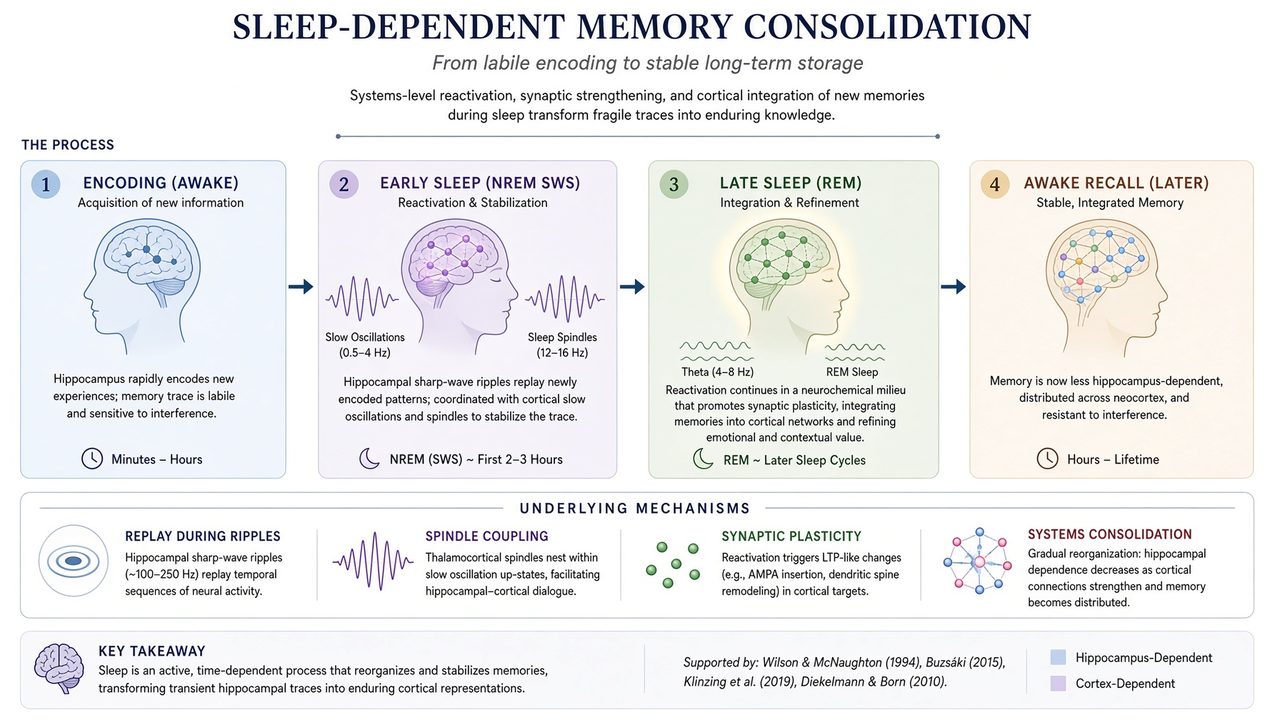
Rapid eye movement (REM) sleep, the stage most associated with vivid dreams, plays a distinct role in memory. While slow-wave sleep helps stabilize new facts, REM appears to support emotional processing, integration of information and creative problem solving.
What REM sleep is
REM sleep occurs in cycles through the night, with longer periods in the later hours. The brain is highly active, resembling wakefulness on EEG, while the body's muscles are paralyzed, through brainstem circuits, to prevent acting out dreams. Acetylcholine levels are high, while norepinephrine and serotonin are low. Theta rhythms are prominent in the hippocampus. Adults spend about 20 to 25 percent of sleep in REM, and infants much more.
Evidence for a role in memory
- Procedural and perceptual learning: studies by Avi Karni and colleagues found that selectively depriving people of REM sleep prevented overnight improvement on a visual texture discrimination task, while depriving them of slow-wave sleep did not. Other studies find that both stages contribute in sequence.
- Emotional memory: REM sleep is associated with enhanced retention of emotional material relative to neutral material. Matthew Walker has proposed the "sleep to forget and sleep to remember" hypothesis, in which REM, with low noradrenaline, reprocesses emotional memories and reduces their affective charge, a process he describes as overnight therapy. Findings are mixed, and some studies show that sleep preserves rather than diminishes emotional intensity.
- Insight and creativity: Denise Cai and colleagues found that participants who had REM sleep during a nap performed better on the Remote Associates Test, which taps creative problem solving, than those who had quiet rest or non-REM sleep. REM may promote linking of distantly related information.
- Abstraction and gist: REM may help extract general rules from specific examples.
- Animal studies: disrupting hippocampal theta during REM impaired contextual fear memory consolidation in mice.

The sequential hypothesis
The sequential hypothesis proposes that slow-wave sleep stabilizes and strengthens memories, and subsequent REM sleep integrates them with existing knowledge and prunes or refines connections. A whole night of cycles, therefore, benefits memory more than fragments.
Dreams and memory
Dreams incorporate fragments of recent experiences, often with a delay of several days, called the dream-lag effect, and they blend them with older memories in unusual combinations. A study showed that people who dreamed about a maze task they had learned improved more than those who did not. Whether dreams are part of the consolidation process, or an epiphenomenon, is unknown.
Caveats and debates
- People who take antidepressants that strongly suppress REM sleep, such as some SSRIs, or who have brainstem lesions that abolish REM, do not show clear memory deficits, which raises questions about how essential REM is for declarative memory.
- Many studies are small and findings vary with task type and measurement.
- It is difficult to separate effects of REM sleep from other changes in sleep and from circadian influences.
The consensus is that REM contributes, particularly to emotional, procedural and integrative aspects, but the details and strength of effects are still being clarified.
Disorders involving REM
- REM sleep behavior disorder: loss of muscle paralysis, leading to acting out dreams. It is a strong early marker of later Parkinson's disease, Lewy body dementia or multiple system atrophy, and requires medical evaluation.
- Narcolepsy: abnormal REM intrusions.
- PTSD and depression: altered REM sleep patterns, and nightmares.
- Sleep apnea: disrupts REM, with potential impacts.
Protecting REM sleep
- Get enough total sleep, since REM is concentrated in the last third of the night, and cutting sleep short by two hours can sacrifice a large portion of it.
- Keep a regular schedule.
- Limit alcohol, which suppresses REM early in the night and fragments sleep later.
- Be aware of medications that can reduce REM, including some antidepressants, and discuss concerns with your clinician instead of stopping them.
- Treat sleep apnea.
- Manage stress, since high stress can lead to fragmented sleep.
- Avoid late caffeine and heavy late-night meals.
Takeaway
REM sleep is the brain's late-night workshop for emotion and integration. Protecting a full night of sleep gives it the time it needs.
Further reading from authoritative sources
- National Institute of Neurological Disorders and Stroke (NINDS)
- National Center for Complementary and Integrative Health (NCCIH)
This article is educational and does not replace advice from a licensed clinician. See the medical disclaimer. Looking for specialist care? Browse the neurology clinic directory.