The Role of Emotion in Memory: Why Feelings Stick
You may not remember what you ate last Tuesday, but you probably remember your first kiss, or the day you got terrible news. Emotionally significant events leave stronger memories than ordinary ones, and the brain has dedicated machinery for this.
The amygdala-hippocampus partnership
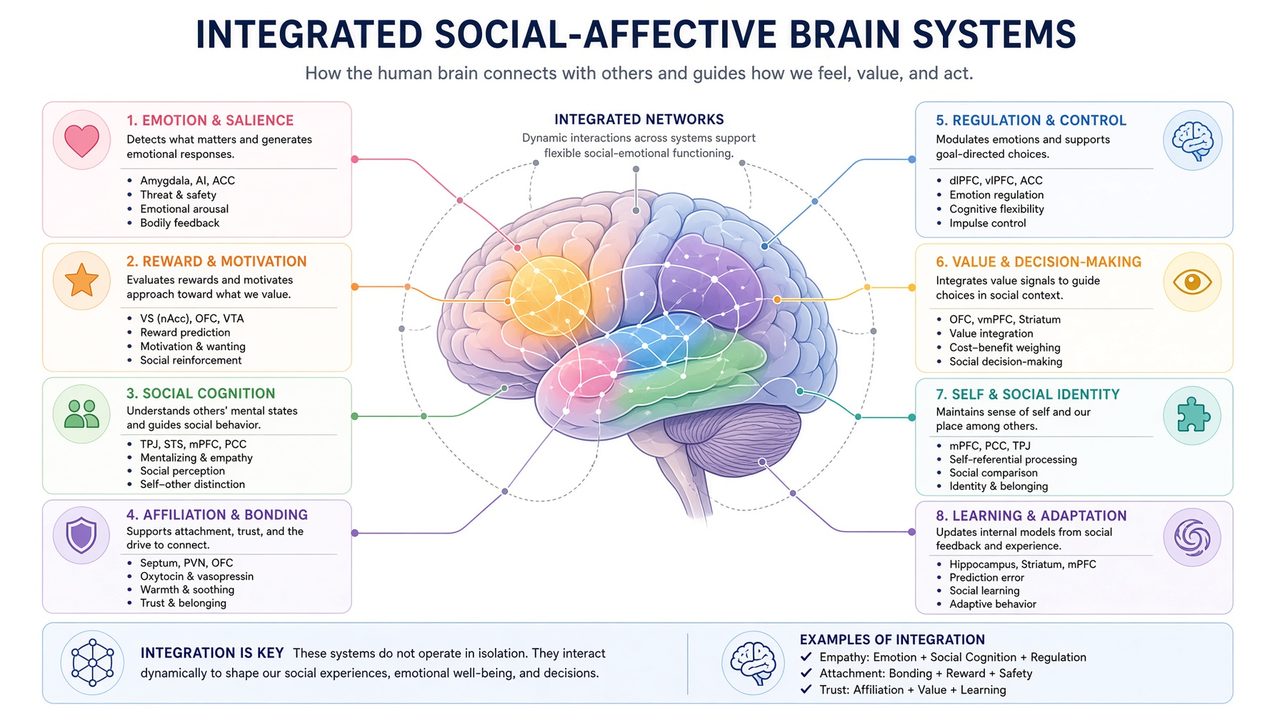
The amygdala, an almond-shaped cluster of nuclei in the temporal lobe, evaluates the emotional significance of events. When it is activated by arousing stimuli, it signals the hippocampus and other regions to strengthen consolidation. Patients with amygdala damage typically do not show the usual advantage for emotional stories over neutral ones, while their memory for neutral material remains relatively normal. Imaging studies by Larry Cahill and others found that activity in the amygdala during viewing of emotional pictures predicts how well they are remembered weeks later.
Hormones and neurotransmitters
Arousing events release adrenaline and noradrenaline, and cortisol follows. These act on the amygdala to boost consolidation. In experiments, blocking noradrenaline receptors with beta-blockers such as propranolol reduces the memory advantage of emotional material, and administering stress hormones after learning can enhance it. Dopamine from reward circuits also supports consolidation of positive and novel events.

What gets remembered better
- The emotional gist or central details of an event, such as the weapon in a robbery, are often remembered well.
- Peripheral details may be remembered less well, a phenomenon called weapon focus or attentional narrowing.
- Negative events tend to be remembered more vividly, though positive events also benefit, and older adults often show a relative preference for positive memories.
- Emotional intensity matters more than whether the emotion is positive or negative.
When emotion distorts memory
Emotional memories feel vivid and certain, but they are not necessarily accurate. People can be confident and wrong about emotional events, as discussed in research on flashbulb memories. Emotions at retrieval also shape recall: when sad, people recall more sad memories, a phenomenon called mood-congruent memory. Memories are also modified each time they are retrieved and reconsolidated, so emotional narratives can drift with retelling.
Emotion and learning
Emotion influences what we attend to and what we rehearse. Material linked to personal meaning or curiosity is better remembered than abstract facts. Teachers use stories, humor and surprise for this reason. However, intense anxiety or distress during learning can interfere.
When emotional memory goes wrong
- Post-traumatic stress disorder: intrusive, vivid memories of trauma, with weak contextual tagging in time and place so that they feel as if happening now. At the same time, voluntary recall of details may be fragmented.
- Anxiety disorders: overgeneralized fear memories
- Depression: biased retrieval of negative memories and difficulty recalling specifics
- Phobias: strong learned associations
Therapeutic approaches
Treatments take advantage of memory reconsolidation and extinction. Exposure therapy creates new safety learning that competes with fear. Trauma-focused cognitive behavioral therapy and EMDR have evidence in PTSD. Researchers are studying whether propranolol or other drugs given around memory reactivation can dampen emotional intensity, with mixed results. Such approaches should be pursued only under professional care.
Using emotion to remember
- Connect new material to something personally meaningful.
- Use vivid imagery, stories and humor.
- Teach or discuss ideas with others, which adds social emotion.
- Take care with high stress, which can undermine learning.
- Be humble about vivid memories, and check important details against records.
Takeaway
Feelings stick because the brain is designed to remember what matters. That design makes memory powerful, though not perfectly reliable.
Further reading from authoritative sources
- National Institute of Neurological Disorders and Stroke (NINDS)
- National Center for Complementary and Integrative Health (NCCIH)
This article is educational and does not replace advice from a licensed clinician. See the medical disclaimer. Looking for specialist care? Browse the neurology clinic directory.