How the Brain Processes Sound: From Ear to Cortex
Hearing seems effortless, yet turning air vibrations into speech, music and a sense of space requires a long chain of processing. Each stage extracts something different, from pitch and loudness to location and meaning.
From vibration to nerve signal
Sound waves enter the ear canal and vibrate the eardrum. Three tiny bones, the malleus, incus and stapes, amplify the vibration and pass it to the cochlea, a fluid-filled spiral. Inside, the basilar membrane vibrates at different places depending on frequency, high pitches near the base and low pitches near the tip. Hair cells on the membrane convert motion into electrical signals, a map called tonotopy that continues through much of the auditory system.
The auditory pathway
1. Auditory nerve carries signals from the cochlea to the brainstem. 2. Cochlear nuclei begin sorting information about timing and intensity. 3. Superior olivary complex compares signals from both ears to determine location, using tiny differences in timing and loudness. 4. Inferior colliculus in the midbrain integrates information and helps with reflexive orienting. 5. Medial geniculate nucleus of the thalamus relays signals to the cortex. 6. Auditory cortex in the temporal lobe analyzes complex features.
Unlike vision, auditory information crosses and recrosses between sides, so each ear projects to both hemispheres.

Cortical processing
The primary auditory cortex on Heschl's gyrus processes basic features such as pitch and loudness. Surrounding belt and parabelt areas respond to more complex features like speech sounds and melodies. Dual streams are proposed: a "what" stream identifies sounds, and a "where" stream localizes them. Speech engages left-hemisphere areas including Wernicke's area, while music perception involves both hemispheres, with the right often stronger for pitch and melody.
Attention and the cocktail party
The brain can focus on one voice among many by enhancing neural responses to the attended speaker. Efferent fibers from the brain even adjust cochlear sensitivity.
Plasticity
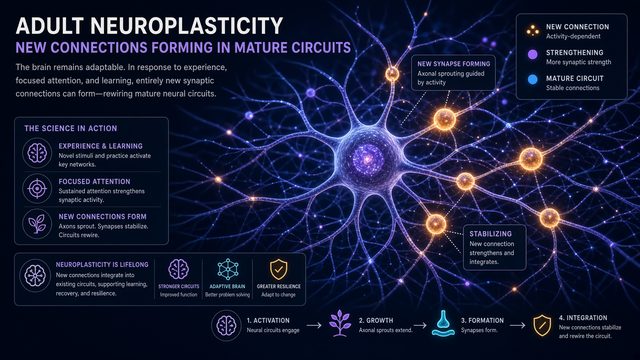
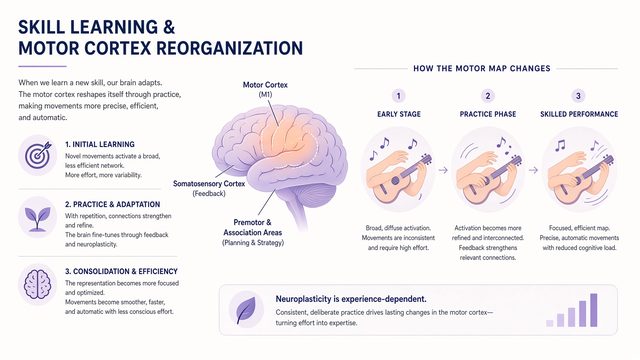
Musicians show enhanced brainstem encoding of sound and larger auditory cortex representations. After hearing loss, cortex can reorganize, and cochlear implant users gradually adapt to new signals through learning.
Disorders
- Sensorineural hearing loss from hair cell or nerve damage, caused by age, noise or ototoxic drugs
- Conductive hearing loss from problems in the outer or middle ear
- Tinnitus, a phantom sound linked to changed activity in auditory and other networks
- Hyperacusis, abnormal sensitivity to sound
- Auditory processing disorder, difficulty interpreting sounds despite normal hearing
- Cortical deafness and auditory agnosia after stroke
- Auditory hallucinations, as in some psychiatric conditions
Hearing and brain health
Large studies link untreated hearing loss with higher risk of cognitive decline, and treating it with hearing aids may help, although causal evidence is still evolving.
Protecting your hearing
- Keep volume moderate and use the 60/60 rule for headphones.
- Wear ear protection around loud noise.
- Get hearing tested if you notice difficulty in noisy places.
- Seek urgent care for sudden hearing loss.
Takeaway
Hearing is an active, layered process. Care for the ear and brain together keeps this essential sense sharp.
Further reading from authoritative sources
This article is educational and does not replace advice from a licensed clinician. See the medical disclaimer. Looking for specialist care? Browse the neurology clinic directory.