Critical Periods in Brain Development
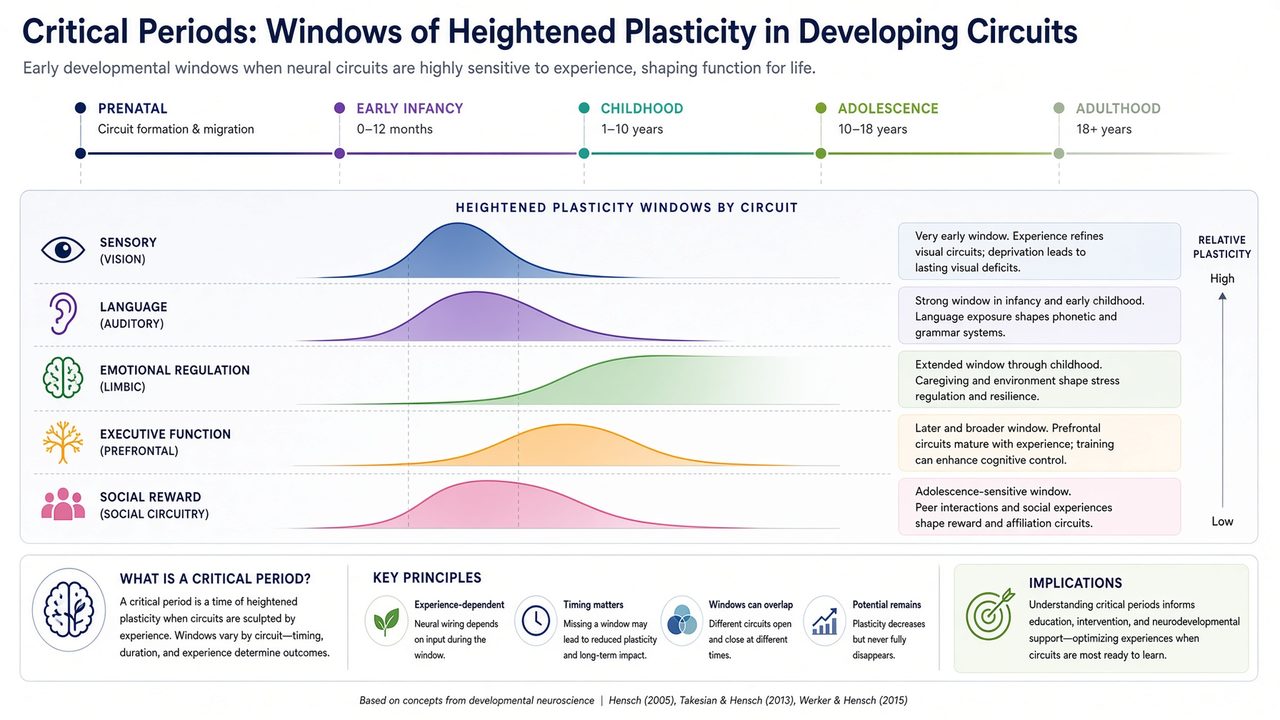
The developing brain is exquisitely sensitive to experience, especially at certain times. These windows, called critical periods or sensitive periods, are times when particular inputs are needed for circuits to form properly. Understanding them highlights the importance of early experience while also revealing how adults can learn.
Vision: the classic example
In the 1960s, David Hubel and Torsten Wiesel closed one eye of kittens and found that visual cortex neurons lost responsiveness to the deprived eye if the closure occurred during an early critical period, with lasting vision loss. In humans, a similar process underlies amblyopia ("lazy eye"). Children with a misaligned eye or cataract need early treatment, such as patching, since the period of greatest plasticity is during the first years of life. Vision can still improve later in some cases, though less readily.
Language
Children exposed to language in early life acquire it effortlessly. Evidence for a sensitive period comes from several sources:
- Children deprived of language show severe, lasting difficulties, as in rare cases of extreme neglect
- Deaf children who receive sign language late show less mastery than those who learn early
- Second language learning is easiest in childhood for accent and grammar, though adults can reach high proficiency, and the picture is more gradual than a sharp cutoff
- Infants begin life able to distinguish sounds of all languages but become attuned to their native sounds by about 10 to 12 months
Hearing and cochlear implants
Children who receive cochlear implants early, ideally in the first couple of years, tend to develop better spoken language than those implanted later, underscoring auditory critical periods.
Emotional and social development
Responsive caregiving in the first years supports attachment and stress regulation. Severe early deprivation, as in institutional care, can affect cognitive, emotional and brain development, and earlier rescue yields better recovery.
Mechanisms: what opens and closes windows
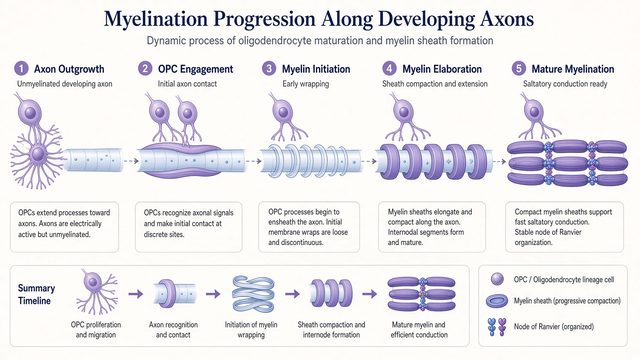
- Inhibitory circuits. Maturation of GABA neurons, particularly parvalbumin interneurons, helps open critical periods.
- Molecular brakes. Structures such as perineuronal nets and myelin-related proteins limit plasticity once the window closes.
- Neuromodulators. Acetylcholine and other chemicals gate plasticity.
- Experience. Sensory input drives the refinement and pruning of synapses.
Reopening plasticity
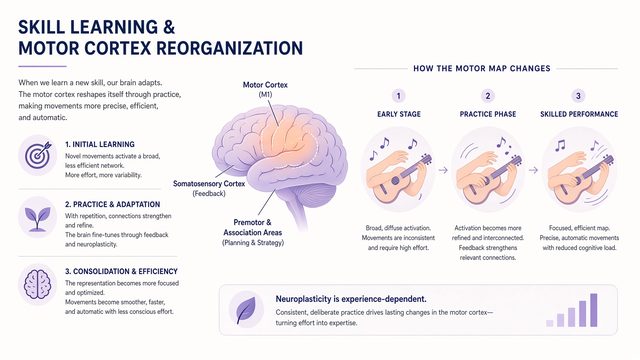
Research in animals shows that critical periods can be reopened by dissolving perineuronal nets, using certain drugs, enriched environments, exercise or fluoxetine. In humans, studies of perceptual learning, video games for amblyopia and psychedelics are early-stage. Adults can recover from stroke and learn new skills, although it often takes more effort and repeated practice.
Brain development timeline
- Sensory areas mature first, followed by language and motor regions
- Prefrontal cortex matures last, into the mid-twenties
- Different abilities have different sensitive periods, and many are more flexible than "critical" implies
Practical implications
- Screen vision and hearing early. Newborn hearing screening and childhood vision checks catch problems while treatable.
- Talk, read and sing to children from birth.
- Provide responsive, stable care.
- Offer varied stimulation appropriate to age, without pressure.
- Seek early intervention for developmental delays, which can make a difference.
- Support children after adversity, since later positive experiences can help.
Myths
The notion that everything is determined by age three is an overstatement. Brains continue to adapt throughout life. Flashcards for infants or expensive "brain-boosting" products are not supported by evidence, while everyday interactions are.
The bottom line
Early life is a time of unusual plasticity, and meeting children's basic needs for care, language and stimulation matters. But the brain stays plastic, so it is never too late to learn and heal.
Further reading from authoritative sources
- National Institute of Mental Health (NIMH)
- National Institute of Neurological Disorders and Stroke (NINDS)
This article is educational and does not replace advice from a licensed clinician. See the medical disclaimer. Looking for specialist care? Browse the neurology clinic directory.