How the Brain Senses Pain: Pathways and Processing
Pain is not simply a signal from damaged tissue. It is a construction of the brain that combines sensory input with emotion, memory and expectation. Understanding the pathways and processing explains why pain can persist without injury or disappear in the heat of a game.
From tissue to spinal cord
Nociceptors, specialized nerve endings in skin, muscle, joints and organs, respond to potentially damaging stimuli: extreme heat or cold, pressure, and chemicals released by injury. Two main fiber types carry signals:
- A-delta fibers, thinly myelinated, carry fast, sharp "first pain."
- C fibers, unmyelinated, carry slower, dull, burning "second pain."
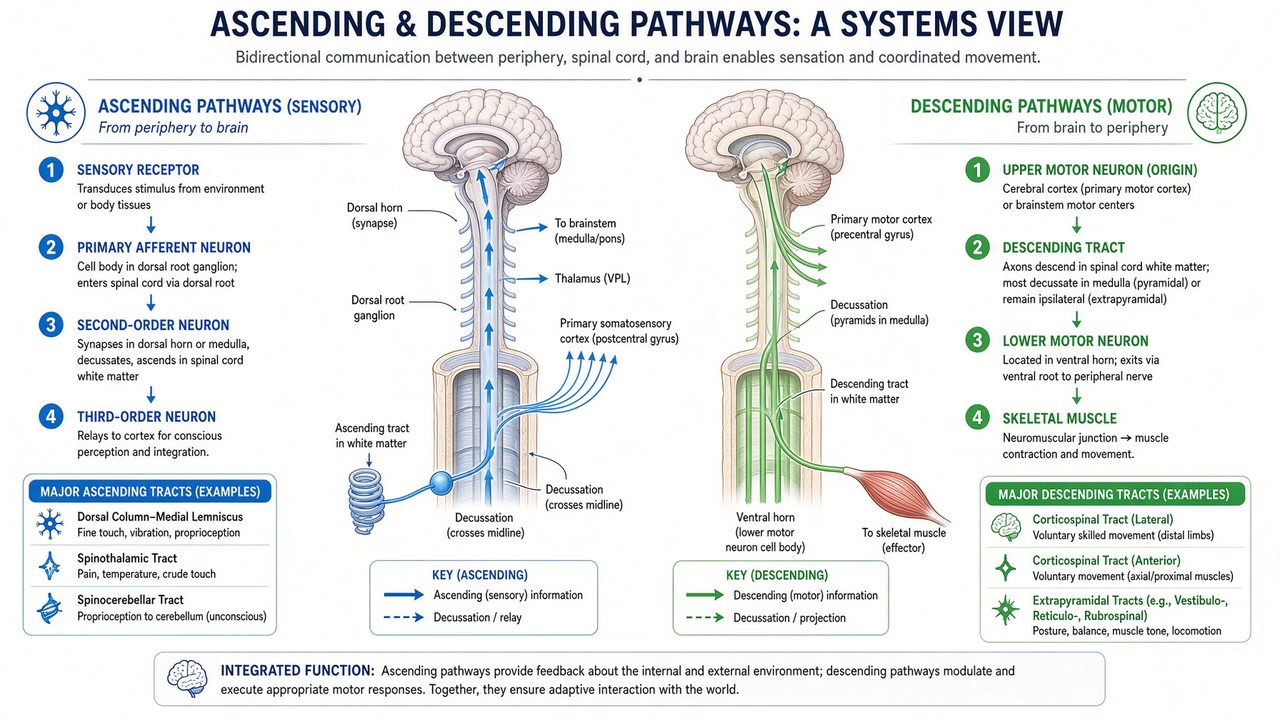
These fibers enter the spinal cord's dorsal horn, where they release glutamate and neuropeptides such as substance P onto second-order neurons. Local interneurons and descending inputs modulate transmission, the basis of the 1965 gate control theory of Melzack and Wall, which explains why rubbing a bumped elbow helps.
Ascending pathways
Second-order neurons cross to the opposite side and ascend in the spinothalamic tract to the thalamus, with branches to the brainstem. Two components have been described:
- Lateral system: to the thalamus and then the primary and secondary somatosensory cortex, encoding location, intensity and quality
- Medial system: to medial thalamus, anterior cingulate cortex, insula and amygdala, encoding unpleasantness and emotional response

The "pain matrix"
Imaging shows that painful stimuli engage somatosensory cortex, insula, anterior cingulate, thalamus, prefrontal cortex and others. These regions also respond to salient non-painful events, so researchers now see them as part of a general salience and threat-response network rather than pain-specific machinery.
Top-down modulation
The brain can suppress pain through a descending pathway from the cortex and hypothalamus to the periaqueductal gray in the midbrain, then to the rostral ventromedial medulla and down to the spinal cord. This system uses endogenous opioids, serotonin and norepinephrine. It explains why athletes or soldiers may not notice injuries at the moment, and underlies the placebo effect, in which expectation of relief activates opioid systems. Conversely, anxiety, attention to the pain and catastrophizing amplify it.
Acute versus chronic pain
Acute pain protects us. Chronic pain, persisting beyond normal healing for about three months, can involve sensitization: peripheral nociceptors become hyper-responsive, spinal neurons undergo LTP-like changes ("wind-up"), and brain networks reorganize so that emotion circuits dominate. Glial cells also contribute, releasing inflammatory signals. Chronic pain frequently coexists with depression, anxiety and sleep problems, which feed back to worsen pain.
Special conditions
- Neuropathic pain arises from nerve damage, as in diabetic neuropathy or shingles.
- Phantom limb pain follows amputation.
- Central pain after stroke or spinal injury.
- Fibromyalgia involves heightened pain processing.
- Congenital insensitivity to pain, due to mutations such as in the SCN9A gene, shows pain's protective role, as people with it suffer repeated injuries.
- Referred pain, such as arm pain during a heart attack, arises from convergence of visceral and body inputs.
Approaches to treatment
- Medications: acetaminophen, NSAIDs, certain antidepressants and anticonvulsants for neuropathic pain, and opioids for selected cases, with considerable risk of dependence
- Physical therapy and exercise, which are among the most effective long-term treatments
- Cognitive behavioral therapy, acceptance and commitment therapy and mindfulness
- Biofeedback and relaxation training
- Neuromodulation: spinal cord stimulation, nerve blocks, TMS
- Sleep and stress management
- Pain neuroscience education, which helps people understand that hurt does not always equal harm
When to seek care
New severe pain, pain with fever, weakness, numbness, bowel or bladder changes, chest pain, or pain after significant trauma requires prompt evaluation.
Takeaway
Pain is an experience created by the brain from many inputs. This explains why mind-body approaches can legitimately help, and why persistent pain deserves comprehensive care.
Further reading from authoritative sources
This article is educational and does not replace advice from a licensed clinician. See the medical disclaimer. Looking for specialist care? Browse the neurology clinic directory.