How the Brain Stores Procedural Memories
Once you learn to ride a bicycle, you rarely forget, even if you have not ridden in decades. This kind of memory, for skills and habits, is called procedural memory. It differs from remembering facts or events, and it relies on a different set of brain structures.
Memory systems
Researchers distinguish declarative (explicit) memory, for facts and events that can be consciously recalled, from nondeclarative (implicit) memory, which includes procedural skills, priming and conditioning. Procedural memory is expressed through performance rather than recollection. You may be unable to explain how you balance on a bike, yet you can do it.
Evidence from amnesia
The patient H.M., who lost the ability to form new declarative memories after hippocampal removal in 1953, could still learn a mirror-tracing task and improved across days, though he did not remember practicing it. This showed that skill learning relies on separate circuits. Similarly, people with Alzheimer's disease often retain the ability to play familiar music or perform practiced routines late in the disease, while those with Parkinson's disease or Huntington's disease have trouble learning new motor sequences despite intact declarative memory.
Key brain regions
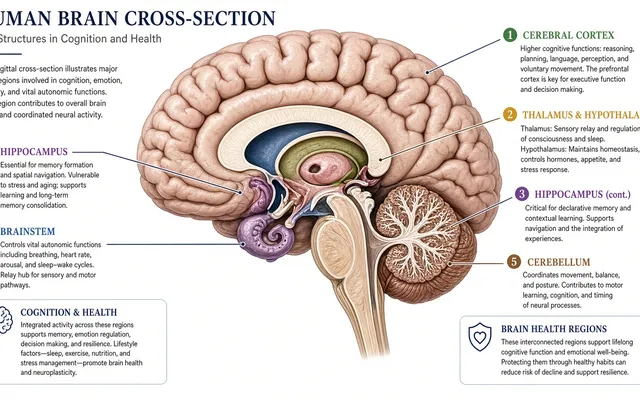
- Basal ganglia (striatum): involved in learning sequences, selecting actions and forming habits, with dopamine signaling reward-based refinement
- Cerebellum: fine-tunes timing and coordination, and learns to correct errors, for example through adaptation to new conditions such as prism goggles
- Motor cortex and premotor areas: representations of movements change with practice, with expanded or refined areas for trained skills
- Supplementary motor area: sequences of movements
- Prefrontal and parietal cortex: important in early learning when attention is required
- Thalamus: links these loops
Stages of skill learning
1. Early (cognitive) stage: performance is slow and effortful, needing attention and drawing on prefrontal and hippocampal systems. 2. Intermediate stage: errors drop, movements smooth out. 3. Late (automatic) stage: performance becomes fluent and requires little attention, with control shifting toward striatal and cerebellar circuits.
Consolidation and sleep
Skills improve not only during practice but also afterward. Studies show that sleep, particularly stage 2 non-REM sleep with its sleep spindles, enhances performance on finger-tapping sequences the next day. Some improvement even occurs after a short period of wakeful rest.
Plasticity at the cellular level
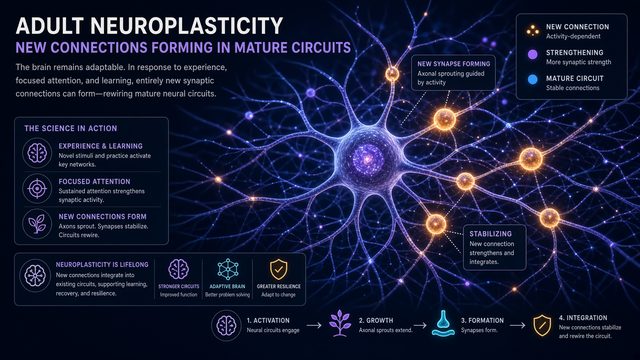
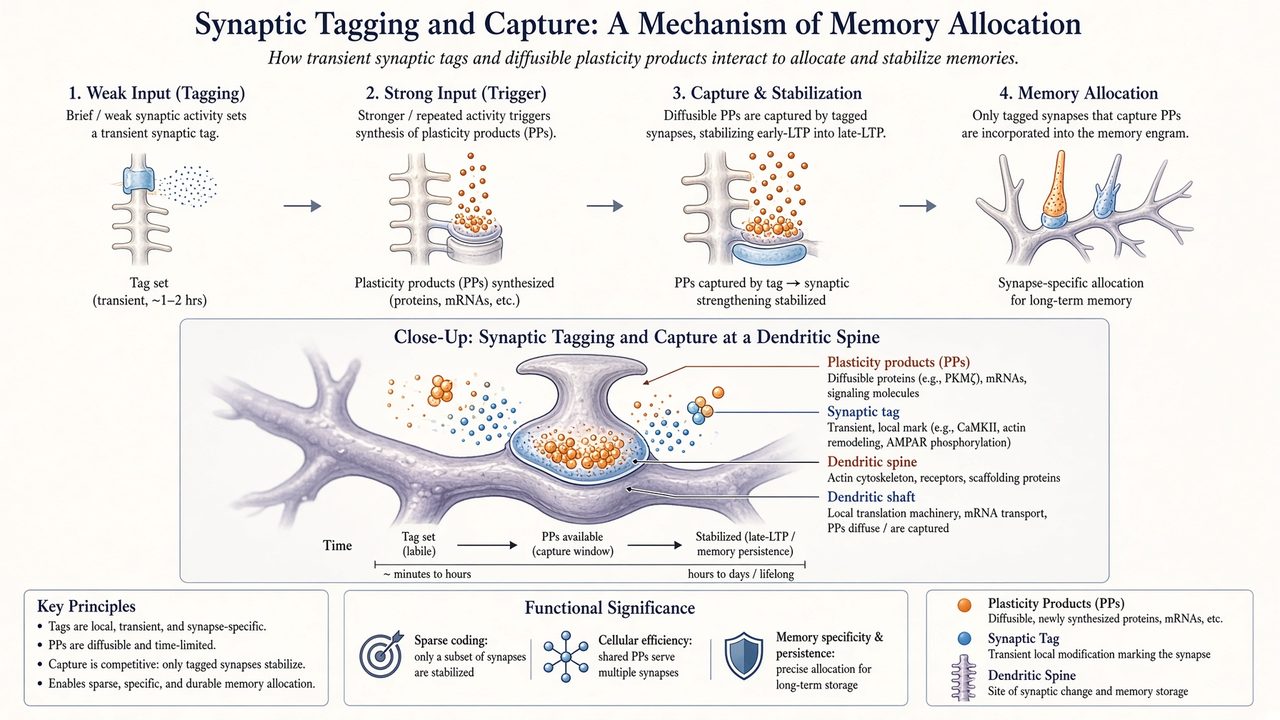
Practice strengthens synapses in motor cortex and striatum, enlarges dendritic spines, and increases myelination in trained pathways. Imaging studies show that regions associated with a practiced skill, such as finger areas in violinists, expand.
How to practice effectively
- Break skills into parts, then combine them.
- Practice in short, focused sessions with breaks rather than one long marathon.
- Use variable practice, such as changing speed or context, which improves transfer even though it feels harder.
- Get feedback, from a coach or recording, since the cerebellum learns from errors.
- Practice mentally as well as physically, as imagery activates motor circuits.
- Sleep well after practicing.
- Stay patient, since automaticity takes weeks to months.
Disorders and rehabilitation
- Parkinson's disease: difficulty with automatic movements. External cues like rhythmic beats or floor lines can bypass the damaged circuits.
- Stroke: repetitive, task-specific therapy harnesses plasticity.
- Cerebellar disease: impaired motor adaptation and coordination.
- Dyspraxia and developmental coordination disorder: difficulties learning motor skills.
- Focal dystonia such as musician's cramp can arise from over-practiced movements disrupting sensorimotor maps.
Takeaway
Procedural memory lets us do without thinking. Its resilience, even in amnesia and dementia, offers hope for rehabilitation and ways to keep skills alive.
Further reading from authoritative sources
This article is educational and does not replace advice from a licensed clinician. See the medical disclaimer. Looking for specialist care? Browse the neurology clinic directory.