The Architecture of Thought: How Cortical Columns Shape Cognition
The cerebral cortex, the wrinkled outer layer of the brain, handles perception, language, planning and much of what we call thought. Despite this variety, the cortex has a surprisingly regular structure. One of the most influential ideas in neuroscience is that it is built from repeating modules called cortical columns.
What a cortical column is
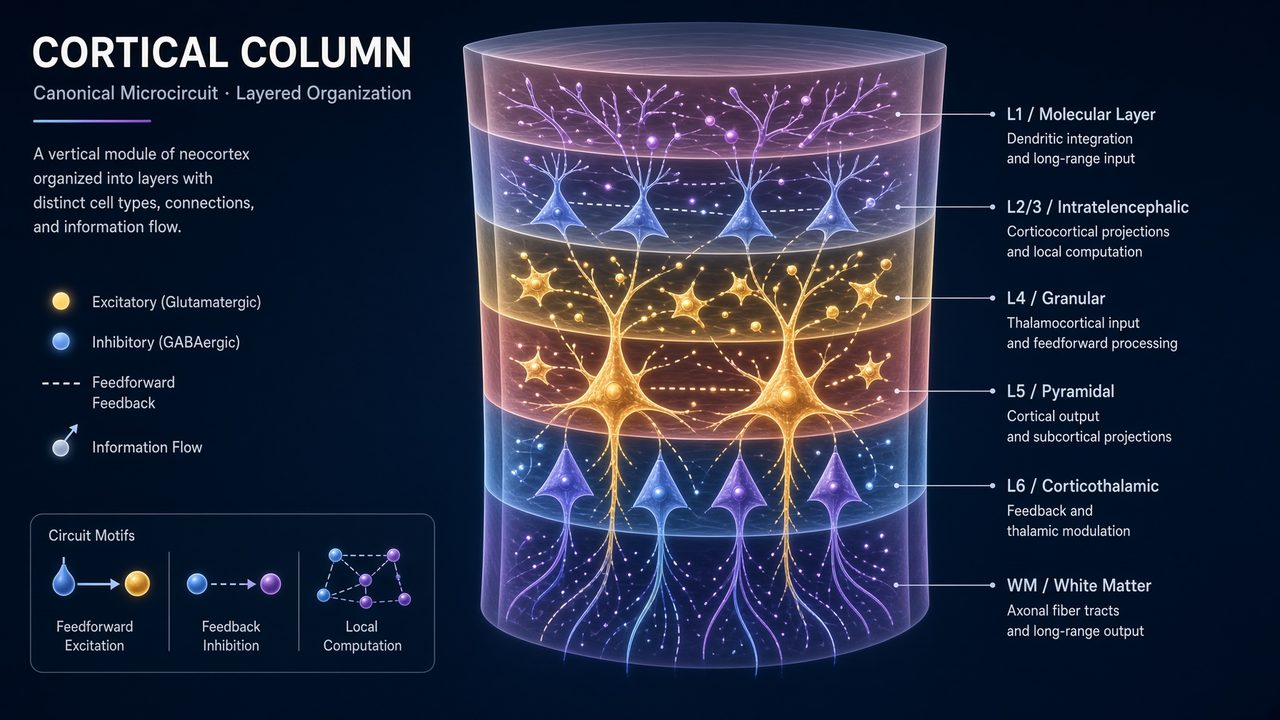
The cortex is about two to four millimeters thick and divided into six layers of cells. Neurons arranged vertically across those layers, from the surface to the white matter, often share a preferred input. Vernon Mountcastle first reported this in the somatosensory cortex of cats in the 1950s, finding that neurons in a vertical track responded to the same kind of touch on the same patch of skin.
Discoveries in vision
David Hubel and Torsten Wiesel extended the idea in the visual cortex, work that earned them a Nobel Prize in 1981. They found orientation columns, in which neurons prefer lines tilted at a particular angle, and ocular dominance columns, which favor input from one eye. Together these form repeating "hypercolumns" that process all orientations for a small patch of the visual field.

The six layers
Each layer has a typical role:
- Layer 4 receives most input from the thalamus
- Layers 2 and 3 communicate with other cortical areas
- Layer 5 sends output to subcortical structures such as the basal ganglia and brainstem
- Layer 6 sends feedback to the thalamus
- Layer 1 contains mostly connections from other regions
This layered wiring pattern, called a canonical microcircuit, appears across many cortical areas, suggesting a shared computational design.
Minicolumns and macrocolumns
Researchers describe smaller minicolumns, containing roughly 80 to 100 neurons, and larger macrocolumns that bundle many minicolumns. Terminology varies, and columns are not always visible as sharp physical units under a microscope.
Do all animals and areas have columns?
Not clearly. Cats and primates show striking columns in some areas, but rodents lack orientation columns in their visual cortex, even though their neurons still tune to orientation in a scattered "salt and pepper" pattern. This suggests that columns may be a way of organizing neurons efficiently rather than a requirement for computation.
Columns and cognition
Beyond senses, columns may help the cortex represent features, combine them and predict what will come next. Some theorists, including Jeff Hawkins, propose that each column builds models of objects and that thinking emerges from many columns voting. Others view this as an interesting but unproven hypothesis. Evidence in association areas that support abstract thought is less direct than in sensory regions.
Development and plasticity
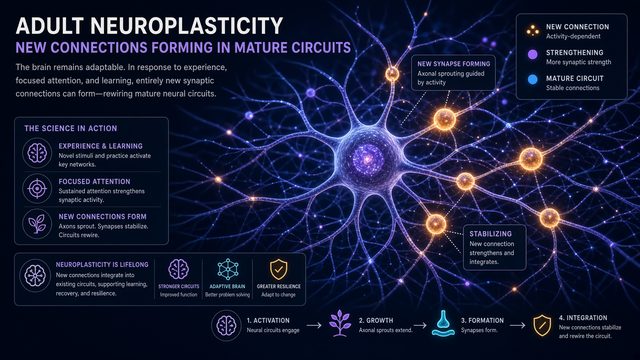
Columns form partly under genetic control and partly through experience. Visual deprivation in early life can alter ocular dominance columns, an example of critical periods in development. Adult cortex remains adaptable, and maps can shift after injury or learning.
Imaging columns in people
High-field MRI at 7 tesla can now resolve columnar and layer-level patterns in living human brains. This opens a path to study how information flows within the cortex in health and disease, including in conditions such as autism, epilepsy and schizophrenia, where researchers have proposed altered cortical organization.
What remains debated
Scientists disagree about how universal columns are, how to define them and whether they are fundamental computational units. What is clear is that the cortex has a repeated architecture, and understanding it is a key step toward explaining how thought arises from tissue.
Further reading from authoritative sources
This article is educational and does not replace advice from a licensed clinician. See the medical disclaimer. Looking for specialist care? Browse the neurology clinic directory.