The Basal Ganglia and the Art of Habit Formation
Brushing your teeth, driving a familiar route or typing without looking at the keys all depend on a group of deep brain structures called the basal ganglia. They help you choose actions, learn from rewards and, over time, turn deliberate behaviors into habits.
The structures
The basal ganglia include:
- Striatum (caudate nucleus and putamen), the main input
- Globus pallidus (internal and external segments), the main output
- Subthalamic nucleus
- Substantia nigra (pars compacta, which supplies dopamine, and pars reticulata)
The nucleus accumbens, part of the ventral striatum, is involved in reward and motivation.
How they work
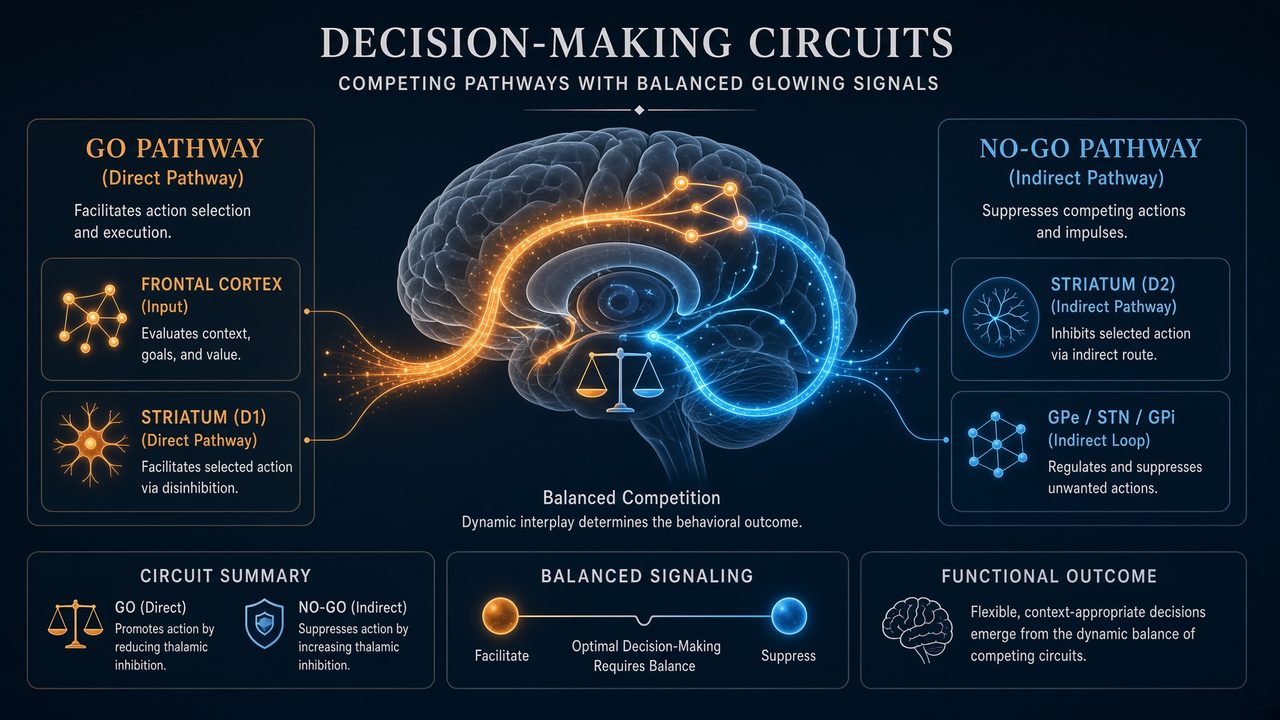
Cortical areas send signals to the striatum, which processes them and influences output through two main routes:
- The direct pathway facilitates movement by releasing the thalamus from inhibition, acting like a "go" signal.
- The indirect pathway suppresses competing movements, acting like a "no-go" signal.
Dopamine from the substantia nigra modulates the balance, promoting the direct pathway via D1 receptors and reducing the indirect pathway via D2 receptors. The net effect is to select appropriate actions and inhibit others.
Learning from reward
Dopamine neurons signal reward prediction errors. When an action leads to a better-than-expected outcome, dopamine strengthens the cortical-striatal connections that produced it, making the action more likely in the future.
From goal-directed to habit
Early in learning, behavior is goal-directed and relies on the dorsomedial striatum and prefrontal cortex, where actions are guided by the value of the outcome. With repetition, control shifts to the dorsolateral striatum, and behavior becomes habitual, triggered by cues, and insensitive to changes in outcome. Habits free up mental resources but can be rigid. Researchers describe a habit loop of cue, routine and reward.
Chunking
Neurons in the striatum show activity at the start and end of a learned sequence, suggesting that the basal ganglia "chunk" a series of actions into a single unit that can run automatically.
Beyond movement
Parallel basal ganglia loops involve the prefrontal and limbic cortex, influencing cognition and emotion. This explains why basal ganglia disorders affect mood and thinking as well as movement.
Disorders
- Parkinson's disease: loss of dopamine neurons leads to tremor, rigidity, slowness and difficulty initiating movement. Treatments include levodopa and deep brain stimulation of the subthalamic nucleus or globus pallidus.
- Huntington's disease: degeneration of the striatum causes involuntary movements (chorea), cognitive decline and psychiatric symptoms.
- Dystonia: sustained muscle contractions.
- Tourette syndrome: tics linked to basal ganglia circuits.
- Obsessive-compulsive disorder: altered cortico-striatal loops.
- Addiction: drugs hijack the striatal learning system, leading to compulsive use.
- ADHD: differences in striatal function are reported.
Changing habits
Understanding the habit system suggests strategies:
- Change cues in your environment.
- Substitute a new routine for the same cue and reward.
- Make new behaviors easy and reward them immediately.
- Use implementation intentions, such as "if X, then I will Y."
- Be consistent. Repetition builds automaticity, taking about two months on average in one study, with wide variation.
- Reduce stress and sleep loss, which push the brain toward habitual behavior.
Takeaway
The basal ganglia let us automate behavior and conserve effort. Working with this system, rather than against it, is the key to lasting habit change.
Further reading from authoritative sources
This article is educational and does not replace advice from a licensed clinician. See the medical disclaimer. Looking for specialist care? Browse the neurology clinic directory.