The Claustrum: The Brain's Mysterious Conductor
Tucked beneath the insular cortex lies a thin, irregular sheet of gray matter called the claustrum, from the Latin for "hidden away." Its connections to almost every region of the cortex have made it one of neuroscience's more intriguing puzzles, and even prompted speculation about its role in consciousness.
Anatomy
The claustrum is a thin, sheet-like structure, only a few millimeters thick, between the insula and the putamen, separated from them by white matter layers called the external and extreme capsules. In humans it is a few centimeters long and contains relatively few neurons. Its small size and location make it difficult to study with imaging.
Connections
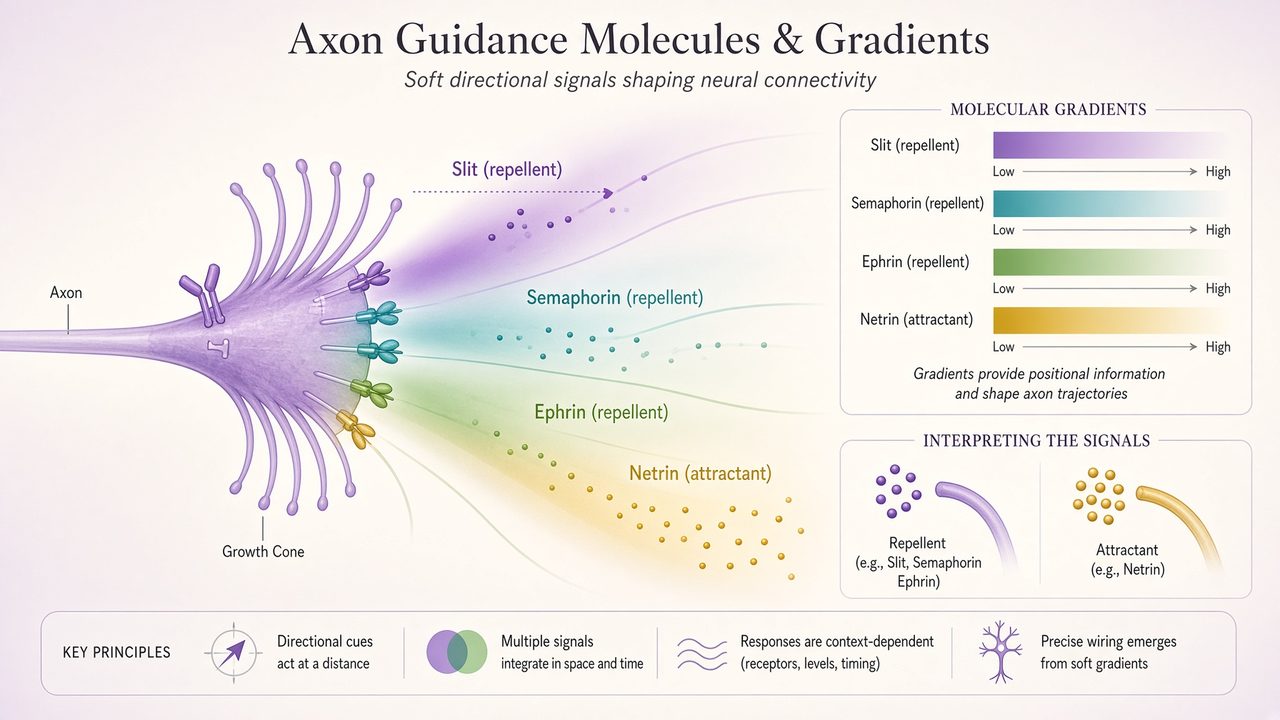
Tracing studies in animals show that claustral neurons receive input from, and project to, widespread cortical areas, including frontal, sensory, motor and cingulate regions, often in both directions. Some claustral neurons send branching axons to multiple cortical areas. Sparse connections also link it to the thalamus, amygdala and other subcortical regions. In mice, a single claustral neuron has been shown to have axons spanning an entire hemisphere.
Francis Crick's hypothesis
In 2005, Francis Crick and Christof Koch proposed that the claustrum might act like the conductor of an orchestra, binding information from different cortical areas into unified conscious experience. The idea sparked research, but it remains a hypothesis. A 2014 case report described a woman whose consciousness was reversibly interrupted when an electrode stimulated near the claustrum during epilepsy surgery, which drew attention, but the stimulation also affected neighboring white matter, so the finding is not conclusive.
Other proposed functions
- Attention and salience: experiments in rodents suggest that claustrum neurons help direct attention and respond to novelty.
- Sensory integration: neurons respond to multiple senses.
- Network synchrony: activation may coordinate slow cortical waves during sleep, with evidence that it influences cortical down states.
- Cognitive control: claustrum activity affects the ability to switch tasks.
- Impulsivity and cognitive performance: inhibition of claustrum cells changes cortical network activity and behavior in rodent experiments.
Clinical links
Studies have reported claustral changes in various conditions, including epilepsy, Parkinson's disease, Alzheimer's disease, schizophrenia, autism and the effects of some drugs, but findings are preliminary. Damage to the claustrum from stroke or toxic exposure has been described in rare cases. A 2019 study suggested that claustral neurons may help the cortex manage energy use, a more mundane but interesting possibility.
Challenges
- Small size makes it hard to isolate with MRI.
- Anatomical definition of its boundaries is debated.
- Interspecies differences limit generalization from rodents.
- Causal tools, such as optogenetics, are mainly applicable to animals.
Why it matters
Whether or not it proves central to consciousness, the claustrum may help explain how widely separated cortical areas coordinate. Understanding it could shed light on attention disorders and the neural basis of awareness.
Reading claims critically
Because consciousness is a popular and difficult topic, claims about the claustrum can outrun evidence. Be cautious about articles that present it as a definitive seat of consciousness or about products claiming to "activate" it.
Takeaway
The claustrum reminds us how much remains unknown about the brain. Its extensive wiring suggests an important role, which scientists are still working to define.
Further reading from authoritative sources
This article is educational and does not replace advice from a licensed clinician. See the medical disclaimer. Looking for specialist care? Browse the neurology clinic directory.