The Hippocampus: Your Brain's Memory Gateway
Tucked deep inside each temporal lobe is a curved structure whose name comes from the Greek word for seahorse. The hippocampus is only a few centimeters long, yet it is central to how you form new memories, find your way around, and connect what happened to where and when it happened.
What the hippocampus does
The hippocampus is best known for supporting declarative memory, the kind you can put into words: the name of a colleague, what you ate yesterday, the plot of a film. It acts like an index that links separate details, such as faces, sounds, places and emotions, into one coherent episode.
The case that changed neuroscience
In 1953 a patient known for decades as H.M. (later identified as Henry Molaison) had much of his hippocampus and surrounding tissue removed to treat severe epilepsy. His seizures improved, but he could no longer form new long-term memories of facts and events. He could still learn physical skills, which showed that different memory systems rely on different brain structures.
A built-in map
In the 1970s researchers discovered place cells in the hippocampus that fire when an animal is in a particular location. Neighboring regions contain grid cells that provide a coordinate-like framework. The discovery of this "inner GPS" was recognized with the 2014 Nobel Prize in Physiology or Medicine. Brain imaging of London taxi drivers has also found that the back part of the hippocampus tends to be larger in drivers who have memorized the city's streets, suggesting that intensive spatial learning can shape the structure.
How memories move through it
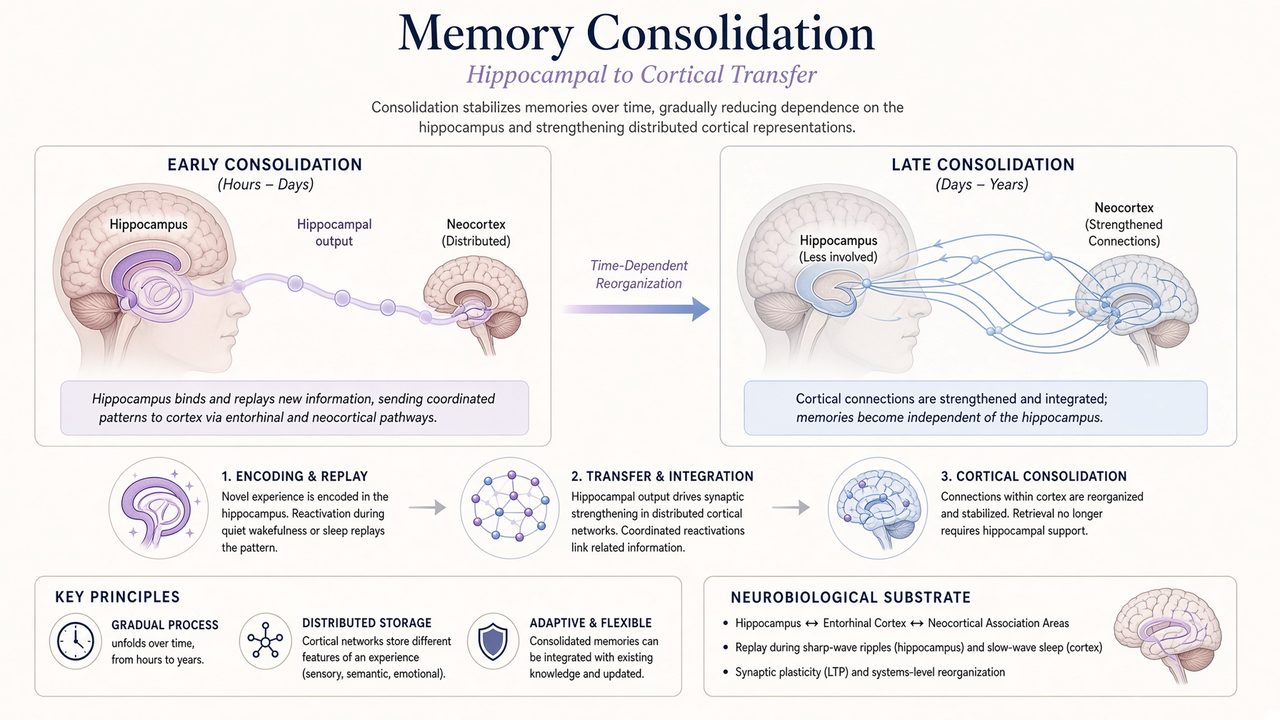
When you experience something new, information from your senses converges on the hippocampus through a series of connected subregions. Strengthened connections between neurons here create a temporary trace. During rest and especially during sleep, the hippocampus appears to "replay" recent activity, helping the cortex gradually take over the storage. This process is called consolidation, and it explains why sleep after learning improves recall.

Why the hippocampus is vulnerable
The hippocampus is unusually sensitive to several kinds of stress:
- Alzheimer's disease typically affects the hippocampus and nearby entorhinal cortex early, which is why new-memory problems are often the first symptom.
- Chronic stress and high cortisol are linked to reduced hippocampal volume in some studies, and stress can impair memory formation.
- Oxygen deprivation, such as after a cardiac arrest or severe stroke, can damage hippocampal neurons.
- Epilepsy often originates in the temporal lobe, and long-standing seizures can scar the hippocampus.
- Sleep loss interferes with the replay that supports consolidation.
Can the adult hippocampus make new neurons?
The dentate gyrus of the hippocampus is one of the few places where new neurons are produced in adult animals. Whether and how much this continues in adult humans is an active scientific debate, with studies reaching different conclusions. What is clear is that the hippocampus remains highly plastic throughout life, meaning its connections change with experience.
Supporting hippocampal health
No supplement or app has been proven to grow the hippocampus, but several habits have good evidence for protecting memory function overall:
- Regular aerobic exercise, which has been linked to modest improvements in hippocampal volume and memory in older adults in some trials
- Seven or more hours of good-quality sleep for most adults
- Managing blood pressure, blood sugar and cholesterol
- Staying mentally and socially engaged
- Treating depression, hearing loss and sleep apnea
When to seek help
Occasional forgetfulness is normal. See a clinician if memory problems are new, getting worse, or interfering with daily life, for example repeatedly asking the same question, getting lost in familiar places, or struggling to follow conversations. A neurologist can arrange cognitive testing, lab work and imaging to look for treatable causes.
Further reading from authoritative sources
This article is educational and does not replace advice from a licensed clinician. See the medical disclaimer. Looking for specialist care? Browse the neurology clinic directory.