The Thalamus: Your Brain's Central Relay Station
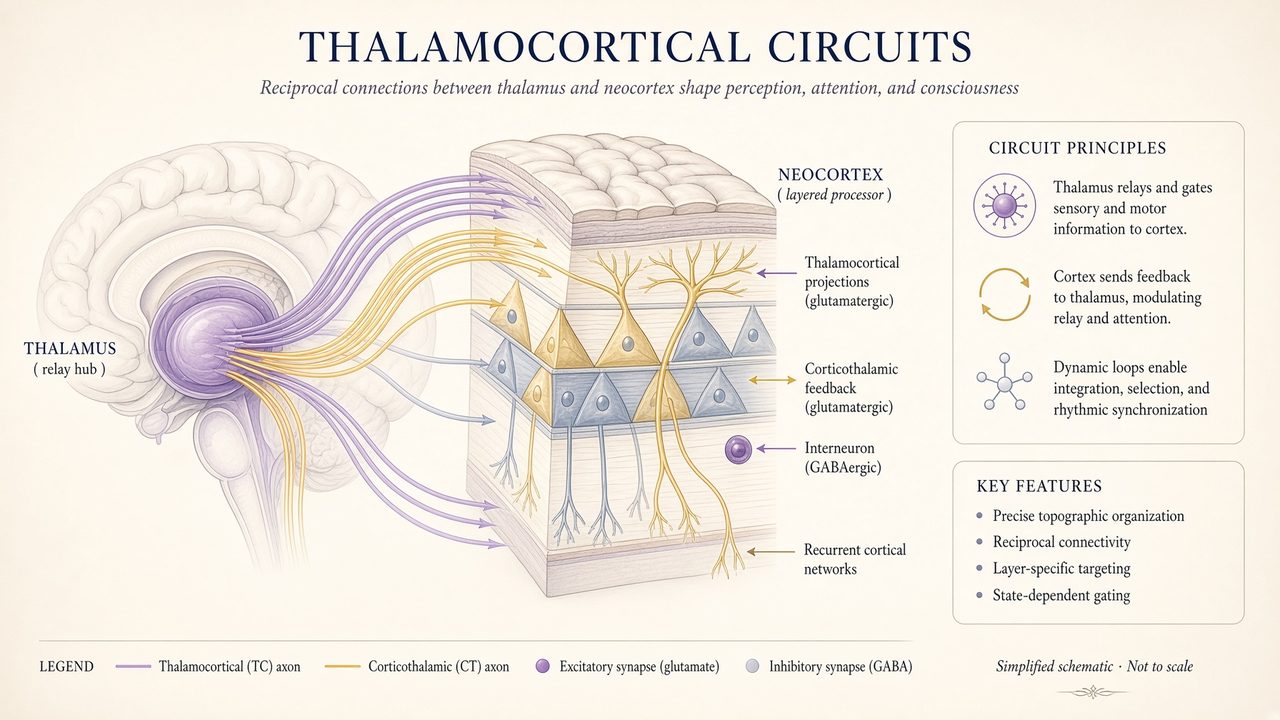
Deep in the center of the brain sits the thalamus, a pair of egg-shaped structures roughly the size of walnuts. Nearly every sensory signal, except smell, passes through it on the way to the cerebral cortex. That earned it the nickname "relay station," though modern research shows it does far more than pass messages along.
Anatomy
The thalamus is made up of many nuclei, each with specific connections. Together they form two broad groups:
- First-order nuclei relay information from the senses or other brain regions to the cortex. The lateral geniculate nucleus carries vision, the medial geniculate nucleus carries hearing, and the ventral posterior nucleus carries touch and body position.
- Higher-order nuclei, such as the pulvinar and mediodorsal nucleus, link cortical areas with one another, supporting attention and cognition.
A thin sheet of inhibitory neurons, the thalamic reticular nucleus, wraps around the thalamus and regulates traffic through it.
Relay with a twist
Signals traveling to the cortex are not simply copied. The thalamus adjusts their strength and timing depending on alertness and attention. During deep sleep, thalamic neurons enter a bursting mode that blocks most sensory input from reaching the cortex, which is partly why you do not notice ordinary sounds when asleep. During wakefulness they switch to a mode that transmits information faithfully.

Beyond sensation
Motor control
Nuclei such as the ventral lateral nucleus receive input from the cerebellum and basal ganglia and send it to motor cortex, so the thalamus is a link in loops that shape movement.
Attention
The pulvinar and reticular nucleus help select which stimuli get processed. Damage can impair the ability to orient attention.
Memory and emotion
The anterior and mediodorsal nuclei connect with the hippocampus, mammillary bodies, prefrontal cortex and limbic system, and are important for memory and executive function.
Sleep and consciousness
Thalamocortical loops produce sleep spindles and slow waves, and thalamic activity is essential for maintaining wakefulness. Deep brain stimulation of the central thalamus has been tested for restoring responsiveness in some people with severe brain injury.
When the thalamus is damaged
- Thalamic stroke can cause loss of sensation on one side, severe persistent pain (thalamic pain syndrome, or Dejerine-Roussy syndrome), memory impairment, and changes in alertness or language.
- Fatal familial insomnia, a rare prion disease, destroys thalamic nuclei and leads to untreatable insomnia and dementia.
- Wernicke-Korsakoff syndrome, from thiamine deficiency often related to alcohol use, damages the thalamus and mammillary bodies, producing confusion and severe memory loss.
- Tumors, trauma and infection can also affect it.
Disorders involving thalamic circuits
Altered thalamocortical communication has been reported in epilepsy, in which thalamic circuits sustain absence seizures, as well as in schizophrenia, autism, Parkinson's disease and chronic pain. Thalamic stimulation is used in treatment of essential tremor, and responsive stimulation of the thalamus is being studied for epilepsy.
Imaging and research
MRI and diffusion imaging allow researchers to map thalamic nuclei and their connections in living people, and studies relate thalamic structure to aging, intelligence and disease risk. The thalamus is an increasingly important focus in theories of consciousness.
Protecting thalamic health
Because the thalamus depends on healthy blood vessels, controlling blood pressure, diabetes and cholesterol reduces stroke risk. Avoiding heavy alcohol use and ensuring adequate nutrition protect against Wernicke-Korsakoff syndrome.
Takeaway
The thalamus is far more than a switchboard. By gating and coordinating information, it helps the brain decide what to notice, when to sleep and how to bind sensation to thought.
Further reading from authoritative sources
This article is educational and does not replace advice from a licensed clinician. See the medical disclaimer. Looking for specialist care? Browse the neurology clinic directory.