The Visual Cortex: Decoding the World We See
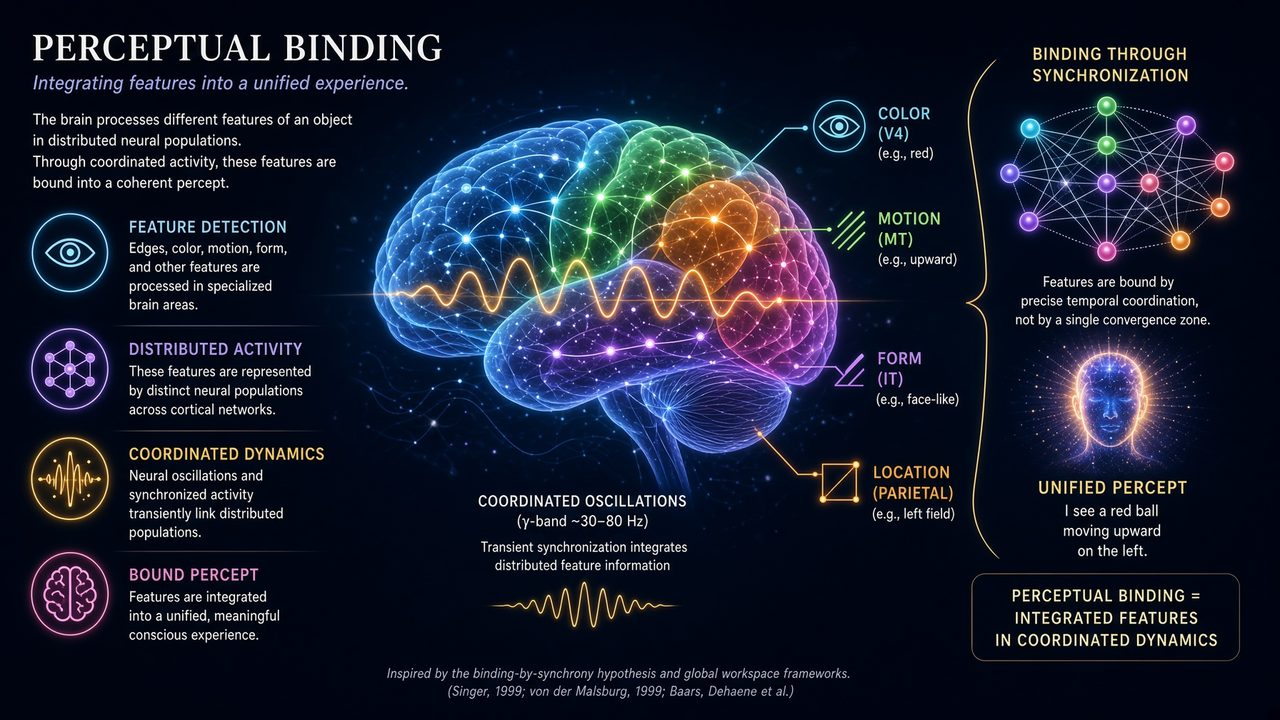
About a third of the human cortex is devoted in some way to vision. The visual cortex, mostly in the occipital lobe at the back of the head, turns patterns of light into a coherent world of edges, colors, motion, faces and objects.
From eye to cortex
Light hits the retina, where photoreceptors, rods and cones, convert it into signals. Retinal ganglion cells send axons through the optic nerve. At the optic chiasm, fibers from the nasal half of each retina cross, so that the left visual field is processed in the right hemisphere and vice versa. Most fibers synapse in the lateral geniculate nucleus of the thalamus before reaching the primary visual cortex (V1), also called striate cortex.
V1: edges and orientation
David Hubel and Torsten Wiesel won the Nobel Prize for showing that V1 neurons respond to specific features, such as lines of a particular orientation. V1 contains a retinotopic map in which neighboring points in the image map to neighboring points on the cortex, with the center of vision given disproportionate space.

Beyond V1
Information passes to extrastriate areas, including V2, V3, V4 and V5/MT:
- V2 processes more complex contours.
- V4 is important for color and form.
- V5/MT specializes in motion.
Two streams
- The ventral stream ("what pathway") runs to the temporal lobe and supports object and face recognition. The fusiform face area responds strongly to faces.
- The dorsal stream ("where/how pathway") runs to the parietal lobe and guides action and spatial awareness.
Milner and Goodale's studies of patient DF, who could not recognize shapes but could still post a card through a slot correctly, supported this distinction.
Top-down influences
Vision is not only bottom-up. Predictions, attention and memory shape what we see through feedback connections, which outnumber feedforward ones. This helps explain illusions and why we see what we expect.
Plasticity and development
Visual cortex requires normal input early in life. Hubel and Wiesel found that closing one eye in kittens during a critical period permanently reduced cortical responses, mirrored in human amblyopia, which is why early treatment of childhood vision problems is important. In people born blind, visual cortex is recruited for touch, hearing and language such as Braille reading.
Damage and disorders
- Cortical blindness from V1 damage, although some people show blindsight, responding to stimuli without awareness
- Visual field defects such as hemianopia after stroke
- Akinetopsia, inability to perceive motion, from MT damage
- Cerebral achromatopsia, loss of color perception
- Prosopagnosia, difficulty recognizing faces
- Visual agnosia, difficulty recognizing objects
- Migraine aura, a wave of activity across visual cortex
- Charles Bonnet syndrome, visual hallucinations after vision loss
Taking care of visual brain health
Regular eye examinations, controlling blood pressure and diabetes, wearing protective eyewear, and seeking urgent care for sudden vision loss or new visual field changes protect vision.
Why it matters in daily life
Understanding the visual cortex explains common experiences: why optical illusions fool us, why you can miss an obvious object while attending elsewhere, and why bright flashes leave afterimages. It also guides practical design, from road signs that exploit motion and contrast sensitivity to accessible interfaces for people with low vision. Rehabilitation specialists use this knowledge to retrain scanning after field loss.
Takeaway
Seeing is a construction by the brain. The visual cortex shows how simple features build into rich perception.
Further reading from authoritative sources
This article is educational and does not replace advice from a licensed clinician. See the medical disclaimer. Looking for specialist care? Browse the neurology clinic directory.