AI and Brain Imaging: The Next Frontier
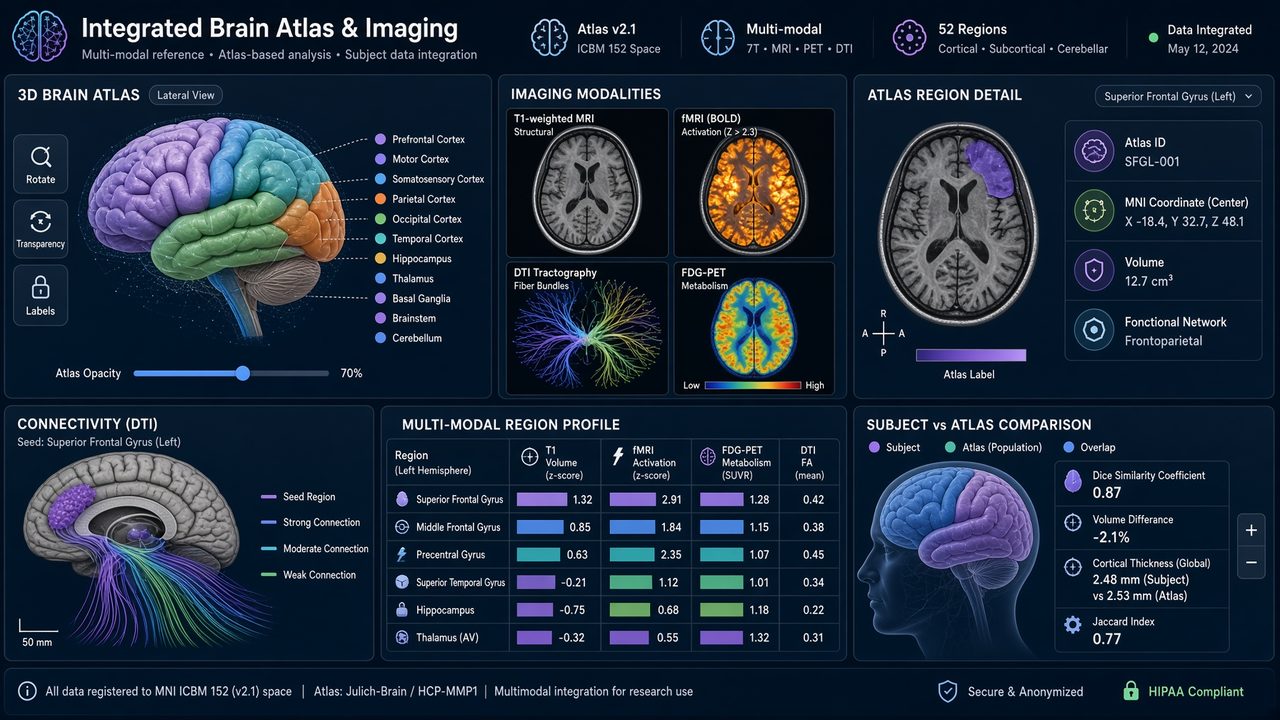
Brain scans produce enormous amounts of data, and artificial intelligence is well suited to find patterns in it. AI tools are already used in stroke care and radiology, and research is pushing toward earlier detection of dementia and psychiatric disease.
What AI does with brain images
Machine learning, especially deep learning with convolutional neural networks, learns from labeled examples to recognize patterns. In brain imaging, applications include:
- Detecting emergencies: algorithms flag intracranial hemorrhage and large vessel occlusion on CT within minutes, helping teams prioritize patients and speed treatment. Several FDA-cleared tools exist.
- Measuring structure: automatic segmentation of brain regions, such as hippocampal volume, white matter lesions and tumor boundaries, saves time and improves consistency.
- Multiple sclerosis and dementia tracking: quantifying lesion and atrophy changes over time.
- Image enhancement: AI can reduce scan time, remove noise and reconstruct high-quality images from less data, making scans faster and sometimes using lower radiation or contrast doses.
- Diagnosis and prediction: models are being trained to distinguish Alzheimer's from other dementias, predict who will convert from mild cognitive impairment to dementia, classify epilepsy and detect subtle abnormalities.
- Psychiatry research: efforts to find imaging signatures of depression, schizophrenia and autism have shown promise but limited replication.
- Brain age: models estimate "brain age" from MRI, and the difference between predicted and chronological age may reflect health risks.
- Decoding research: AI can reconstruct images or words from fMRI activity in laboratory experiments, which raises privacy questions.
Limitations
- Generalization: models trained on one scanner or population may perform worse elsewhere.
- Bias: underrepresented groups may be less accurately assessed.
- Small, noisy datasets in many research areas.
- Black box issues: it can be hard to know why a model made a prediction.
- Overfitting and hype: many published models have not been tested in real-world settings.
- Reproducibility: a widely discussed study in Nature in 2022 by Scott Marek and colleagues showed that associations between brain structure and behavior often require thousands of participants to be reliable.
- Accountability: clinicians remain responsible for decisions.
What it means for patients
You may not notice AI, but it may help your scan be read faster or measured more precisely. You can ask your clinician how AI is used and how results are verified. Consumer brain scan services that claim to diagnose or predict disease from AI are not recommended without clinical context.
Looking ahead
Future systems may combine imaging with genetics, blood tests and clinical records to give a more complete picture, and may support earlier and more personalized treatment decisions. Regulators are developing frameworks for continuously learning algorithms, and patient groups are asking for transparency about how tools are tested and monitored. The most valuable progress will pair strong technology with ethical use and human care.
Staying informed
Patients can ask whether an imaging report involved AI-assisted measurements and how the radiologist confirmed them. Keep copies of your scans and reports so that future studies can be compared.
Takeaway
AI is becoming a useful assistant in brain imaging. Its best uses support clinicians, speed care and extend research, while its limits require caution.
Further reading from authoritative sources
- National Institute of Neurological Disorders and Stroke (NINDS)
- National Center for Complementary and Integrative Health (NCCIH)
This article is educational and does not replace advice from a licensed clinician. See the medical disclaimer. Looking for specialist care? Browse the neurology clinic directory.