The Science of Neurofeedback Technology
Neurofeedback is a technology that lets a person watch a representation of their own brain activity in real time and try to change it. It sits at the border of clinical practice and research, and understanding its technical basis helps evaluate its claims.
The technical chain
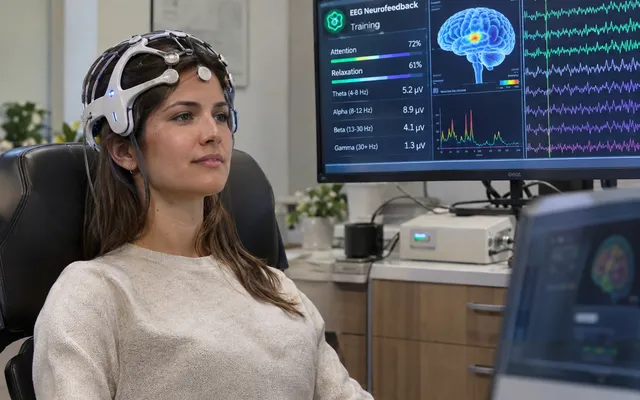
1. Signal acquisition: EEG electrodes record voltage fluctuations from the scalp, typically in the microvolt range. Other approaches use functional MRI, functional near-infrared spectroscopy or magnetoencephalography. 2. Processing: software removes artifacts from blinks, muscle activity and movement, and decomposes the signal into frequency bands such as delta, theta, alpha, beta and gamma. In fMRI, activity in a target region or network is calculated. 3. Feature extraction: a measure, such as the power of a frequency band at a particular location, ratios, coherence or slow cortical potentials, is computed. 4. Feedback: the feature is turned into a visual, auditory or game-like display that changes when the person moves toward the target. Reward may be a brightening picture, a movie that plays clearly or a pleasant sound. 5. Learning: through trial, error and operant conditioning, the person learns, often without explicit strategies, to produce the desired state. Sessions are repeated across weeks.
Main protocols
- Frequency band training: increasing sensorimotor rhythm or beta, decreasing theta, or enhancing alpha.
- Slow cortical potential training: regulating slow shifts in cortical activity, used for ADHD and epilepsy.
- Alpha-theta training: used in some trauma and addiction programs.
- Quantitative EEG-guided or Live Z-score training: compare a person's EEG with a normative database.
- Real-time fMRI neurofeedback: targets specific regions such as the amygdala, with research uses in depression, anxiety and pain.
- Connectivity and network feedback: an emerging research area.
What the research says
Evidence for ADHD is the most developed. A meta-analysis found improvements in parent-rated symptoms, but benefits were smaller or not significant when raters were blinded, and a large trial found no advantage over sham feedback. For epilepsy, slow cortical potential and sensorimotor training show some seizure reductions. Studies of anxiety, depression, insomnia, PTSD and cognition are suggestive but small, with mixed sham-controlled results. Critics note that placebo, attention and relaxation effects are difficult to exclude, and that it is unclear whether learned changes in EEG cause clinical improvement.
What to look for
- Standards: guidelines from groups like the Association for Applied Psychophysiology and Biofeedback evaluate evidence by condition.
- Quality equipment and artifact control.
- Clear goals, baseline tests and progress measures.
- Qualified clinicians and realistic claims.
Technical pitfalls
Artifacts from eye blinks, jaw clenching and movement can masquerade as brain signals and make a person appear to succeed without changing brain activity. Good systems monitor and reject artifacts, use proper electrode placement and impedance checks, and report how feedback relates to the person's real learning. Ask providers how they handle these issues.
Takeaway
Neurofeedback technology is a clever application of learning principles. Its promise is real, but the evidence is condition-specific, so ask for data, and expect honesty.
Further reading from authoritative sources
- National Institute of Neurological Disorders and Stroke (NINDS)
- National Center for Complementary and Integrative Health (NCCIH)
This article is educational and does not replace advice from a licensed clinician. See the medical disclaimer. Looking for specialist care? Browse the neurology clinic directory.