How the Brain Transitions Between Sleep and Wake

Falling asleep and waking up feel like gradual fades, yet in the brain they involve fast switching between competing networks. Understanding the circuitry reveals why transitions can fail, as in insomnia or narcolepsy.
The wake-promoting system
Wakefulness is maintained by an ascending arousal system in the brainstem and hypothalamus. Key groups include:
- Noradrenergic neurons in the locus coeruleus
- Serotonergic neurons in the raphe nuclei
- Dopaminergic neurons in the ventral tegmental area and periaqueductal gray
- Cholinergic neurons in the brainstem and basal forebrain
- Histaminergic neurons in the tuberomammillary nucleus of the hypothalamus
- Orexin (hypocretin) neurons in the lateral hypothalamus, which stabilize wakefulness
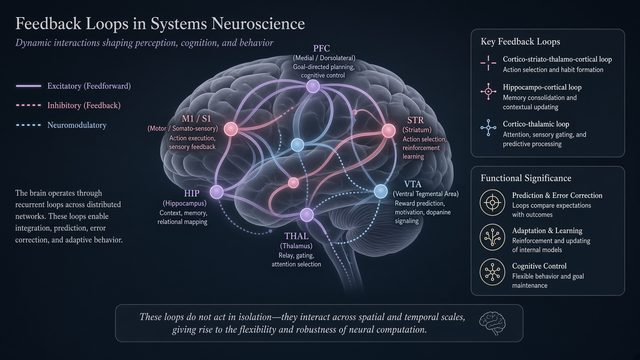
These systems project widely to the thalamus and cortex, switching them to a desynchronized, alert state.
The sleep-promoting system
The ventrolateral preoptic nucleus (VLPO) of the hypothalamus contains GABA and galanin neurons that inhibit the arousal centers during sleep, as identified by Clifford Saper and colleagues. Other regions, such as the median preoptic nucleus and parafacial zone, also promote sleep. The thalamus generates spindles and slow rhythms that characterize non-REM sleep.

The flip-flop switch
Saper proposed that sleep and wake circuits mutually inhibit each other, as in an electrical flip-flop circuit, so that the system tends to be in one state or the other, with rapid transitions. Orexin neurons excite the arousal centers and reinforce the wake state, preventing unwanted transitions. Loss of orexin neurons causes narcolepsy type 1, with sudden sleep attacks and cataplexy, which illustrates how an unstable switch fails. Drugs such as orexin receptor antagonists for insomnia target this system.
Controlling the timing
Two forces influence the switch: homeostatic sleep pressure, tied to adenosine and other factors, and the circadian signal from the suprachiasmatic nucleus, which promotes wake in the evening just before habitual bedtime (the wake maintenance zone) and then falls to promote sleep. Melatonin from the pineal gland rises in darkness and signals biological night.
REM sleep switching
REM sleep is controlled by interactions among brainstem regions, including the sublaterodorsal nucleus that triggers REM and the muscle atonia that paralyzes the body during dreams, and REM-off regions in the periaqueductal gray and locus coeruleus. REM Sleep Behavior Disorder arises when the paralysis circuit fails, which may signal early neurodegenerative disease.
Sleep onset and waking in practice
- Falling asleep involves reduced arousal system activity, thalamic changes and the gradual shift to slower EEG rhythms. Localized sleep-like patterns can appear in parts of the cortex before others. In insomnia, the transition is impeded by hyperarousal.
- Waking up: the circadian rise in cortisol and temperature, light exposure and loss of sleep pressure prepare awakening. Sleep inertia is the groggy, impaired state lasting 15 to 60 minutes, when cortical networks, particularly the prefrontal cortex, are slower to wake than the brainstem.
Tips for smoother transitions
- Keep a regular schedule to align circadian timing.
- Get morning light to anchor the clock and speed waking.
- Dim lights and reduce stimulation in the evening.
- Avoid waking from deep sleep, if possible, with consistent schedules and sufficient sleep.
- Limit caffeine and alcohol at night.
- Use a gentle wake-up cue, and avoid snoozing repeatedly, which fragments sleep.
- See a doctor for sudden sleep attacks, cataplexy or acting out dreams.
Takeaway
Sleep and wake are a decisive switch, not a dimmer. When the switch works well, you fall asleep easily and wake alert, and when it falters, sleep disorders arise.
Further reading from authoritative sources
- National Institute of Neurological Disorders and Stroke (NINDS)
- National Center for Complementary and Integrative Health (NCCIH)
This article is educational and does not replace advice from a licensed clinician. See the medical disclaimer. Looking for specialist care? Browse the neurology clinic directory.