Restorative Sleep: What Recovery Means for the Brain
You can spend eight hours in bed and still wake feeling unrefreshed, which suggests that how well you sleep matters as much as how long. The brain accomplishes essential maintenance during sleep, and understanding it explains what makes sleep truly restorative.
What the brain does during sleep
- Energy and metabolic restoration: brain glucose use falls in deep sleep. Glycogen stores in astrocytes may be replenished.
- Waste clearance: Maiken Nedergaard's group discovered the glymphatic system, in which cerebrospinal fluid flows through the brain along vessels and clears metabolic waste, including amyloid-beta, and is more active during sleep, particularly slow wave sleep. Findings in humans are still emerging, and recent studies have debated the strength of the effect.
- Synaptic homeostasis: Giulio Tononi and Chiara Cirelli proposed that sleep downscales synapses that were strengthened during wake, preserving the important ones, which restores capacity for learning and reduces energy demand.
- Memory consolidation: slow waves and spindles help transfer memories to cortical storage, and REM supports emotional processing and integration, as described in other articles.
- Hormone regulation: growth hormone is released in deep sleep, and cortisol and appetite hormones are reset.
- Emotional recalibration: REM sleep helps modulate emotional reactivity.
- Immune function and cardiovascular recovery: blood pressure and heart rate fall during non-REM sleep.
The architecture of a night
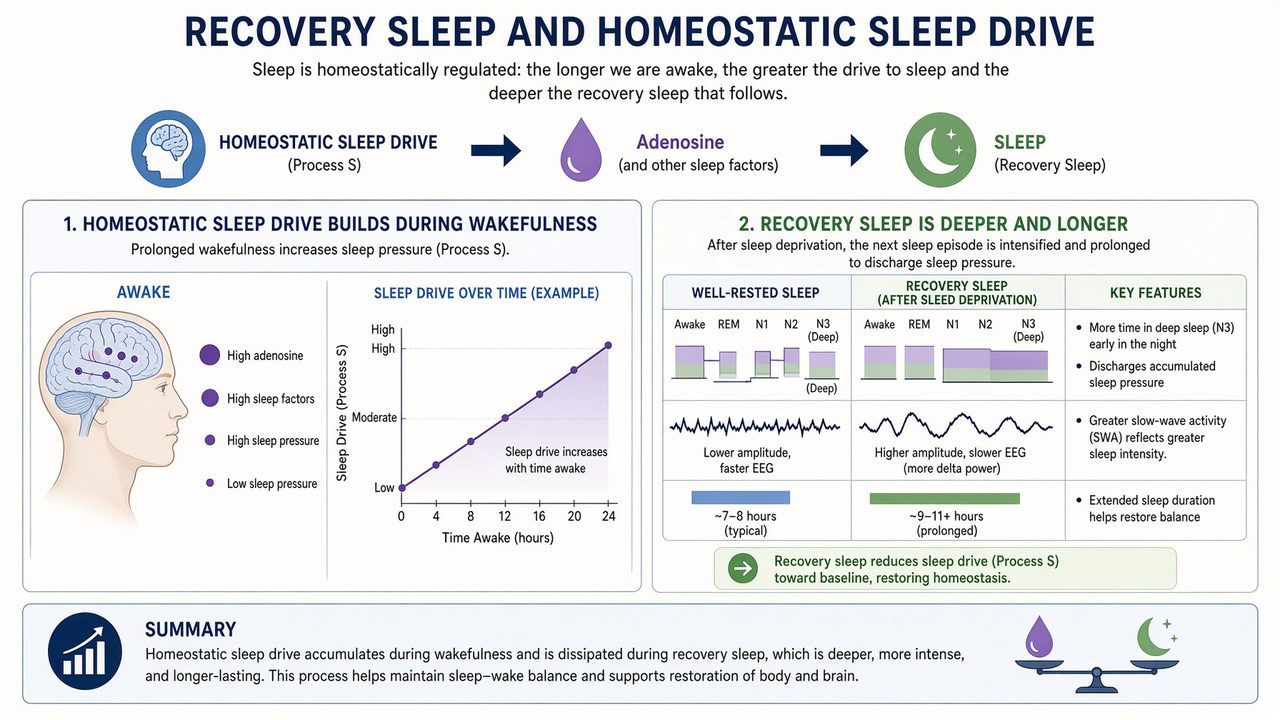
A normal night has four to six cycles of about 90 minutes, moving through light stages (N1, N2), deep slow wave sleep (N3), and REM. Deep sleep dominates the first half of the night, and REM the second half, with longer periods toward morning. Cutting sleep short disproportionately reduces REM, and delayed bedtime may shorten deep sleep.

Why sleep can feel unrefreshing
- Fragmentation: repeated arousals from sleep apnea, noise, pain, restless legs, alcohol or caffeine reduce deep sleep and REM.
- Insufficient time or irregular timing: sleep misaligned with the circadian clock, as in shift work, is less efficient.
- Medications and substances: alcohol, sedatives and some drugs alter sleep architecture.
- Medical and mental health conditions: depression, anxiety, thyroid disorders, anemia and chronic fatigue conditions.
- Idiopathic hypersomnia and other disorders can cause unrefreshing sleep despite long duration.
- Misperception: some people with insomnia underestimate their sleep.
How to improve sleep quality
- Get enough hours, and keep a regular schedule, including weekends.
- Create a dark, quiet, cool bedroom, and a comfortable bed.
- Get morning light and daytime exercise.
- Avoid alcohol and heavy meals before bed, and caffeine after midday.
- Unwind with a calming routine, and reduce evening stress and screens.
- Manage worries through journaling and relaxation.
- Treat sleep apnea, insomnia and other conditions, with professional help.
- Review medications with your doctor.
- Consider a sleep study if you snore loudly, wake gasping, or remain unrefreshed despite adequate time in bed.
- Track patterns, and use that information to adjust habits.
Takeaway
Restoration depends on both quantity and quality of sleep. Protecting the continuity and rhythm of your nights gives the brain what it needs to recover.
Further reading from authoritative sources
- National Institute of Neurological Disorders and Stroke (NINDS)
- National Center for Complementary and Integrative Health (NCCIH)
This article is educational and does not replace advice from a licensed clinician. See the medical disclaimer. Looking for specialist care? Browse the neurology clinic directory.