Sleep and Decision-Making: Why Rest Matters
Judges, surgeons, traders and parents all make consequential decisions, often on too little sleep. Research shows that tiredness alters how the brain weighs risks and rewards and handles complexity, often without the person realizing it.
What sleep loss does to decisions
- Risk and reward: studies by Vinod Venkatraman and Michael Chee found that sleep-deprived participants focused more on potential gains and less on potential losses in gambling tasks, with increased activity in the nucleus accumbens and decreased activity in the insula, which signals risk. William Killgore showed that sleep deprivation impairs performance on the Iowa Gambling Task, involving risky choices.
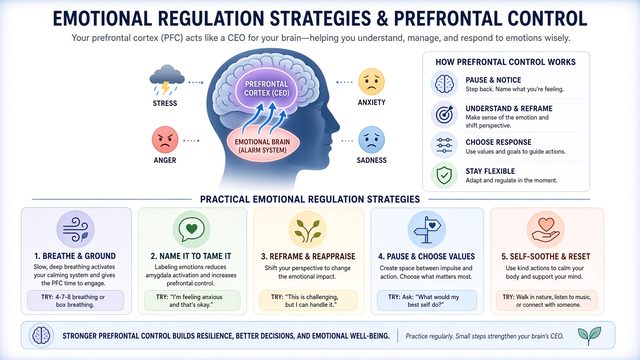
- Impulsivity and self-control: reduced prefrontal activity weakens inhibition, and decisions are more driven by emotion.
- Flexible thinking and updating: sleep-deprived people are slower to adapt strategy when circumstances change, and more likely to persevere with ineffective approaches. Yvonne Harrison and James Horne found impairments in innovation and updating of plans.
- Attention and working memory: reduced capacity makes complex decisions harder, and lapses cause errors.
- Moral and social judgment: sleep loss is associated with more unethical behavior, according to research by Christopher Barnes and colleagues, and with lower empathy.
- Confidence: people often fail to notice their impairment, and may be overconfident.
- Real-world data: studies show that medical residents working extended shifts make more serious errors, according to research by Charles Czeisler and Christopher Landrigan. An analysis of judges found more lenient decisions after rest, and a controversial study suggested that parole decisions vary by time of day, though its interpretation is debated. Drowsy driving causes tens of thousands of crashes yearly, and accidents such as Chernobyl and the Challenger disaster involved fatigue among decision-makers.
Mechanisms
Sleep deprivation reduces dorsolateral prefrontal and parietal activity, increases amygdala reactivity, and alters dopamine signaling, so that reward and threat processing becomes unbalanced. Adenosine accumulation and reduced glucose metabolism in prefrontal regions contribute.

Protecting decision quality
- Sleep before big decisions: avoid signing contracts or making major financial or personal choices when exhausted.
- Aim for seven to nine hours regularly.
- Use checklists, second opinions and structured processes to reduce reliance on tired judgment.
- Schedule demanding decisions at your best time of day, and avoid the post-lunch dip.
- Take a nap of 10 to 30 minutes when facing a critical task and sleepy.
- Use caffeine strategically, which helps vigilance but does not fully restore complex judgment.
- Beware of overconfidence: if you are tired, assume you are more impaired than you feel.
- Organizations: limit extended work hours, provide rest breaks, and plan rotations that protect sleep, in safety-critical fields.
- Sleep on it: when possible, defer important choices overnight.
Decision-making in teams and families
Sleep loss affects groups as well as individuals, because tired teams communicate less clearly, share information poorly and are more likely to defer to the loudest voice. Parents of newborns, students during exams and professionals on call all face this pressure. Agreeing in advance on rules, such as no major purchases or relationship ultimatums late at night, and building in handoffs and double checks, protects decisions from the predictable errors of exhausted brains.
Takeaway
Good decisions need a rested brain. Sleep is not a luxury for decision-makers but a requirement.
Further reading from authoritative sources
- National Institute of Neurological Disorders and Stroke (NINDS)
- National Center for Complementary and Integrative Health (NCCIH)
This article is educational and does not replace advice from a licensed clinician. See the medical disclaimer. Looking for specialist care? Browse the neurology clinic directory.