How Synapses Strengthen and Weaken: LTP and LTD Explained
Learning and memory depend on changes in the strength of connections between neurons. Two well-studied forms of this change are long-term potentiation (LTP), a lasting increase in synaptic strength, and long-term depression (LTD), a lasting decrease. Together they let circuits be sculpted by experience.
Hebb's idea
In 1949, Donald Hebb proposed that when one neuron repeatedly helps fire another, the connection between them strengthens, often summarized as "cells that fire together wire together." LTP, discovered in the rabbit hippocampus by Terje Lømo and Tim Bliss in 1973, provided physical evidence for the idea.
How LTP works
At many excitatory synapses in the hippocampus, glutamate is the transmitter and two receptor types matter:
- AMPA receptors pass sodium and generate the basic response.
- NMDA receptors are blocked by a magnesium ion at resting voltage. They open only when glutamate is bound and the postsynaptic cell is already depolarized, so they act as coincidence detectors.
When strong activity opens NMDA receptors, calcium enters the postsynaptic cell. A large, fast calcium rise activates enzymes such as CaMKII, which add more AMPA receptors to the synapse and make existing ones more responsive. Later phases of LTP require new protein synthesis and gene activation, and may involve structural growth, enlarging dendritic spines and sometimes forming new synapses. Early LTP lasts about an hour, while late LTP can last days or longer.

How LTD works
LTD usually arises from prolonged, low-frequency activity that causes a smaller, slower rise in calcium. This activates phosphatases such as calcineurin, which remove AMPA receptors from the synapse. LTD weakens connections that are not useful, and so helps the brain avoid saturating and allows refinement of circuits. There are also forms of LTD dependent on other receptors, such as metabotropic glutamate receptors and endocannabinoids.
Timing matters
Spike-timing-dependent plasticity shows that the order of firing is important. If a presynaptic neuron fires just before the postsynaptic neuron, within roughly 20 milliseconds, the connection strengthens. If the order is reversed, it weakens. This matches the logic that a synapse that helps cause firing should be reinforced.
Evidence for roles in memory
- Blocking NMDA receptors in the hippocampus impairs spatial learning in rodents.
- Mice with genetically enhanced NMDA receptor function showed improved learning in some studies, earning the nickname "Doogie mice."
- Learning itself produces LTP-like changes that can be measured.
- Researchers have used optogenetics to erase or reinstate a memory by inducing LTD or LTP in the relevant synapses of rodents.
Evidence is strong but mostly from animals, and the full link between LTP and memory in humans is still being worked out.
Homeostatic plasticity
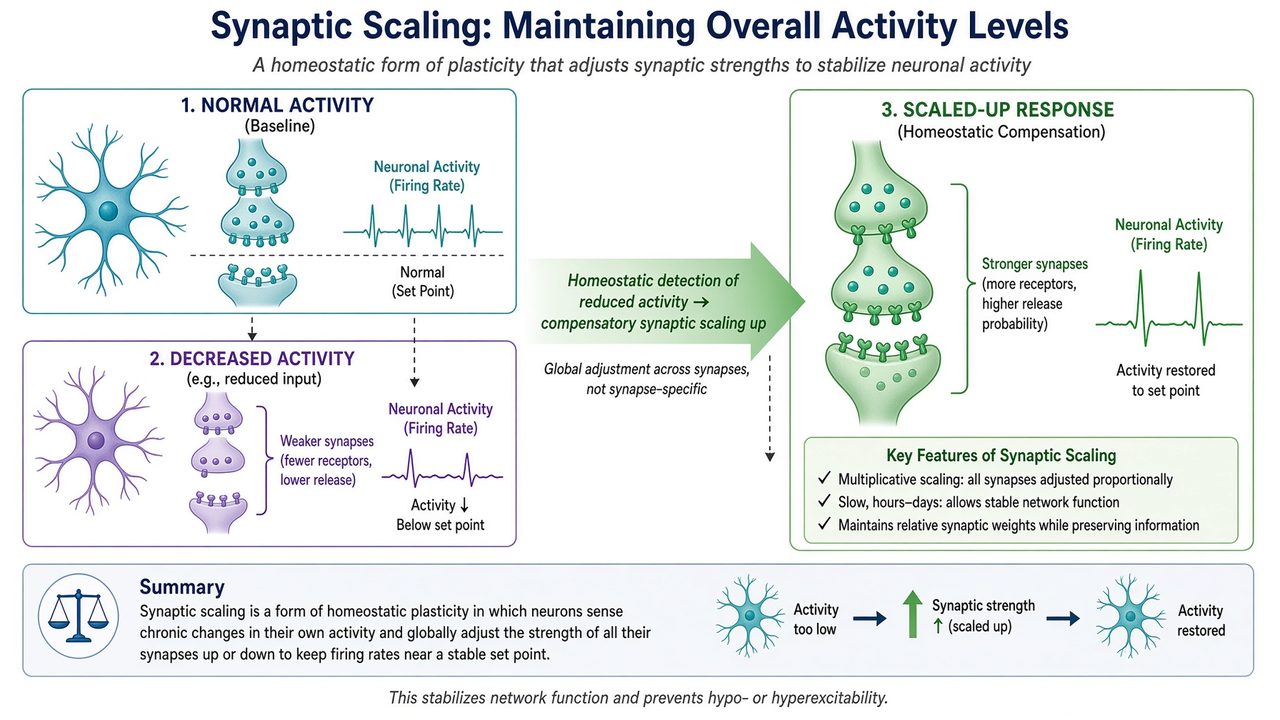
To keep activity stable, neurons also scale all their synapses up or down in response to overall activity levels, a process called synaptic scaling. This prevents runaway excitation.
When plasticity goes wrong
- Alzheimer's disease: amyloid-beta oligomers impair LTP and enhance LTD in experiments, consistent with early synaptic dysfunction.
- Epilepsy: excessive excitation can reflect maladaptive plasticity.
- Chronic pain: LTP-like changes in pain pathways may maintain sensitization.
- Addiction: drugs induce lasting synaptic changes in reward circuits.
- Autism, fragile X syndrome and schizophrenia: altered synaptic plasticity has been described.
- Stress: chronic stress impairs hippocampal LTP.
- Aging: reduced LTP induction accompanies age-related memory decline.
Factors that support plasticity
- Exercise raises brain-derived neurotrophic factor, which supports LTP.
- Sleep helps consolidate synaptic changes.
- Learning with spaced repetition exploits the biology of late-phase LTP.
- Enriched environments support synaptic growth.
- Avoiding chronic stress and heavy alcohol use protects hippocampal function.
Takeaway
LTP and LTD are the brain's way of editing its wiring. Studying them helps explain learning and points to targets for treating memory disorders.
Further reading from authoritative sources
This article is educational and does not replace advice from a licensed clinician. See the medical disclaimer. Looking for specialist care? Browse the neurology clinic directory.