The Role of Adenosine in Sleep Pressure
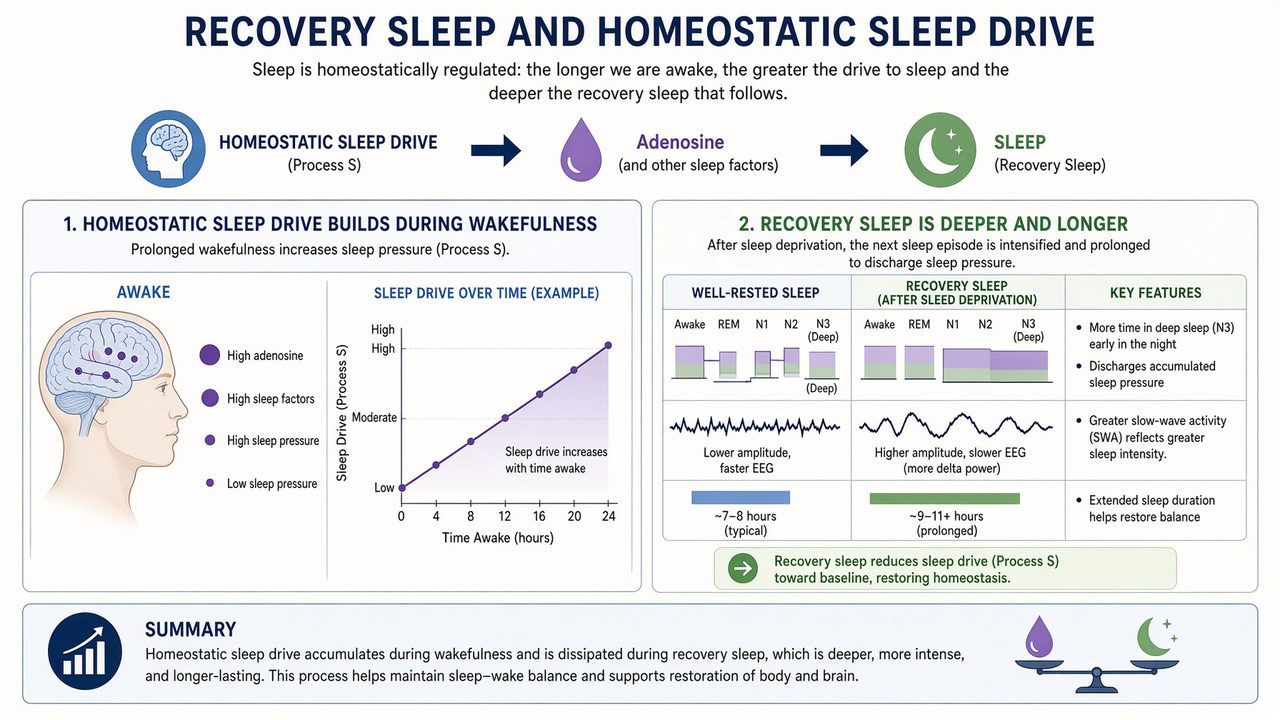
Why do you feel sleepier the longer you stay awake? A major part of the answer is a small molecule called adenosine, which accumulates in the brain during wakefulness and signals the need for sleep.
The two-process model
Alexander Borbély proposed that sleep is regulated by two processes. Process S is homeostatic sleep pressure, rising with time awake and falling during sleep. Process C is the circadian clock, which promotes alertness at certain times of day and sleep at others, independent of how long you have been awake. Adenosine is a leading candidate for the chemical basis of Process S.
How adenosine works
Neurons and glia use energy in the form of ATP. When ATP is broken down, adenosine is released as a byproduct, and extracellular levels rise during sustained activity, particularly in the basal forebrain, a region that promotes wakefulness. Studies by Robert McCarley, Radhika Basheer and colleagues show that adenosine rises in the basal forebrain during prolonged wakefulness, and falls during recovery sleep. Adenosine binds to A1 receptors, inhibiting wake-promoting cholinergic neurons, and to A2A receptors in the nucleus accumbens and hypothalamus, which activate sleep-promoting neurons, such as those in the ventrolateral preoptic area. Astrocytes may contribute to adenosine release.

Caffeine as an adenosine blocker
Caffeine is chemically similar to adenosine and blocks A1 and A2A receptors without activating them, so adenosine cannot signal sleepiness. Importantly, caffeine does not remove adenosine, which continues to accumulate. When caffeine wears off, the accumulated adenosine can produce a "caffeine crash." Caffeine's half-life is about five to six hours in healthy adults, so afternoon coffee can still be active at bedtime. Genetic differences in adenosine receptor and caffeine metabolism genes affect sensitivity, and some people can drink coffee late and sleep, though sleep quality may still be reduced.
Sleep and adenosine clearance
Slow wave sleep is thought to reduce adenosine levels, which restores alertness. Short naps may partially lower adenosine, and long periods of sleep deprivation raise it substantially, producing strong pressure for recovery sleep, with more slow wave activity.
Beyond sleepiness
Adenosine also modulates blood flow, inflammation and neuroprotection, and has roles in the heart and immune system. Drugs targeting adenosine receptors are studied for Parkinson's disease (A2A antagonists such as istradefylline are used in some countries), epilepsy and other conditions.
Practical implications
- Plan for sleep pressure: an overactive daytime schedule builds pressure that supports sleep at night, and long or late naps reduce it.
- Time caffeine thoughtfully: consider stopping caffeine at least eight hours before bedtime, and avoid relying on it to cover chronic sleep loss.
- Take a coffee nap: coffee immediately before a short nap can work because the nap clears adenosine and caffeine arrives as you wake.
- Do not expect to bank sleep: sleep pressure rises with extended wakefulness, but sleeping extra in advance only partially helps.
- If you cannot sleep despite being tired, the circadian clock, stress, light or arousal may be involved, in addition to adenosine.
- Keep consistent timing for sleep, light and meals to align the two processes.
- Talk to a clinician if you rely on high caffeine doses to function, or have persistent sleepiness.
Takeaway
Adenosine acts like a sleepiness meter running in the background of your brain. Understanding it explains why caffeine works, why naps help and why sleep cannot be skipped indefinitely.
Further reading from authoritative sources
- National Institute of Neurological Disorders and Stroke (NINDS)
- National Center for Complementary and Integrative Health (NCCIH)
This article is educational and does not replace advice from a licensed clinician. See the medical disclaimer. Looking for specialist care? Browse the neurology clinic directory.