How the Cerebellum Coordinates Movement and Thought
Tucked beneath the back of the cerebrum, the cerebellum, Latin for "little brain," makes up about 10 percent of brain volume but contains roughly 80 percent of its neurons. Long regarded as a movement controller, it is now recognized as contributing to cognition and emotion too.
Anatomy
The cerebellum has two hemispheres joined by a central strip called the vermis. Its surface is tightly folded into fine folia, and its outer cortex has a strikingly regular structure with three layers. Purkinje cells, large neurons with elaborate branching dendrites, are the sole output of the cerebellar cortex. Their signals travel through the deep cerebellar nuclei to the thalamus and brainstem. Huge numbers of tiny granule cells supply input.
Core movement functions
- Coordination. The cerebellum smooths movements so that reaching, walking and speaking are accurate and well-timed.
- Balance and posture. It integrates signals from the inner ear and body.
- Timing. It helps sequence movements and predict their consequences.
- Motor learning. It adjusts movements through practice, such as when you adapt to wearing prism glasses or learn to throw a ball.
Theories describe the cerebellum as building internal models, predictions of how the body will move, and comparing them with sensory feedback. When there is an error, it updates the model.

What damage looks like
Cerebellar injury, from stroke, tumor, alcohol-related degeneration or hereditary ataxias, does not cause paralysis. Instead it produces ataxia: clumsy, unsteady movement, a wide-based gait, tremor when reaching for an object, slurred speech and difficulty with rapid alternating movements.
Beyond movement
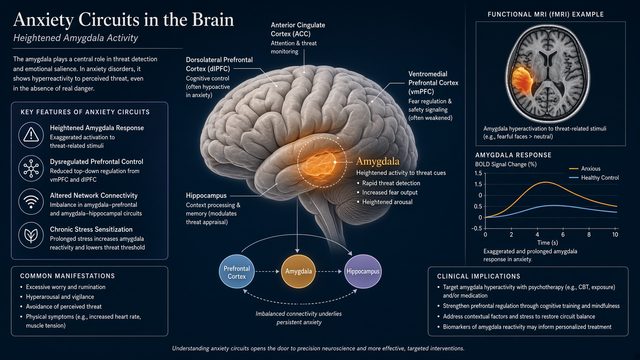
Neuroimaging and clinical studies show the cerebellum connects with prefrontal, parietal and limbic regions. Damage can produce the cerebellar cognitive affective syndrome, described by Jeremy Schmahmann, which includes difficulties with planning, language fluency, visuospatial skills, attention and emotional regulation, sometimes with flattened affect or impulsivity.
Researchers propose that the same error-correcting and predictive computation applied to movement also supports mental operations, such as timing, sequencing words and anticipating social outcomes.
Links to conditions
Differences in cerebellar structure or connectivity have been reported in autism, ADHD, dyslexia and schizophrenia, though findings are variable and causality is not established. Treatments for movement disorders increasingly consider cerebellar stimulation as a possible approach in research settings.
Plasticity and learning
Synapses between granule cells and Purkinje cells can strengthen or weaken with experience, a process known as long-term depression, which is thought to underlie motor learning. This makes the cerebellum a model system for studying how experience changes circuits.
Neurogenesis and aging
The cerebellum shows gradual volume loss with age, and cerebellar integrity is associated with balance and gait in older adults. Staying physically active and practicing balance exercises may help preserve function.
Practical takeaways
- Practicing a motor skill, such as dance, tai chi or an instrument, engages cerebellar circuits.
- Heavy alcohol use can damage the cerebellum and cause lasting ataxia.
- New clumsiness, unsteadiness or slurred speech needs prompt medical evaluation.
Further reading from authoritative sources
This article is educational and does not replace advice from a licensed clinician. See the medical disclaimer. Looking for specialist care? Browse the neurology clinic directory.