How Culture Shapes the Brain
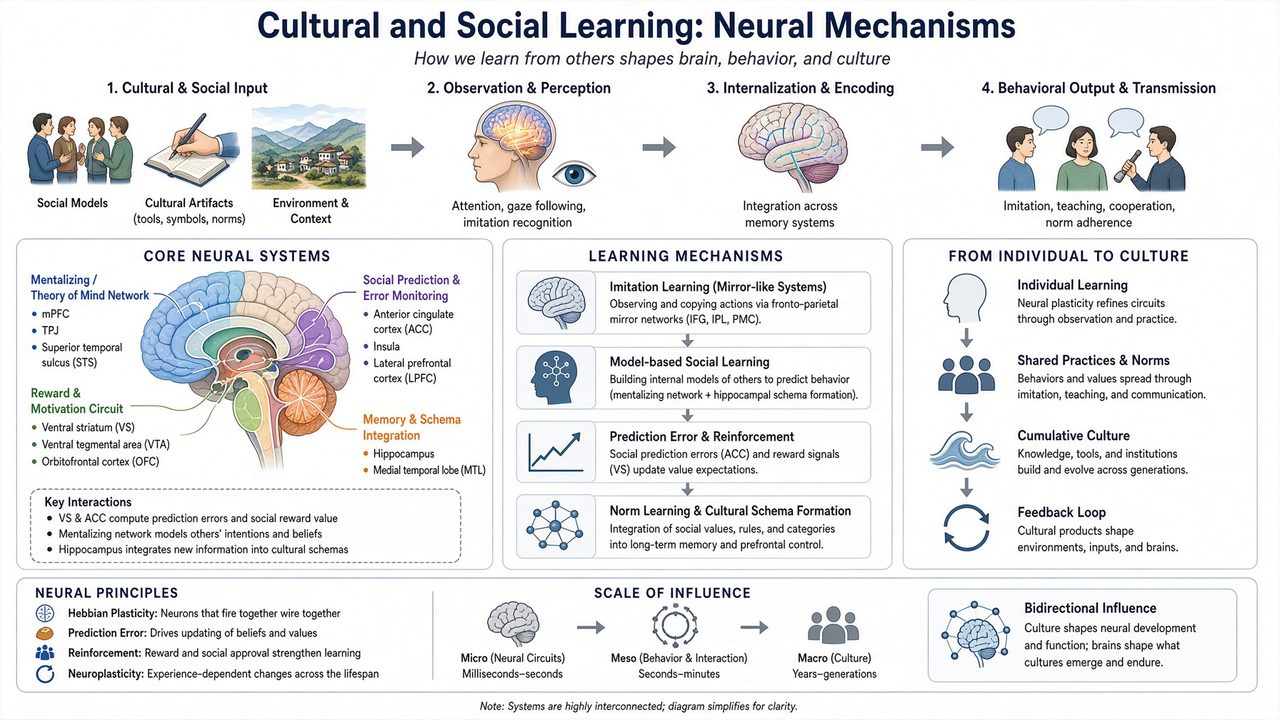
Humans learn their cultures from infancy, and the brain is built to absorb social information. Cultural neuroscience asks how values, language, practices and environments shape brain structure and function.
Plasticity and learning
Because the brain changes with experience, cultural practices that involve repeated activity leave traces. Examples include the enlarged hippocampi of London taxi drivers, changes linked to musical training, and differences in how literate and illiterate adults process written language, as shown in work by Stanislas Dehaene and colleagues. Learning to read recruits and reshapes visual regions.
Perception and attention
Richard Nisbett and colleagues proposed that East Asian cultures tend toward holistic attention to context, while Western cultures tend toward analytic focus on objects. Some brain imaging studies have found cultural differences in neural responses to objects versus backgrounds, though effects are modest and debated, and individual variation is large.

Self and others
Studies by Shinobu Kitayama, Joan Chiao and others suggest that people from cultures emphasizing interdependence engage brain regions differently when thinking about themselves and close others than those from cultures emphasizing independence. For example, medial prefrontal activity during self-judgment may be more similar to activity for a close other in East Asian participants. Culture also shapes emotion expression and display rules, and how people regulate emotion.
Language
Languages direct attention to different features, such as color categories, spatial relations or time metaphors. Bilingual people may show enhanced executive control and later onset of dementia symptoms in some studies, but results vary. Tonal languages are associated with differences in processing of pitch.
Cautions
- Culture is not a fixed trait: people within a culture vary, and cultures change.
- Sampling bias: most research has used participants from Western, educated, industrialized, rich and democratic societies, a problem described by Joseph Henrich and colleagues.
- Overinterpretation: differences in brain activity do not imply superiority or biological determinism.
- Confounds: education, socioeconomic status and language use vary along with culture.
- Stereotyping risks.
Implications
Healthcare, education and technology should be designed with cultural context in mind. Mental health assessments and cognitive tests need to be validated across languages and backgrounds. Researchers are working to include diverse populations.
Culture and health care
Culture influences how people describe symptoms, view mental illness, seek help and make decisions about treatment. Clinicians who ask about beliefs and use interpreters, rather than assuming, provide better care. Cognitive tests normed on one population can misclassify people from another, which is why culturally fair assessment matters.
Looking ahead
Global collaborations are recruiting more diverse participants, which will give a fuller picture of how brains develop in different environments.
Staying curious
Travel, learning a language, and friendships across backgrounds expose the brain to new patterns and keep cognition flexible. Approaching other cultures with curiosity, not judgment, is itself a brain-friendly habit.
Key point
Culture and biology are intertwined, and neither explains behavior alone.
Takeaway
Culture gets under the skin by shaping experience. Understanding it helps us interpret brain research responsibly and care for people in context.
Further reading from authoritative sources
- National Institute of Mental Health (NIMH)
- National Institute of Neurological Disorders and Stroke (NINDS)
This article is educational and does not replace advice from a licensed clinician. See the medical disclaimer. Looking for specialist care? Browse the neurology clinic directory.