The Neuroscience of Attachment Styles
Attachment theory, developed by John Bowlby and Mary Ainsworth, describes how early bonds with caregivers shape expectations about relationships. Neuroscience is now investigating how these patterns relate to brain systems for stress, reward and social understanding.
The main styles
Ainsworth's "Strange Situation" experiments, in which toddlers were observed during brief separations, identified patterns:
- Secure: the child is distressed by separation, seeks comfort and recovers quickly
- Anxious (ambivalent): the child is very distressed and hard to soothe
- Avoidant: the child shows little visible distress and avoids the caregiver on return
- Disorganized: the child shows confused or contradictory behavior, often linked to frightening or unpredictable caregiving
In adults, researchers describe secure, anxious-preoccupied, dismissive-avoidant and fearful-avoidant styles, often measured along dimensions of attachment anxiety and avoidance.
Brain systems involved
Stress regulation
Responsive caregiving helps develop a calm HPA axis and a flexible stress response. Children with insecure or disorganized attachment may show altered cortisol patterns. In animals, maternal care alters stress system development through epigenetic changes in the hippocampus.
Amygdala and prefrontal circuits
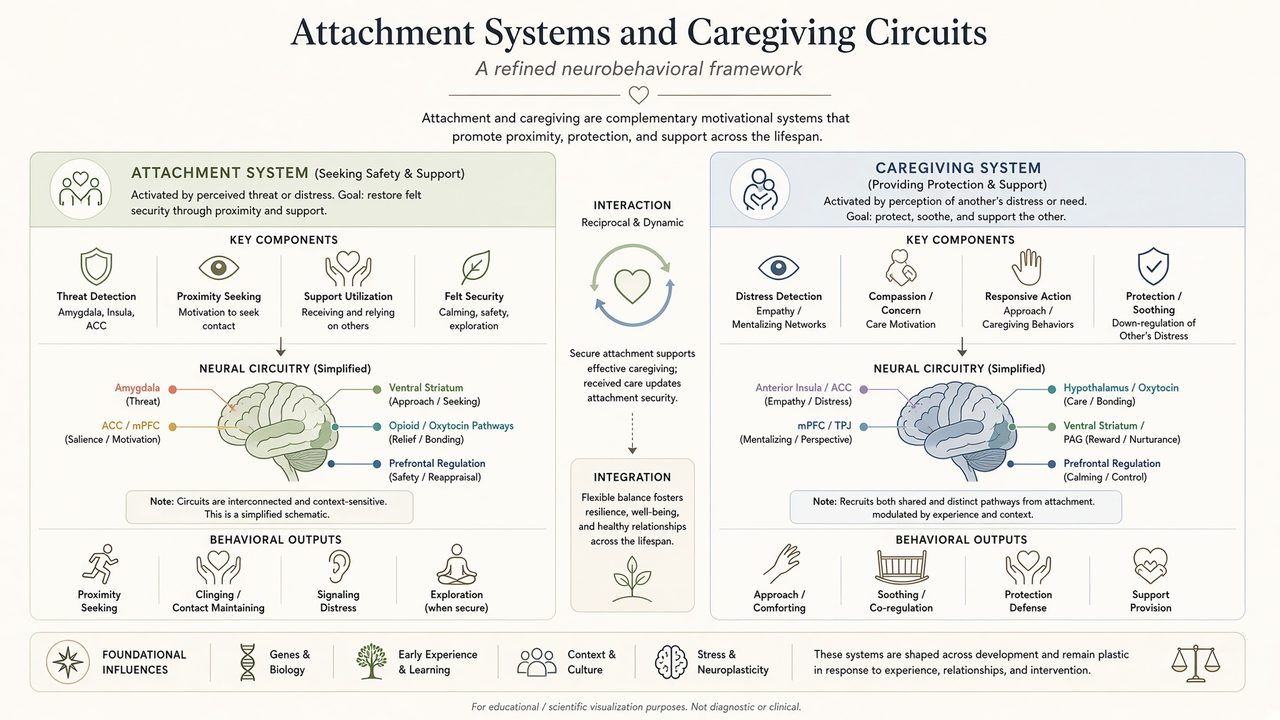
Securely attached people tend to show stronger prefrontal regulation of amygdala responses to emotional stimuli, according to some imaging studies. Anxious attachment is associated with heightened amygdala reactivity to threat and rejection cues, and avoidant attachment with dampened responses to emotional signals.
Reward and bonding
Oxytocin and vasopressin, along with dopamine in the nucleus accumbens, are involved in bonding. Viewing images of a romantic partner or one's own child activates reward regions. Whether oxytocin sprays reliably change human attachment behavior is debated, with mixed findings.
Social cognition
The medial prefrontal cortex, temporoparietal junction, anterior insula and anterior cingulate help interpret others' feelings and track social pain. Attachment security is associated with different patterns of activity in these areas during social tasks.

Early adversity
Neglect, abuse and unstable care increase the risk of insecure and disorganized attachment, and are linked with changes in stress systems, amygdala and prefrontal development. Studies of children raised in severe institutional deprivation, such as the Bucharest Early Intervention Project, found that moving children into foster families early led to better outcomes in attachment and brain development, particularly when placement occurred before about two years.
Stability and change
Attachment patterns show moderate stability, but they are not destiny. People can develop earned security through supportive relationships, therapy and life experiences. Adult attachment can shift in response to a loving partner, a good mentor or therapy. Genetic factors, temperament and later experiences also play roles.
Caution about pop psychology
Online quizzes and labels often oversimplify. Researchers view attachment as dimensions rather than rigid types, and findings about brain differences are generally modest, group-level and correlational. An "anxious" or "avoidant" label does not define a person.
What supports secure attachment
- Responsive caregiving: noticing and meeting a child's needs consistently
- Warm physical contact and soothing
- Reflective talk about feelings
- Repair after conflict, since perfect parenting is not required
- Parent support, such as programs that coach caregivers; interventions that increase parental sensitivity can improve attachment security
For adults
- Notice your patterns in relationships
- Communicate needs and listen to a partner
- Consider therapy, such as attachment-based or emotionally focused approaches
- Build a supportive social network
- Practice emotion regulation skills
When to seek help
If relationship patterns cause persistent distress, or a child shows extreme difficulty with attachment, a mental health professional can help. Supportive, consistent relationships are among the most powerful influences on brain and emotional development.
Further reading from authoritative sources
- National Institute of Mental Health (NIMH)
- National Institute of Neurological Disorders and Stroke (NINDS)
This article is educational and does not replace advice from a licensed clinician. See the medical disclaimer. Looking for specialist care? Browse the neurology clinic directory.