Aphasia: When Language Is Lost and Recovered
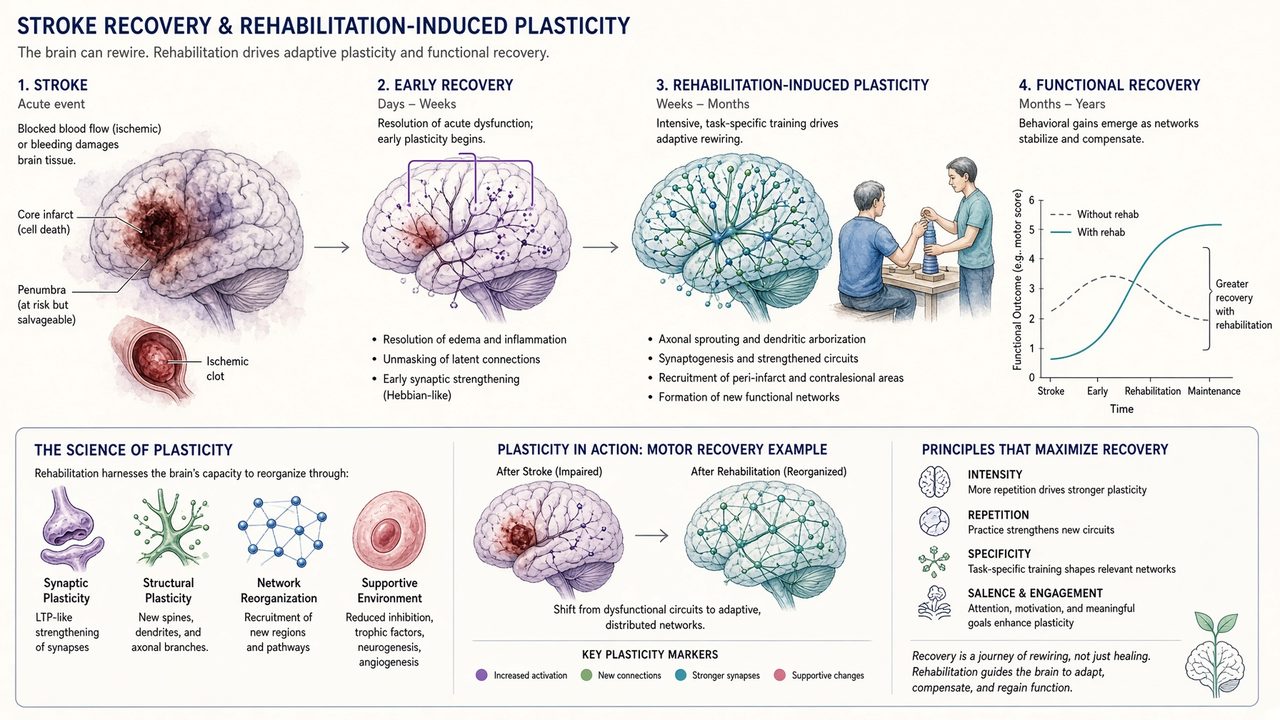
Aphasia is an acquired language disorder that affects the ability to speak, understand, read or write. It results from damage to language areas in the brain, most often the left hemisphere, and does not affect intelligence. About a third of stroke survivors develop aphasia.
Causes
- Stroke, the most common cause
- Traumatic brain injury
- Brain tumors
- Infections such as encephalitis
- Neurodegenerative disease, which produces primary progressive aphasia
Language networks
In most right-handed people and many left-handed people, language is lateralized to the left hemisphere. Key regions include Broca's area in the frontal lobe, important for speech production and grammar, Wernicke's area in the temporal lobe, important for comprehension, and the arcuate fasciculus, a bundle of fibers linking them. Modern research emphasizes broader networks rather than two isolated areas.
Types of aphasia
Broca's (nonfluent) aphasia
Speech is effortful, halting and telegraphic, such as "walk dog park." Comprehension is relatively good, and people are often aware of and frustrated by their difficulty. Right-sided weakness often accompanies it.
Wernicke's (fluent) aphasia
Speech flows easily but may be nonsensical, with made-up words, and comprehension is poor. People may be unaware of their errors.
Global aphasia
Severe impairment of both expression and comprehension, typically after large strokes.
Anomic aphasia
Prominent difficulty finding words, with otherwise fluent speech.
Conduction aphasia
Difficulty repeating words, with relatively good comprehension and fluency.
Primary progressive aphasia
A gradual language decline from neurodegeneration, discussed with frontotemporal dementia.
Recovery
The greatest improvement occurs in the first weeks to months after stroke, as swelling subsides and the brain reorganizes, but gains can continue for years with therapy. Factors influencing recovery include the size and location of the lesion, age, severity, therapy intensity and motivation. Imaging shows that recovery involves recruitment of surrounding left-hemisphere regions and, sometimes, right-hemisphere regions.
Treatment
Speech-language therapy
A speech-language pathologist designs individualized therapy, which may include naming exercises, sentence building, comprehension work, reading and writing practice. Intensive therapy appears to produce greater gains. Constraint-induced language therapy encourages verbal communication by limiting gestures. Melodic intonation therapy uses singing patterns to help produce words, building on the fact that singing may use different brain pathways.
Technology
Apps, tablets and computer programs provide practice at home, and augmentative communication devices help in severe cases.
Brain stimulation
Transcranial magnetic stimulation and transcranial direct current stimulation, combined with therapy, are being investigated. Results are promising but not yet standard care.
Medications
Drug treatments are still experimental, and none is routinely recommended.
Group and community programs
Aphasia centers and support groups reduce isolation and build confidence. The "life participation" approach focuses on helping people engage in meaningful activities.
Communicating with a person with aphasia
- Reduce distractions and give time to respond.
- Speak naturally in short, simple sentences without talking down.
- Ask yes/no questions or give choices.
- Use gestures, drawing, writing and pictures.
- Do not finish sentences unless asked, and do not pretend to understand.
- Confirm understanding by summarizing.
- Treat the person as a capable adult.
Emotional impact
Aphasia can lead to depression, frustration and social isolation. Counseling, family education and peer support are important. Caregivers need support too.
When to seek help
Sudden difficulty speaking or understanding is a stroke warning sign and requires emergency care. After a stroke, ask for a referral to a speech-language pathologist as early as possible.
Looking ahead
Research is exploring brain stimulation, pharmacological augmentation and intensive telepractice. Meanwhile, therapy, practice and support remain the foundation. Many rehabilitation centers in our directory offer aphasia services.
Further reading from authoritative sources
This article is educational and does not replace advice from a licensed clinician. See the medical disclaimer. Looking for specialist care? Browse the neurology clinic directory.