Speech Therapy and the Brain's Language Networks
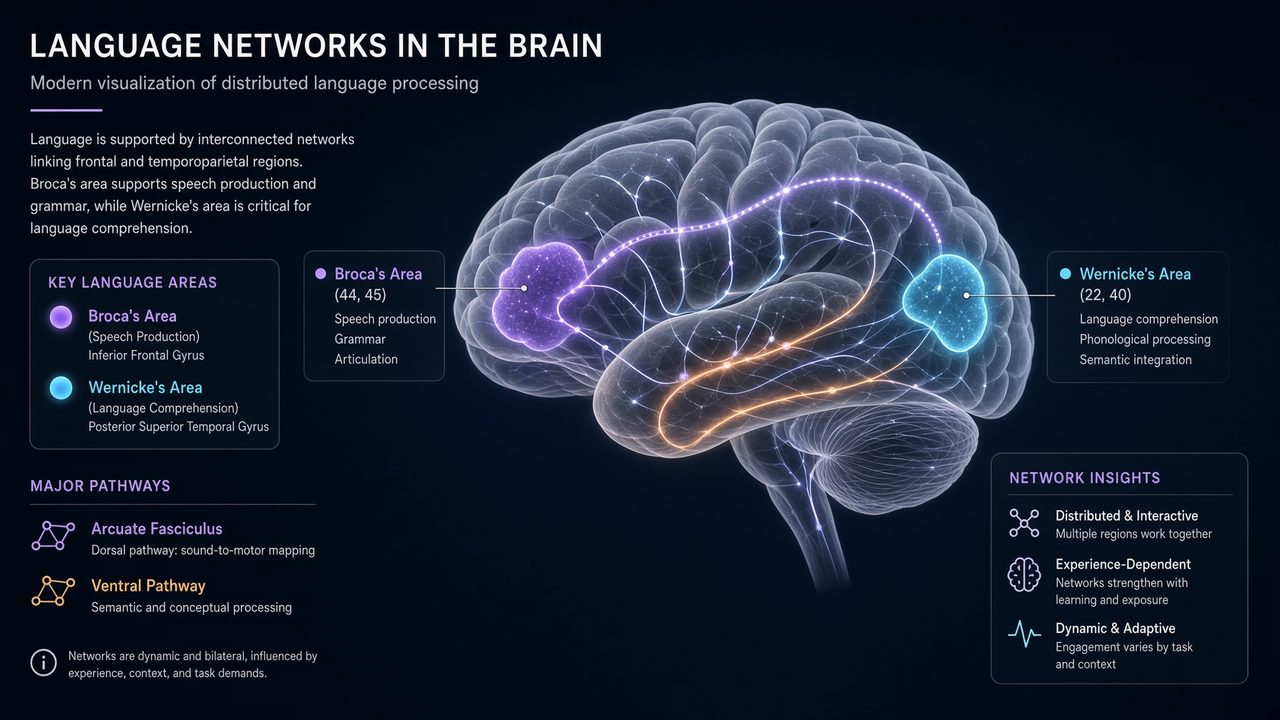
Language depends on a distributed network, mostly in the left hemisphere, and damage to it can disrupt speaking, understanding, reading and writing. Speech-language pathologists treat these problems, along with swallowing difficulties and voice disorders.
The language network
Classic models describe Broca's area in the left frontal lobe for speech production, and Wernicke's area in the left temporal lobe for comprehension, linked by the arcuate fasciculus. Modern views, such as the dual stream model by Gregory Hickok and David Poeppel, describe broader networks, with a ventral stream for mapping sound to meaning and a dorsal stream for mapping sound to articulation. The right hemisphere contributes to prosody, discourse and recovery.
Aphasia
About a third of stroke survivors develop aphasia, an acquired language disorder. Types include nonfluent aphasia, where speech is effortful but comprehension is relatively good, fluent aphasia, where speech flows but may lack meaning and comprehension is impaired, and global aphasia. Intelligence is typically intact.
Therapy approaches
- Intensive therapy: studies suggest that higher doses of therapy improve outcomes more than low doses. Constraint-induced aphasia therapy, developed by Friedemann Pulvermüller, involves intensive language practice and has improved speech production.
- Melodic intonation therapy, which uses singing and tapping to access preserved right-hemisphere and music-related pathways, for some people with nonfluent aphasia
- Naming and word retrieval therapy: semantic feature analysis and phonological cueing
- Script training and conversation therapy: practice of functional phrases and communication partner training
- Computer-based and app-based therapy: allows more practice at home
- Group therapy and aphasia choirs: build confidence and social connection
- Augmentative and alternative communication: picture boards, speech-generating devices, and apps
- Transcranial stimulation: experimental, with mixed results
Other problems treated
- Dysarthria: weak or uncoordinated speech muscles, treated with exercises such as LSVT LOUD for Parkinson's disease
- Apraxia of speech: difficulty planning movements for speech
- Dysphagia: swallowing problems, treated with exercises and diet modifications to reduce the risk of aspiration
- Cognitive-communication disorders after brain injury
- Childhood speech and language delays
- Stuttering: therapy to improve fluency and reduce impact
- Voice disorders
Recovery
Recovery is greatest in the first months, but gains continue for years with therapy. Imaging studies suggest recovery involves both restoration of left hemisphere networks and recruitment of right hemisphere regions, depending on lesion and time.
Tips for communication partners
- Speak simply and slowly, but treat the person as an adult
- Allow time for responses
- Use gestures, writing and pictures
- Reduce noise and distractions
- Ask yes or no questions when helpful
- Avoid finishing sentences unless asked
Children and developmental language disorders
Children with developmental language disorder, which affects about 7 percent of children, benefit from early therapy that builds vocabulary, grammar and storytelling, along with strategies at home and school. Reading aloud and conversation matter for all children.
Telepractice
Video sessions allow therapy at home, expanding access in rural areas and reducing travel burden, with outcomes comparable to in-person sessions for many language and speech problems.
Takeaway
Speech therapy helps the brain relearn and find new ways to communicate. Patience, intensity and support lead to progress.
Further reading from authoritative sources
This article is educational and does not replace advice from a licensed clinician. See the medical disclaimer. Looking for specialist care? Browse the neurology clinic directory.