How the Brain Makes Ethical Decisions
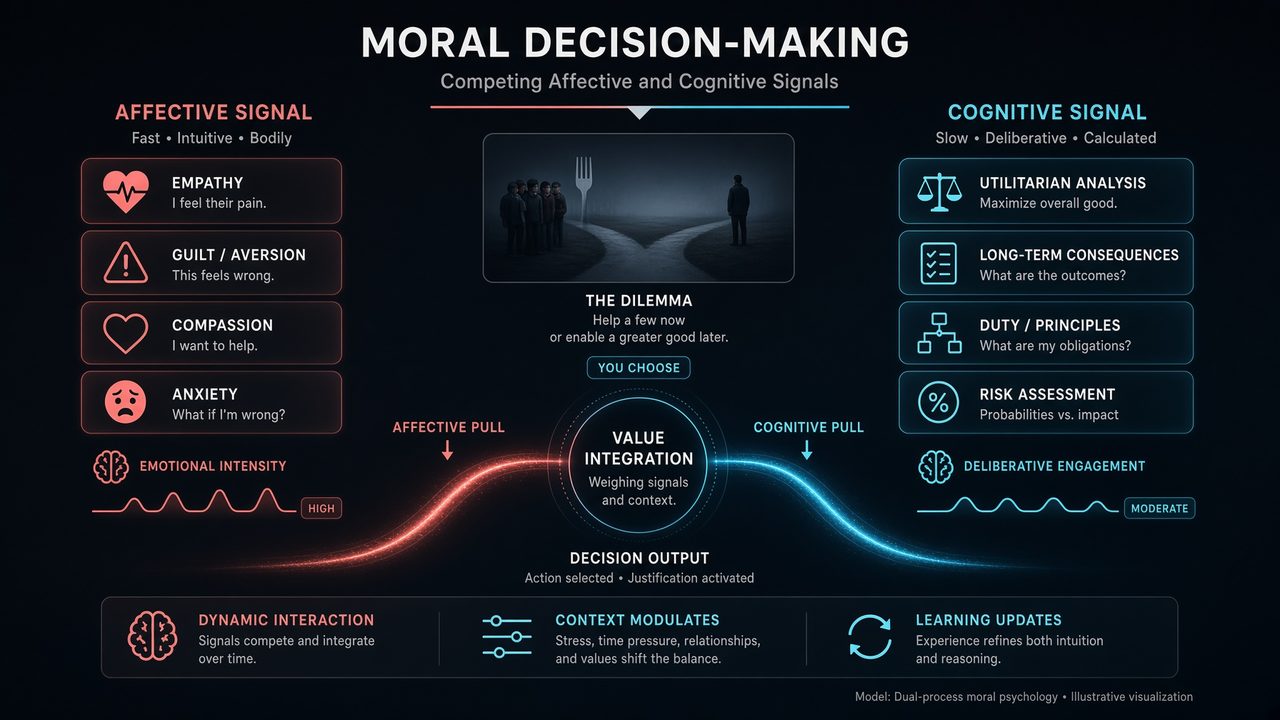
Everyday ethical decisions, such as whether to tell a hard truth, report a colleague or keep a promise, involve more than abstract principles. The brain weighs values, emotions, consequences and social context, often in a fraction of a second.
Decision-making systems
Ethical choices engage valuation circuits, which compute the worth of options, social cognition regions that consider others' perspectives, and control systems that inhibit impulses and apply rules. Emotions such as guilt, empathy and anger give signals about harm and fairness. Patients with damage to the ventromedial prefrontal cortex often struggle in real-life social decisions, though they can reason about hypothetical dilemmas, which highlights the role of emotion in action.
Why good people do bad things
- Motivated reasoning: people justify actions that serve their interests while feeling moral. Dan Ariely and Francesca Gino's studies found that most people cheat a little, up to the point where they can still see themselves as honest.
- Moral disengagement: Albert Bandura described how people minimize harm, shift responsibility or dehumanize victims.
- Situational pressure: obedience in Stanley Milgram's experiments, where most participants delivered what they believed to be strong shocks under instruction from an authority, showed how powerful situations are, although the interpretation is debated.
- Conformity and groupthink
- Stress, fatigue and ego depletion: can weaken self-control, although some evidence for ego depletion has failed to replicate.
- Moral licensing: doing good makes people feel entitled to behave worse.
- Ethical fading: when ethical dimensions of a decision are overlooked, as in business settings.
- Distance and anonymity: harm is easier to ignore from afar.
- Power: power can reduce empathy and increase rule breaking in some contexts.

Helping the brain choose well
- Name the ethical dimension: ask who is affected and what values are at stake
- Slow down for high-stakes choices, and sleep on it
- Consider multiple perspectives: the affected parties, a respected mentor, a stranger or your future self
- Test your decision: would you be comfortable if it were public? Would you endorse the rule if everyone followed it?
- Use frameworks: consider consequences, duties and rights, fairness, and character
- Seek advice from trusted, diverse people
- Create commitments and rules before temptation arises
- Build environments that support integrity: clear policies, accountability and psychological safety to speak up
- Reflect afterwards, and learn from mistakes
- Practice small honesty to build habits
Moral injury
Clinicians describe moral injury as distress after actions or events that violate one's moral beliefs, seen in soldiers, health workers and others. Support from peers, counseling and meaningful repair, such as amends, can help.
Ethics at work and in health care
Clinicians, engineers, teachers and managers face ethical choices under time pressure. Ethics committees, checklists, mentors and open discussion of dilemmas make good decisions easier. Speaking up is hard, so leaders who invite questions and thank people for raising concerns help build an ethical culture.
Teaching ethical thinking
Children and adolescents learn from stories, discussion and modeling. Asking what could happen to others, and how someone might feel, develops perspective taking, and giving young people real responsibilities builds moral confidence.
Takeaway
Ethical decisions are made by human brains with biases and feelings. Awareness, reflection and support make good choices more likely.
Further reading from authoritative sources
- National Institute of Neurological Disorders and Stroke (NINDS)
- National Institute of Mental Health (NIMH)
This article is educational and does not replace advice from a licensed clinician. See the medical disclaimer. Looking for specialist care? Browse the neurology clinic directory.