The Role of Dopamine in Mood and Motivation
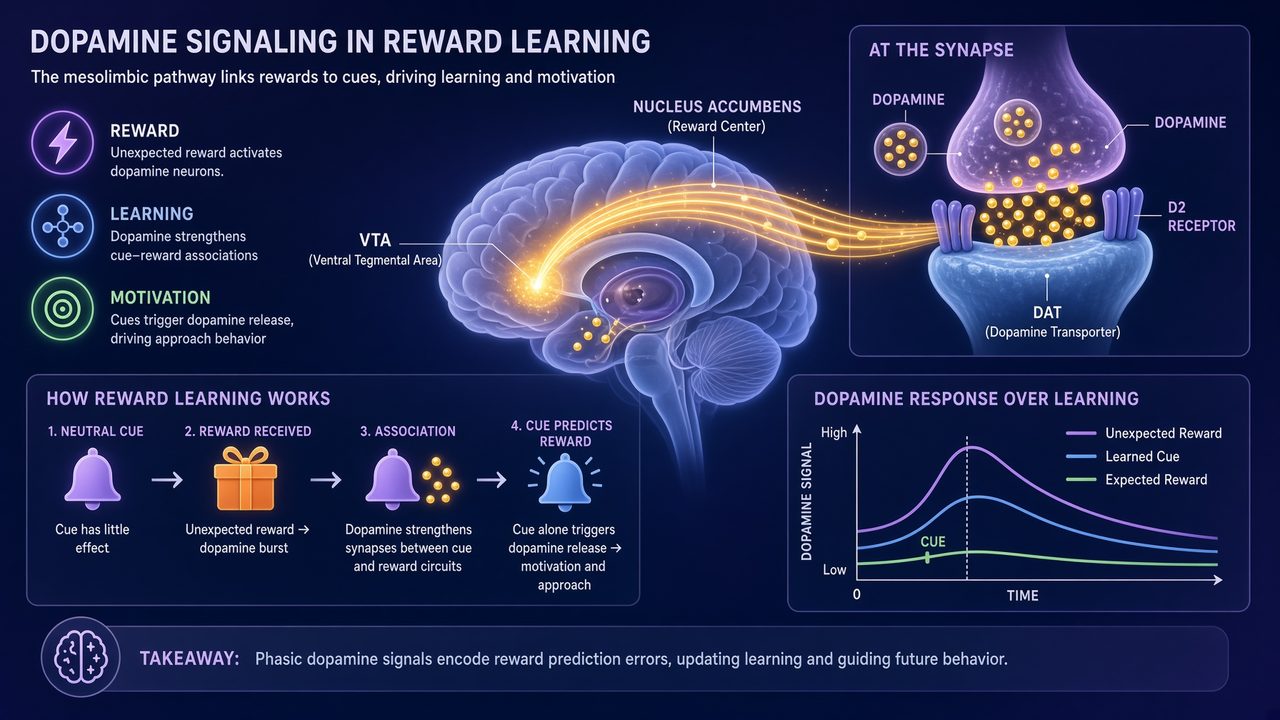
Dopamine is often called the "pleasure chemical," but that description is misleading. Dopamine is better understood as a signal of wanting, learning and motivation, and its roles reach across mood, movement and attention.
Dopamine pathways
- Mesolimbic pathway: from the ventral tegmental area to the nucleus accumbens, involved in reward and motivation.
- Mesocortical pathway: to the prefrontal cortex, supporting working memory, attention and planning.
- Nigrostriatal pathway: from the substantia nigra to the dorsal striatum, controlling movement.
- Tuberoinfundibular pathway: regulates prolactin release.
Reward prediction and motivation
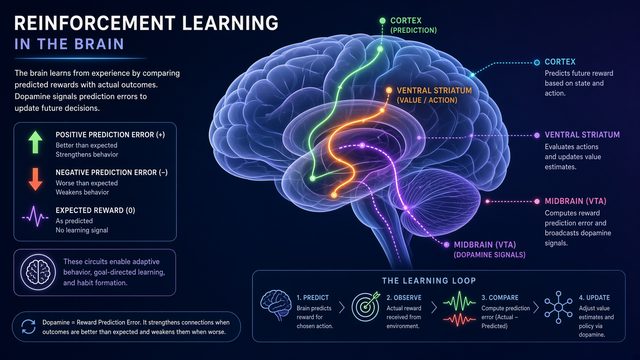
Wolfram Schultz showed that dopamine neurons fire when a reward is unexpected, fire at the cue when a reward is predicted, and dip when an expected reward is omitted, a pattern called reward prediction error that drives learning. Kent Berridge distinguishes "wanting" (incentive motivation, driven by dopamine) from "liking" (pleasure, involving opioid and other systems). Dopamine also determines willingness to exert effort, as studies by John Salamone showed in animals, and by Masud Husain in humans.

Dopamine and mood
- Depression: reduced motivation, anhedonia and psychomotor slowing relate to reduced dopamine signaling in some patients. Antidepressants that increase dopamine, such as bupropion, can help some people, and dopamine-related brain activity in the reward system is blunted in depression.
- Bipolar disorder and mania: heightened dopamine activity may contribute to elevated drive and reward-seeking.
- Anxiety: the role is less clear.
Other conditions
- Parkinson's disease: loss of dopamine neurons in the substantia nigra causes tremor, rigidity and slowed movement. Treatment with levodopa replenishes dopamine, though it can cause side effects such as impulse control disorders, including compulsive gambling and shopping, in some patients on dopamine agonists. Depression, apathy and anxiety are also common.
- ADHD: differences in dopamine and noradrenaline signaling in frontal-striatal networks contribute to attention and impulse control problems. Stimulant medications raise dopamine and noradrenaline availability.
- Schizophrenia: excess dopamine signaling in the striatum is linked to psychotic symptoms, and antipsychotics block dopamine D2 receptors.
- Addiction: drugs hijack dopamine reward signals.
- Restless legs syndrome: linked to dopamine signaling and iron status, and treatments include dopaminergic drugs.
Everyday influences
- Novelty, music, exercise, social connection and achievement can increase dopamine activity.
- Tyrosine, an amino acid precursor, comes from protein-rich foods. Healthy people don't need supplements.
- Sleep and stress affect dopamine function.
- Digital media: variable rewards, such as social media notifications, can engage reward learning, though claims that screens "hijack dopamine" are oversimplified.
Myths
- "Dopamine detox": you cannot detox or "reset" dopamine by avoiding stimulation. Reducing compulsive behaviors can be helpful, but the idea that this restores dopamine is not backed by evidence.
- "Dopamine equals pleasure": it is more about motivation and learning.
- "More is better": too much dopamine can cause problems, and balance matters.
Healthy ways to support motivation
- Set clear goals and break tasks into small, rewarding steps.
- Exercise regularly.
- Prioritize sleep.
- Seek meaningful and varied activities.
- Maintain social connections.
- Talk to a doctor about persistent loss of interest, because depression and other conditions are treatable.
Takeaway
Dopamine is the brain's motivation and learning signal. Understanding its role clears up myths and highlights why movement, mood and drive are so closely linked.
Further reading from authoritative sources
- National Institute of Mental Health (NIMH)
- National Center for Complementary and Integrative Health (NCCIH)
This article is educational and does not replace advice from a licensed clinician. See the medical disclaimer. Looking for specialist care? Browse the neurology clinic directory.