How the Brain Values Reward and Punishment
Every choice involves weighing potential gains against potential losses. The brain has dedicated circuits that estimate the value of rewards and the cost of punishments, learn from outcomes and motivate action. Understanding this system explains habits, motivation and what goes wrong in addiction and depression.
The reward circuit
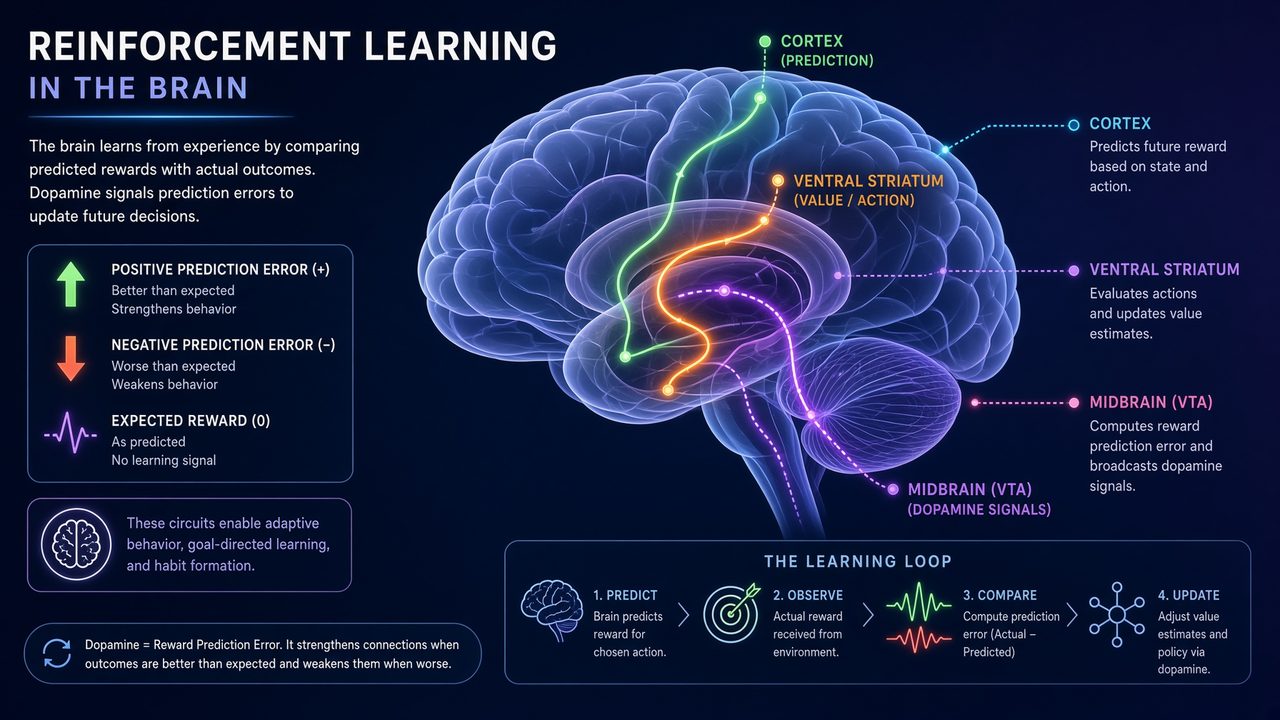
The core of the system is the mesolimbic dopamine pathway, in which neurons in the ventral tegmental area send dopamine to the nucleus accumbens in the striatum, and to the prefrontal cortex. Other key players include the orbitofrontal and ventromedial prefrontal cortex, which represent value, the amygdala, which assigns emotional significance, and the insula and anterior cingulate cortex, which track costs, effort and conflict.
Dopamine: more than pleasure
Wolfram Schultz's recordings in monkeys showed that dopamine neurons fire when a reward is unexpected, stop firing when an expected reward does not appear and shift responses to cues that predict reward. This is reward prediction error, and it is a teaching signal, closely matching algorithms in reinforcement learning. Dopamine is therefore as much about motivation, "wanting" and learning as about enjoyment, a distinction made by Kent Berridge between wanting and liking. Opioid and other systems contribute to pleasure itself.
Punishment and aversive learning
Aversive outcomes engage partly distinct circuits:
- Amygdala, central to fear learning
- Lateral habenula, which activates when expected rewards are omitted or punishments occur, suppressing dopamine neurons
- Insula and anterior cingulate, involved in pain, disgust and anticipation of loss
- Serotonin, which has been implicated in aversive processing and behavioral inhibition, though its role is complex
Dopamine neurons appear to dip with negative prediction errors, but some dopamine neurons also respond to aversive events, and the system is more heterogeneous than once thought.
Combining value
The brain computes a common "currency" of subjective value, represented in the ventromedial prefrontal cortex and striatum, that lets us compare unlike options. Discounting makes distant rewards less valuable, and loss aversion makes losses loom larger than equivalent gains, reflected in stronger responses to potential losses in some regions.
Habits and goal-directed action
Early in learning, actions are goal-directed, guided by the value of outcomes. With repetition, control shifts to habit circuits in the dorsolateral striatum, which trigger responses to cues automatically. Habits help efficiency but can be hard to break.
When the system goes wrong
- Addiction. Drugs hijack the dopamine system, producing large, rapid dopamine increases and driving learning of strong cue-drug associations. Over time, tolerance, reduced reward sensitivity and weaker prefrontal control contribute to compulsive use.
- Depression. Anhedonia, loss of interest and pleasure, is linked to blunted reward circuit responses and altered effort valuation.
- Parkinson's disease. Loss of dopamine causes movement problems, and dopamine medications can occasionally trigger compulsive gambling or shopping.
- Gambling and gaming. Unpredictable rewards produce strong dopamine responses and persistent behavior.
- ADHD and schizophrenia involve altered dopamine function and reward processing.
Practical implications
- Immediate rewards shape behavior, so make good habits satisfying and bad ones less accessible.
- Small wins build motivation.
- Variable rewards, as in social media notifications, can create compulsive checking.
- Punishment is a weaker teacher than reward for lasting behavior change, and can lead to avoidance.
- Clear feedback and goals support learning.
- Sleep, exercise and stress control keep the system healthy.
Treatments
Medications, psychotherapy and behavioral approaches such as contingency management, which provides rewards for abstinence, target these circuits. Deep brain stimulation of the nucleus accumbens is being studied for severe addiction and depression.
Bottom line
Reward and punishment shape what we want and learn. Appreciating how the brain calculates value can help us design environments and habits that work with, not against, our motivation.
Further reading from authoritative sources
- National Institute of Neurological Disorders and Stroke (NINDS)
- National Institute of Mental Health (NIMH)
This article is educational and does not replace advice from a licensed clinician. See the medical disclaimer. Looking for specialist care? Browse the neurology clinic directory.