Sleep and Memory: The Nighttime Consolidation Process
Pulling an all-nighter before an exam is one of the least effective study strategies. Decades of research show that sleep is not wasted time for learning: it is when the brain stabilizes, organizes and strengthens what you experienced during the day.
Sleep before learning
When people are sleep deprived, the hippocampus does not work as efficiently, and attention lapses make encoding less reliable. In experiments, volunteers who were kept awake all night before a learning session remembered substantially less than well-rested participants, even when they were allowed to recover afterward. In other words, you cannot completely make up for poor encoding with later sleep.
Sleep after learning
Slow-wave sleep and replay
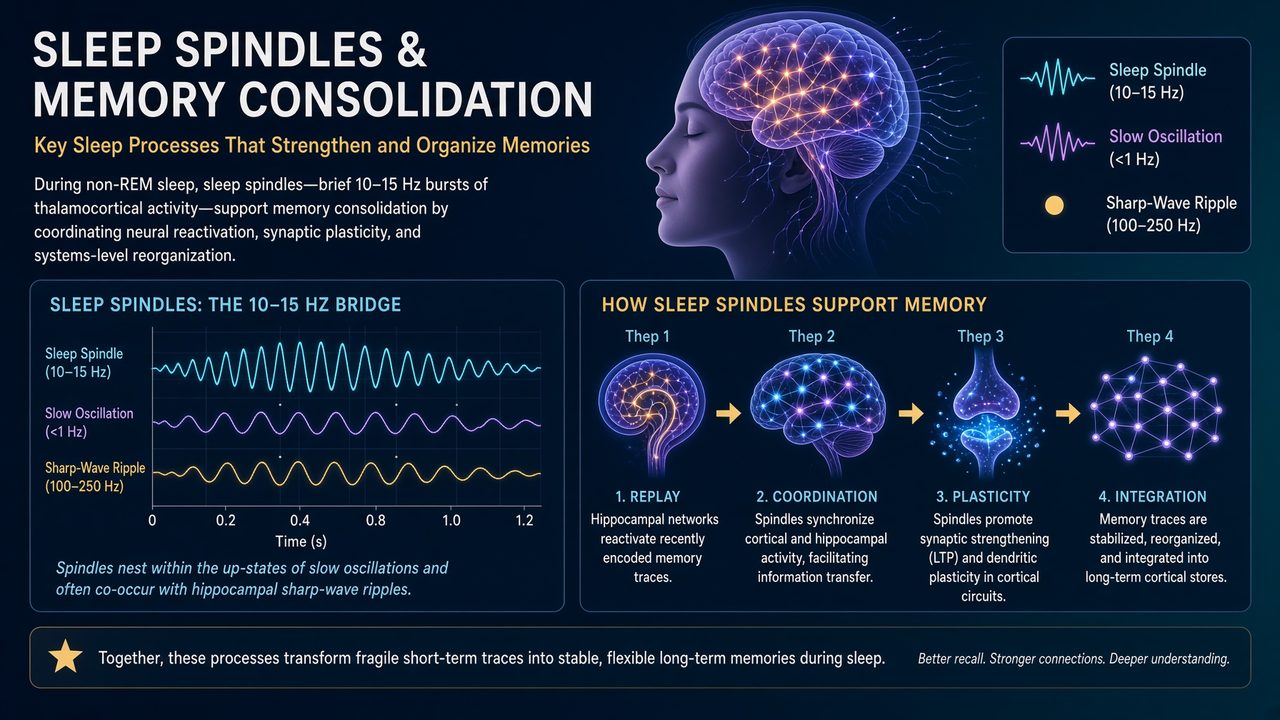
During deep non-REM sleep, large slow oscillations sweep across the cortex. At the same time, the hippocampus appears to replay patterns of activity that occurred during learning. This coordinated dialogue is thought to transfer information from temporary hippocampal storage to more permanent cortical networks. Studies in animals and people show that stronger slow-wave activity after learning is linked to better recall.
Sleep spindles
Spindles are brief bursts of fast activity generated in the thalamus, common in lighter non-REM sleep. People who have more spindles after learning tend to show better memory retention, and spindles are associated with general learning ability.
REM sleep
REM sleep, when vivid dreaming occurs, appears to be important for emotional memories and for integrating new information with existing knowledge. Some research suggests REM supports creative problem-solving and generalization, though the exact roles of different sleep stages are still being worked out.

Different memories, different benefits
- Declarative memory such as facts and events benefits strongly from slow-wave sleep.
- Procedural memory such as motor skills often improves after sleep, which is why practicing a piano passage then sleeping can lead to better performance the next day.
- Emotional memory is influenced by REM sleep.
What about naps?
Short naps can help. Studies show that even a nap of 20 to 90 minutes after learning can improve retention, particularly if it includes slow-wave sleep. Naps are most helpful when you are sleep deprived or when you cannot get a full night.
Practical steps
- Prioritize sleep during exams or intense learning, aiming for seven to nine hours for most adults and more for teens.
- Study earlier in the day and review briefly before bed, if you like, without staying up late.
- Keep a regular schedule. Consistent sleep and wake times support deeper sleep.
- Limit alcohol, which fragments sleep and suppresses REM.
- Be cautious with sleep medications. Some can reduce sleep quality or interfere with memory, so discuss them with your doctor.
When poor sleep might signal something else
Loud snoring, gasping at night and daytime sleepiness can indicate sleep apnea, a treatable condition linked to memory problems. Chronic insomnia is also treatable, often with cognitive behavioral therapy for insomnia. If you are struggling with sleep and memory, see a clinician.
The takeaway
If you want to remember what you study, protect your sleep as carefully as you plan your study sessions. The brain does important work at night, and shortchanging it can undo hours of effort.
Further reading from authoritative sources
- National Institute of Neurological Disorders and Stroke (NINDS)
- National Center for Complementary and Integrative Health (NCCIH)
This article is educational and does not replace advice from a licensed clinician. See the medical disclaimer. Looking for specialist care? Browse the neurology clinic directory.